


Water Crossing Qs
 09-09-2008, 10:50 AM
#1
JK Enthusiast
Thread Starter

Join Date: Sep 2008
Location: SoCal, USA
Posts: 245
Likes: 0
Received 0 Likes
on
0 Posts
 Water Crossing Qs
When going through a water crossing...
Should you turn off your foglights if they get submerged? Headlights as well?
Should you also turn off your A/C and/or fan?
Should you always be in 4Low? (and never change gears I've read with manual tran...)
Thx
Should you turn off your foglights if they get submerged? Headlights as well?
Should you also turn off your A/C and/or fan?
Should you always be in 4Low? (and never change gears I've read with manual tran...)
Thx
 09-09-2008, 08:50 PM
#2
JK Super Freak


Generally, 4 low, as it locks the front/rear diffs together...and sets the traction control computer to the best program for that situation...and it gives more torque if needed as well.
If the water is deep enough to flood your clutch plate areas, when you step on that clutch pedal, water can get in between the plates (A little bad), bringing with it, typically, sand, mud, small fish, etc... (A Lot Bad).
These little particles, especially sand, chew on your plates when you reengage your clutch.
So, shifting under those conditions can get crud between your plates, and cause an early, or earlier, clutch failure.
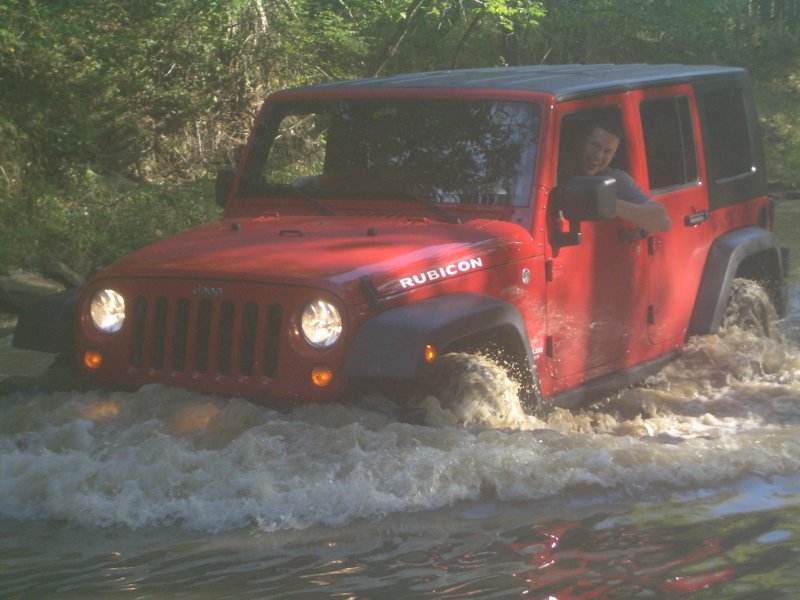
So, water crossing should not be dramatic high speed runs with rooster tails of water arcing through the air flanking the jeep, etc...albeit the pictures do look better that way.
The best technique (Other than for cool pics...) is to go fast enough to not get stuck, but slow enough to avoid splashing too much water under the hood...and do it by preselecting the gear that will get you that speed...in 4 low... that might be second gear...and you enter in 2nd, and stay on it in second, and, emerge in second, w/o shifting. Site conditions may dictate 1st or 3rd too, etc...it depends on how slow is too slow, and how fast is too fast, for the conditions.
I recommend just taking a strap/winch line if you don't make it, rather than shifting into neutral/backing up to get a better line, going forward again, etc.
So - if you forget, and shift in deep enough water to get your clutch wet...it doesn't kill it right then and there..it does hurt it though, and its a bad practice to shift if you don't have to. Essentially, the cleaner the water, the less risk.
BTW - I try not to shift much in the rocks either, and when I do, I'm on/off as quickly as possible...I do not slip the clutch to feather it over rocks, etc...it burns the clutch up over time as well.
I prefer to give it enough gas to get over on momentum, and get off the gas before impact, and coast over...it avoids driveline breakage, and helps to avoid feathering the clutch.
Don't shift going down a steep hill either...let it roll against engine braking the whole way down....the SECOND you clutch, the Jeep will LEAP forward, and you will have sped up way more than you meant to, and can end up going somewhere you didn't want to, etc.
So, there's LOTS of "Don't Clutch" places....not just in deep water.
As for the lights...why are they on anyway? Is it dark? If the lights will be submerged, and you are not jack lighting a Delicious Bass, you don't need them on anyway.
The fan on the JK is electric...so it can kick on by itself - turning off the AC will help a little bit, but, on most water crossings, you need the AC to defog the windshield anyway...on a long crossing, the water itself cools the radiator, on a short crossing, it doesn't heat it...and, you can typically turn the AC back on afterwards.
On one of my trucks, I rigged a dash switch to cut off the engine fan on water crossings, but, I had to remove the engine driven mechanical fan, and install an electric fan in place of it to do that.
As the JK starts with an E fan stock...a simple in-line switch could do the same thing, but is probably overkill.
Hope that helps!
If the water is deep enough to flood your clutch plate areas, when you step on that clutch pedal, water can get in between the plates (A little bad), bringing with it, typically, sand, mud, small fish, etc... (A Lot Bad).
These little particles, especially sand, chew on your plates when you reengage your clutch.
So, shifting under those conditions can get crud between your plates, and cause an early, or earlier, clutch failure.
So, water crossing should not be dramatic high speed runs with rooster tails of water arcing through the air flanking the jeep, etc...albeit the pictures do look better that way.
The best technique (Other than for cool pics...) is to go fast enough to not get stuck, but slow enough to avoid splashing too much water under the hood...and do it by preselecting the gear that will get you that speed...in 4 low... that might be second gear...and you enter in 2nd, and stay on it in second, and, emerge in second, w/o shifting. Site conditions may dictate 1st or 3rd too, etc...it depends on how slow is too slow, and how fast is too fast, for the conditions.
I recommend just taking a strap/winch line if you don't make it, rather than shifting into neutral/backing up to get a better line, going forward again, etc.
So - if you forget, and shift in deep enough water to get your clutch wet...it doesn't kill it right then and there..it does hurt it though, and its a bad practice to shift if you don't have to. Essentially, the cleaner the water, the less risk.
BTW - I try not to shift much in the rocks either, and when I do, I'm on/off as quickly as possible...I do not slip the clutch to feather it over rocks, etc...it burns the clutch up over time as well.
I prefer to give it enough gas to get over on momentum, and get off the gas before impact, and coast over...it avoids driveline breakage, and helps to avoid feathering the clutch.
Don't shift going down a steep hill either...let it roll against engine braking the whole way down....the SECOND you clutch, the Jeep will LEAP forward, and you will have sped up way more than you meant to, and can end up going somewhere you didn't want to, etc.
So, there's LOTS of "Don't Clutch" places....not just in deep water.
As for the lights...why are they on anyway? Is it dark?
If the lights will be submerged, and you are not jack lighting a Delicious Bass, you don't need them on anyway.The fan on the JK is electric...so it can kick on by itself - turning off the AC will help a little bit, but, on most water crossings, you need the AC to defog the windshield anyway...on a long crossing, the water itself cools the radiator, on a short crossing, it doesn't heat it...and, you can typically turn the AC back on afterwards.
On one of my trucks, I rigged a dash switch to cut off the engine fan on water crossings, but, I had to remove the engine driven mechanical fan, and install an electric fan in place of it to do that.
As the JK starts with an E fan stock...a simple in-line switch could do the same thing, but is probably overkill.
Hope that helps!
Last edited by TEEJ; 09-09-2008 at 09:08 PM.

 09-10-2008, 07:29 PM
#5
JK Enthusiast

Join Date: Jul 2008
Location: on the banks of the ocmulgee , GA
Posts: 436
Likes: 0
Received 0 Likes
on
0 Posts
water holes
reckon it depends on the crossing. some water holes are shallow and have a hard packed bottom. I cross them in 2 wd. some holes are shallow with a mushy bottom. I'd go to 4hi if it ain't a long way to the other side. If it's deep and long and has a hard packed bottom I'd go to 4hi. if it's deep and long and has a mushy bottom I'd go to 4lo. it is a good idea to go slow though cuz these new fangled vehicles got all this lectronical stuff that is delicate. I got a 76F250 that I would run through a water hole just anyway I felt like it cuz u ain't gonna hurt it. lessen u get water in the carb. or in the distributer. it's so tall u ain't worried bout that most of the time. unless u go out in the lake like that one fellwe did on that utube video i saw the other day. what a cookoo thing t do to a 20,000 DollaR new vehicle. do that stuff to an old beater!!!
09-11-2008, 01:58 PM
#6
JK Super Freak

Join Date: Nov 2006
Location: trenton ontario canada
Posts: 1,687
Likes: 0
Received 1 Like
on
1 Post
I have had my jeep float the water was do deep
no clutch issues shift fast and firm clarity of water is a factor
yes a/c off
vent closed
fogs off, when the cool water hits the hot lamp it causes a pressure change and it will suck water in to the lamps
water and clutch isn't the issue
mud and clutch is
if you can see into the water all should be ok
if you can't see into water then don't shift
4 lo for water
if you need to shift say to reverse and the water is muddy now turn off shift no clutch and trun key in gear no clutch restart this is good till the water is up to the door frame all actions should be done quick and with purpose
if under water shift fast and hard
if mud and in deep about door line pull shift leaver to neutral no clutch.. leave running and call for a line.
no clutch issues shift fast and firm clarity of water is a factor
yes a/c off
vent closed
fogs off, when the cool water hits the hot lamp it causes a pressure change and it will suck water in to the lamps
water and clutch isn't the issue
mud and clutch is
if you can see into the water all should be ok
if you can't see into water then don't shift
4 lo for water
if you need to shift say to reverse and the water is muddy now turn off shift no clutch and trun key in gear no clutch restart this is good till the water is up to the door frame all actions should be done quick and with purpose
if under water shift fast and hard
if mud and in deep about door line pull shift leaver to neutral no clutch.. leave running and call for a line.

Trending Topics
 09-17-2008, 12:37 PM
#10
JK Enthusiast

Join Date: Jul 2008
Location: Bailey, CO
Posts: 119
Likes: 0
Received 0 Likes
on
0 Posts