


Ball joints wearing out?


Thread Starter
JK Freak
Joined: Jun 2012
Posts: 560
Likes: 0
From: Colorado
 Ball joints wearing out?
What does it feel like when your ball joints start to go?
I have a 2012 JKU that's been on 35's for the last ~15k miles. In the last few months my steering has gotten a lot more "flighty" than I ever remember it. It started to pull to the right and the steering wheel was off center as well. So, I took it in for an alignment at a good shop that knows 4x4's...not sears or anything like that.
My toe was off, but not by much, and the steering wheel was re centered - all good.
But, the alignment tech said my camber was -1 degree, which was causing my tires to slightly rotate outwards (ok, i understand that...) which could be caused by the jeep stock ball joints and the larger tires (didn't know aftermarket HD ball joints could correct camber?).
So, is it true that my ball joints need to be replaced in order to fix my -1 camber?
And, is the flighty steering due to my factory ball joints starting to wear out on me?
I have a 2012 JKU that's been on 35's for the last ~15k miles. In the last few months my steering has gotten a lot more "flighty" than I ever remember it. It started to pull to the right and the steering wheel was off center as well. So, I took it in for an alignment at a good shop that knows 4x4's...not sears or anything like that.
My toe was off, but not by much, and the steering wheel was re centered - all good.
But, the alignment tech said my camber was -1 degree, which was causing my tires to slightly rotate outwards (ok, i understand that...) which could be caused by the jeep stock ball joints and the larger tires (didn't know aftermarket HD ball joints could correct camber?).
So, is it true that my ball joints need to be replaced in order to fix my -1 camber?
And, is the flighty steering due to my factory ball joints starting to wear out on me?

JK Jedi Master

Joined: Feb 2008
Posts: 12,907
Likes: 185
From: Maine
The maximum negative camber for the JK is -0.62°. That's pretty close to the -1° you have. There are lots of people running around with a little too much negative camber with no ill effects.
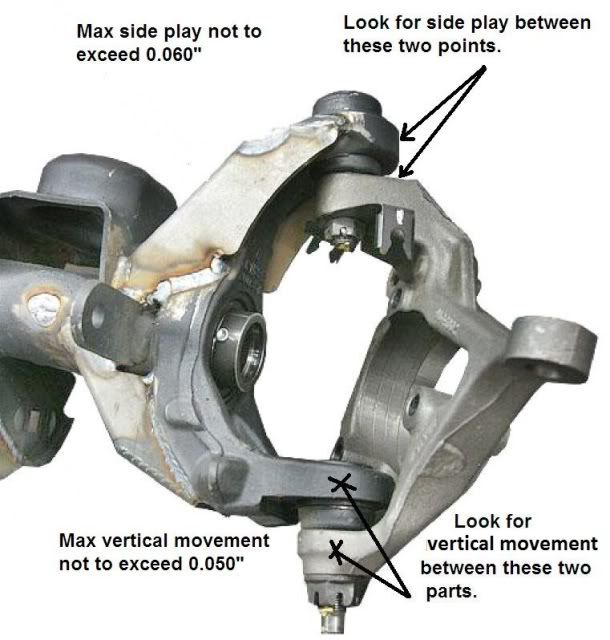
Replacing worn ball joints may fix your camber, but you should verify for yourself that they are worn. I have had two places tell me mine are worn. When I measure them, which the technicians don't do, the ball joints are well within the limits noted below.
Here's how to check them:
Radial (side-to-side) movement in the upper ball joint should not exceed 0.060" (1.5mm).
Axial (up and down) movement in the lower ball joint should not exceed 0.050" (1.25mm).
A dial indicator is the best instrument to measure ball joint play, but you can get a good estimate with a tape measure.
Jack the front tire off the ground.
Place a jack stand under the axle next to the jack.
Lower to put some weight on the jack stand.
Place a long pry bar under the tire, from the side.
Have someone pry the tire up and down while you watch the lower ball joint for up and down play.
Axial (up and down) movement in the lower ball joint should not exceed 0.050"
Have someone grab the tire at top and bottom to wiggle the top in and out while you watch the upper joint for side play.
Radial (side-to-side) movement in the upper ball joint should not exceed 0.060"
Even if the upper joint checks good, change both if the lower checks bad.
Replacing worn ball joints may fix your camber, but you should verify for yourself that they are worn. I have had two places tell me mine are worn. When I measure them, which the technicians don't do, the ball joints are well within the limits noted below.
Here's how to check them:
Radial (side-to-side) movement in the upper ball joint should not exceed 0.060" (1.5mm).
Axial (up and down) movement in the lower ball joint should not exceed 0.050" (1.25mm).
A dial indicator is the best instrument to measure ball joint play, but you can get a good estimate with a tape measure.
Jack the front tire off the ground.
Place a jack stand under the axle next to the jack.
Lower to put some weight on the jack stand.
Place a long pry bar under the tire, from the side.
Have someone pry the tire up and down while you watch the lower ball joint for up and down play.
Axial (up and down) movement in the lower ball joint should not exceed 0.050"
Have someone grab the tire at top and bottom to wiggle the top in and out while you watch the upper joint for side play.
Radial (side-to-side) movement in the upper ball joint should not exceed 0.060"
Even if the upper joint checks good, change both if the lower checks bad.


JK Enthusiast
Joined: May 2013
Posts: 202
Likes: 0
From: Columbus, Ohio
Are they still OE? OE BJ are very weak, alot of plastic. If you need to up grade I would go with Synergy all the way! I up graded all to Synergy couldn't be happier! It may all so depend how much wheeling you do?
Semper Fi!

Semper Fi!

Former Vendor
Joined: Oct 2012
Posts: 1,615
Likes: 0
From: Newton, NJ
The maximum negative camber for the JK is -0.62°. That's pretty close to the -1° you have. There are lots of people running around with a little too much negative camber with no ill effects.
Replacing worn ball joints may fix your camber, but you should verify for yourself that they are worn. I have had two places tell me mine are worn. When I measure them, which the technicians don't do, the ball joints are well within the limits noted below.
Here's how to check them:
Radial (side-to-side) movement in the upper ball joint should not exceed 0.060" (1.5mm).
Axial (up and down) movement in the lower ball joint should not exceed 0.050" (1.25mm).
A dial indicator is the best instrument to measure ball joint play, but you can get a good estimate with a tape measure.
Jack the front tire off the ground.
Place a jack stand under the axle next to the jack.
Lower to put some weight on the jack stand.
Place a long pry bar under the tire, from the side.
Have someone pry the tire up and down while you watch the lower ball joint for up and down play.
Axial (up and down) movement in the lower ball joint should not exceed 0.050"
Have someone grab the tire at top and bottom to wiggle the top in and out while you watch the upper joint for side play.
Radial (side-to-side) movement in the upper ball joint should not exceed 0.060"
Even if the upper joint checks good, change both if the lower checks bad.
Replacing worn ball joints may fix your camber, but you should verify for yourself that they are worn. I have had two places tell me mine are worn. When I measure them, which the technicians don't do, the ball joints are well within the limits noted below.
Here's how to check them:
Radial (side-to-side) movement in the upper ball joint should not exceed 0.060" (1.5mm).
Axial (up and down) movement in the lower ball joint should not exceed 0.050" (1.25mm).
A dial indicator is the best instrument to measure ball joint play, but you can get a good estimate with a tape measure.
Jack the front tire off the ground.
Place a jack stand under the axle next to the jack.
Lower to put some weight on the jack stand.
Place a long pry bar under the tire, from the side.
Have someone pry the tire up and down while you watch the lower ball joint for up and down play.
Axial (up and down) movement in the lower ball joint should not exceed 0.050"
Have someone grab the tire at top and bottom to wiggle the top in and out while you watch the upper joint for side play.
Radial (side-to-side) movement in the upper ball joint should not exceed 0.060"
Even if the upper joint checks good, change both if the lower checks bad.

Replacing the ball joints is labor intense. If you are planning on doing it yourself then it is not very expensive but if you are planning on paying someone to replace them it could become pricy. The Syngery ball joints are a great option. PM us if you would like some pricing.


JK Super Freak
Joined: Mar 2010
Posts: 1,182
Likes: 0
From: Ontario Canada
X3 for the Synergy Ball Joints...installed 9,000KM ago, no issues with stiff steering when no, haven't looked back since. Great product, great price.
Trending Topics
Thread Starter
JK Freak
Joined: Jun 2012
Posts: 560
Likes: 0
From: Colorado
Thanks for the info guys, I will probably go with the synergy when I do it. I may try to get another 3-5k out of the factory ones before I spend the money though. The jeep is still drivable, just not what it was 10k miles ago.
JK Jedi Master
Joined: Feb 2008
Posts: 12,907
Likes: 185
From: Maine
The thing I did that brought back the new Jeep feel to the suspension, front and back, was replace the lower control arm bolts and track bar bolts with bolts of the proper size. Kits are available from some of the forum vendors.
The difference was felt immediately after installation.
The difference was felt immediately after installation.

JK Newbie
Joined: Nov 2012
Posts: 4
Likes: 0
From: Grand Terrace CA
May also be bent parts.. If you have been wheeling with 35s the C's might be bent already. I have a 2013 and have already replaced the ball joints, the drag link and welded in gussets and a truss...
For me the synergy stuff is a good compromise between curry or other really bullet proof parts... Either way have fun..
For me the synergy stuff is a good compromise between curry or other really bullet proof parts... Either way have fun..