


Engine reving



JK Jedi Master

Joined: Feb 2008
Posts: 12,904
Likes: 185
From: Maine

It probably has to do with emissions (assuming there is nothing else wrong).
In the later old days, carburetors had a dash-pot to slow the throttle return.
Here is an example:
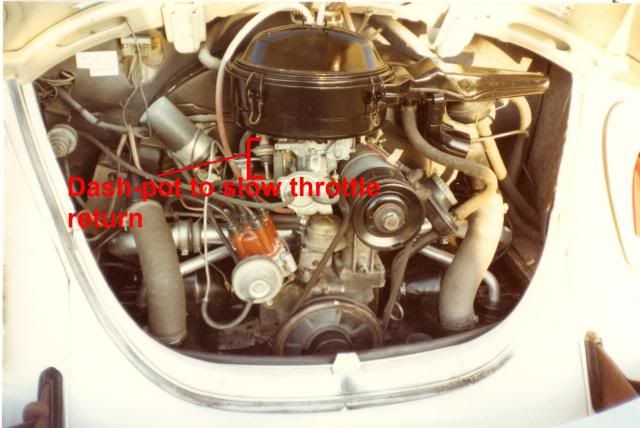
In the later old days, carburetors had a dash-pot to slow the throttle return.
Here is an example:
Last edited by ronjenx; Jun 7, 2010 at 08:45 PM.


JK Junkie
Joined: Aug 2009
Posts: 2,234
Likes: 2
From: NEW HAMPSHIRE
Me too
I noticed when I get it up to about 3 or 4 RPMS to get up to speed on highways I have to wait a few seconds to shift or It sounds like im reving the piss out of my jeep with the clutch held in. The the shift is kinda jerky. Def. takes some getting used too.....

JK Newbie
Joined: Nov 2008
Posts: 44
Likes: 0
From: Arlington, VA
Its annoying thing to try to get used to when you're coming from an older car, but necessary for traction control. And I think we can agree TC is a good thing on the road.
JK Jedi Master
Joined: Feb 2008
Posts: 12,904
Likes: 185
From: Maine
Just out of curiosity, I have to ask:
Nobody else thinks the throttle rate of return to idle is slowed to reduce emissions created by closed throttle engine deceleration? I'm talking just reving the engine, not vehicle deceleration.
It's a principle that has been applied since auto manufacturers have had to comply with EPA regulations.
Nobody else thinks the throttle rate of return to idle is slowed to reduce emissions created by closed throttle engine deceleration? I'm talking just reving the engine, not vehicle deceleration.
It's a principle that has been applied since auto manufacturers have had to comply with EPA regulations.