

A little JEEP History


JK Enthusiast
Joined: Oct 2006
Posts: 187
Likes: 1
From: Lincoln, CA

There are many therories. But the term Jeep was used alot for different vehicles pre WWII. There are adds for a tractor called a jeep. a small aircraft carrier was called a jeep carrier. and so on. Before they were called jeeps, the initial contract after the Bantam proto type. where Willys, Ford, and Bantam, competed with the Ford GP, Willys MA and the Bantam BRC.
The bantam prototype was not a failure. it was sucess. If it was a failure the army would not have asked for the vehicle to be refined. This is when the other manufactures got involved and the blueprints to the initial round hood bantam were handed over for Ford, and Willys to review and copy and refine for their own versions.
After compairing the 3 vehicles, a hybrid of sorts was made. that is the standardised 1/4 ton truck. aka the jeep.
They liked the flat fenders, hood and headlights behind the grill from the ford as they could be utilised for laying out maps or as a table.. they liked the engine from the Willys as it had the most HP.
In the End Bantam Got screwed. as they produced the initial vehicle but got cut out of future contracts as it was deemed that they did not have the capacity for war time production and only gets to produce war time trailers. Willys wins. But later is found out that they don't have the capacity for wartime production either. That is where Ford Got involved. at wars end both Willys and Ford had produced close to 300,000 vehicles each.
one interesting note. The grill that everyone knows as a jeep grill. Was invented by ford. Willys grill was made out of flat strap iron like the Ford GP. When Willys got into producing their tooling they were masters at stamping sheet metal. to cut costs and production time Tey got rid of the slat grill and produced the stamping for the standard 9 slot grill. By CJ time tye went to a 7 slot grill to accomodate the larger headlights. and didn't trademark the jeep name or the grill design until the 1950's.
 BANTAM BRC
 INITIAL BANTAM PROTOTYPE CONTRACT 1
 FORD PIGMY
 FORD GP

 WILLYS MA
 WILLYS MB SLATGRILL
 WILLYS MB
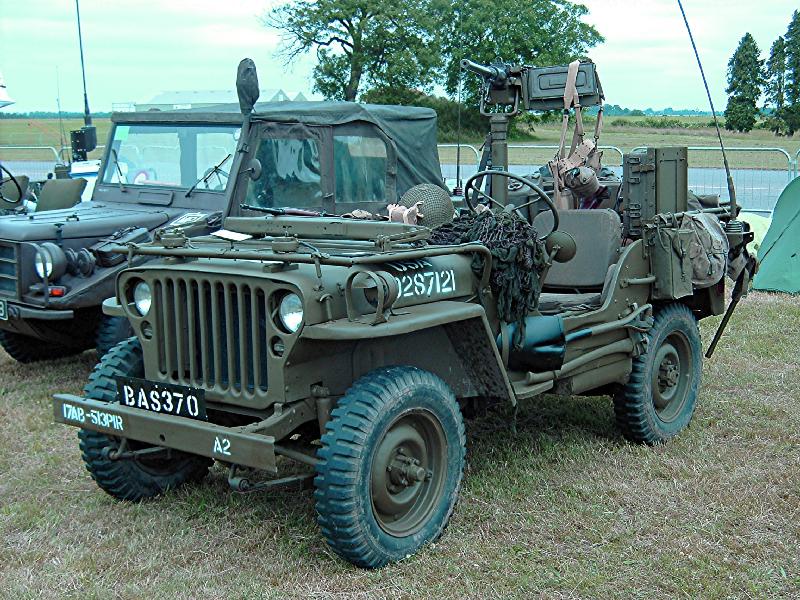
the last picture is mine. I just happed to be driving by the airport when this beauty landed. I had to take a picture. It is a 1942 Ford GPW
 FORD GPW
The bantam prototype was not a failure. it was sucess. If it was a failure the army would not have asked for the vehicle to be refined. This is when the other manufactures got involved and the blueprints to the initial round hood bantam were handed over for Ford, and Willys to review and copy and refine for their own versions.
After compairing the 3 vehicles, a hybrid of sorts was made. that is the standardised 1/4 ton truck. aka the jeep.
They liked the flat fenders, hood and headlights behind the grill from the ford as they could be utilised for laying out maps or as a table.. they liked the engine from the Willys as it had the most HP.
In the End Bantam Got screwed. as they produced the initial vehicle but got cut out of future contracts as it was deemed that they did not have the capacity for war time production and only gets to produce war time trailers. Willys wins. But later is found out that they don't have the capacity for wartime production either. That is where Ford Got involved. at wars end both Willys and Ford had produced close to 300,000 vehicles each.
one interesting note. The grill that everyone knows as a jeep grill. Was invented by ford. Willys grill was made out of flat strap iron like the Ford GP. When Willys got into producing their tooling they were masters at stamping sheet metal. to cut costs and production time Tey got rid of the slat grill and produced the stamping for the standard 9 slot grill. By CJ time tye went to a 7 slot grill to accomodate the larger headlights. and didn't trademark the jeep name or the grill design until the 1950's.
BANTAM BRC INITIAL BANTAM PROTOTYPE CONTRACT 1FORD PIGMY FORD GP WILLYS MA WILLYS MB SLATGRILL WILLYS MBthe last picture is mine. I just happed to be driving by the airport when this beauty landed. I had to take a picture. It is a 1942 Ford GPW
FORD GPW
Last edited by gpwpat; Aug 21, 2010 at 10:46 AM. Reason: images
JK Enthusiast
Joined: Oct 2006
Posts: 187
Likes: 1
From: Lincoln, CA
more jeep history and timeline
Origin of the Military Jeep: Summer 1940
In addition to new tanks and cargo trucks the Army identified a requirement for a light reconnaissance vehicle, small weapons carrier, and personnel transport that would replace automobiles and motorcycles with sidecars. On 22 June 1940 an Army sub-committee of the Ordnance Department's Technical Committee, composed of Infantry, Cavalry, and Quartermaster officers, issued proposed specifications for a vehicle to fill the role. Among the characteristics the new vehicle should have:
•Weight not to exceed 1200 pounds (increased to 1275 lbs 1 July and then to 1308 lbs)
•Carry six hundred pounds of payload in cross country operations
•Wheelbase not to exceed 75 inches (increased to 80 inches 1 July)
•Height not to exceed 36 inches (increased to 40 inches 1 July)
•Ground clearance of 6.25 inches at minimum
•4x4 drive with two speed transfer case, geared for up to 50 mph on-road and down to 3 mph off-road
•Mount for a .30 cal. machine gun
•Approach angle 45° and departure angle 40°
•Rectangular body and folding windshield
•Seating for three soldiers
•Blackout lights
.At the same time, during June 1940, committee members visited the American Bantam Motor Car Company in Butler, PA. Bantam had teamed with Spicer of Toledo, OH (maker of 4wd and axle components) to adapt a small civilian Bantam roadster to meet Army requirements, work in progress long before the 1940 Army specifications. Bantam had loaned test vehicles to the Army and had proved many of the basic design concepts that eventually were incorporated in the jeep. The Army recommendations of June 1940 were greatly influenced by Bantam's work.
Based on the committee specifications and drawings, largely originated by Bantam, on 11 July 1940 the Quartermaster Corps asked 135 companies to bid on seventy "light reconnaissance and command cars".
Origin of the Military Jeep: Fall 1940
Only two companies submitted bids by the target date of 23 July 1940, American Bantam and Willys-Overland. The award of a seventy vehicle order was made to American Bantam priced at $171,185.75 (less than $2500 each), within the amount budgeted by the War Department. Although the Willys bid was actually lower, Bantam was sure they could deliver on time while Willys hedged. The Bantam team, headed by engineer Karl Probst, worked around the clock to deliver the first prototype vehicle on or before the contract deadline of 23 September 1940. On 21 September engineer Harold Crist made the first test drive. On the 23rd, Crist and Probst drove the vehicle (called Number One, the Model Mk I or GPV) from Butler, PA to Camp Holabird, MD (230 miles) for delivery to the Army, arriving with only a half-hour to spare.
The pilot Bantam had its headlights on top of rounded fenders and a curved grill in front. Only one was made and it did not survive. The Bantam pilot was immediately put into testing and was enthusiastically received. Although problems did develop, they were minor compared to the outstanding overall performance and clear usefulness of the new-concept small military truck. Willys and Ford attended the tests and took careful notes of the Bantam pilot. The Army approved sixty nine additional vehicles from Bantam, including agreed upon changes. Eight were to have four-wheel steering, a project subcontracted to Checker. These sixty nine vehicles were the Bantam Reconnaissance Car Model 60 or BRC-60, also known as the Mk II.
Meanwhile, relentless sales efforts and political maneuvering by Ford and Willys coupled with the desire of the Army to have more than one supplier (and doubts about the production capacity of the tiny Bantam company), encouraged both Ford and Willys to produce pilot vehicles based on the specifications of the July procurement. Willys delivered their Quad pilot model jeep on 13 November 1940 and Ford followed on 23 November with their Ford Pygmy, the first vehicle with the flat front radiator. Both looked like close relatives of the Bantam design since the Bantam plans had been used as the basis of both competitive efforts. The Army took the position that the U.S. Government owned the plans and could share them for Army purposes. Although Bantam's designs were being copied, Bantam did not object.
In the period July to November 1940, the QMC made another very important decision: the unrealistic 1,308 pound weight limit was raised to 2,160 pounds based on assertions from all bidders that the lower limit was completely impossible in light of other requirements for power and performance. The number 2,160 lbs was set for Ford's convenience; the Bantam weighed less than that but the Willy's Quad was still overweight.
After public disputes and internal Army politics regarding the contracts to be let -- how many and to which company or companies -- it was decided on 14 November 1940 to order another 1,500 vehicles each from Bantam, Willys and Ford.
As the Army continued to evaluate all three pilot vehicles, they found that there was no clearly superior model. Each had advantages and disadvantages relative to the others. The Willys "Go Devil" engine gave outstanding performance, but with a weight penalty. The others had their own superior features and shortcomings, all of which the Army tabulated. These findings formed the basis of design modifications incorporating the results of the field tests into the new designs and model designations for the 1,500 unit contracts.
By 17 December 1940 the sixty nine additional Bantam BRC-60s had been delivered and sent to Army field units for evaluation. Success was immediate and all testers were impressed, wanting more jeeps for their units, eager to replace all motorcycles and motorized tri-cycles in use at that time.
Origin of the Military Jeep: Spring 1941
Performance on the 1,500 unit contacts was to be completed by 7 May 1941, but there were delays. Bantam made its first delivery of 52 jeeps on 31 March 1941 and built about 65 jeeps per day after that. Ford built their first jeep on 28 February 1941 but strikes at Spicer Axle delayed both Ford and Bantam. Work at Willys to reduce the weight of the Quad below the 2,160 lb limit delayed them about three months. After an exhaustive review of every bolt, nut and washer -- including reducing paint from two coats to one -- Willys was able to redesign within the limit, but not until 7 June 1941. The models produced for the 1,500 unit contracts, after all design changes, were designated the Bantam BRC-40, the Ford GP, and the Willys MA, similar but not identical vehicles.
Meanwhile, Lend Lease requirements for the escalating war in Europe caused the Army to extend the contracts. Ultimately Bantam delivered 2,642 BRC-40 units, Willys delivered 1,553 MA units and Ford eventually delivered 4,456 GP units under the contracts.
Many of the jeeps delivered under these contracts were shipped to England, Russia or other allies under Lend Lease but some were distributed to Army units all over the U.S. (including Alaska and Hawaii) for testing, resulting in detailed comparisons and evaluations of all features, benefits, and shortcomings. This field testing was the basis for combining the best features of all the vehicles to provide the specifications for the large-scale production version yet to come.
As a footnote to history, other companies got interested in the intense competition for the Army reconnaisance car contract and some produced pilot models or at least submitted bids for consideration. Although little is known of the details, Chevrolet, Crosley, Davis, and Kaiser were involved and there was a 1941 agreement between Bantam and Checker that resulted in vehicles being delivered to the Army (see Olive-Drab.com photos of the Checker Bantam).
Origin of the Military Jeep: Summer-Fall 1941
With war imminent in mid-1941, there was no time to redesign from scratch so one of the three existing jeep designs had to be selected. At first the Ford GP was declared the winner, but a firestorm of protest erupted, led by newspaper critic I.F. Stone. The little Bantam company had originated the concept and Willys did best in the tests, so where did giant Ford Motor Co. come from? Political corruption involving the huge Ford company was suspected but the preference for Ford was mainly the Army's desire to use a known-quantity producer with huge capacity, along with some genuinely superior features of the Ford GP. After hearings and much acrimony, the Willys MA was chosen as the standard, primarily due to its more powerful engine. Modifications to the MA were to be determined by blending the outstanding features of the MA and the other competitors.
After contract award to Willys on 23 July 1941 -- for 16,000 jeeps at a price of $738.74 each -- the final modifications were specified. There were to include the Army standard electrical systems with a 2H battery, 40 amp generator, and lighting. The floor gearshift and center handbrake were selected, the gas tank expanded to 15 gallons, and a military pintle tow hook provided at the rear. The Ford GP design elements were adopted for the square hood, cowl, dash, rear body panel, spare tire carrier, front floor and other details. Other parts of the body used the Willys MA design. This composite created the Willys MB, the "Truck, 1/4 ton 4x4" that became famous the world over as the World War II jeep. Willys went into production on the MB in the summer of 1941.
Willys delivered fully on the July contract before the end of August 1941. By October 1941 it was clear that demand would be so great that a second source would be needed. In exchange for a guarantee of contracts for half of the production, Willys made all engineering drawings and manufacturing methodology available to the U.S. Government for second source purposes.
Ford lost the design competition, but its huge production capacity could not be ignored. On 10 November 1941, Ford was given the contract to manufacture the Willys design, to be called the Ford GPW (for GP plus the Willys design modifications). Disgracefully, American Bantam was left out even though they originated the design, produced 2,675 BRC-40s, and had adequate production capacity for a large fraction of the Army's needs. Bantam never produced another jeep, although they were given a contact for the MBT jeep trailer.
Once the Army standardized on the MB/GPW jeep, the remaining units delivered under the 1,500 unit prototype contracts were rounded up and shipped overseas to Allies or were sold as surplus, some through the dealer Berg in Chicago. Few remained in the U.S. and they are quite rare today.
World War II Production of Military Jeeps
During the course of the war, Ford built 277,896 GPW jeeps, and Willys built 335,531 units. Production contracts were terminated in the summer of 1945 as World War II ended. The last Ford GPW was built on 30 July 1945 and the last Willys MB rolled off the Toledo assembly line on 20 August 1945.
Origin of the Military Jeep: Summer 1940
In addition to new tanks and cargo trucks the Army identified a requirement for a light reconnaissance vehicle, small weapons carrier, and personnel transport that would replace automobiles and motorcycles with sidecars. On 22 June 1940 an Army sub-committee of the Ordnance Department's Technical Committee, composed of Infantry, Cavalry, and Quartermaster officers, issued proposed specifications for a vehicle to fill the role. Among the characteristics the new vehicle should have:
•Weight not to exceed 1200 pounds (increased to 1275 lbs 1 July and then to 1308 lbs)
•Carry six hundred pounds of payload in cross country operations
•Wheelbase not to exceed 75 inches (increased to 80 inches 1 July)
•Height not to exceed 36 inches (increased to 40 inches 1 July)
•Ground clearance of 6.25 inches at minimum
•4x4 drive with two speed transfer case, geared for up to 50 mph on-road and down to 3 mph off-road
•Mount for a .30 cal. machine gun
•Approach angle 45° and departure angle 40°
•Rectangular body and folding windshield
•Seating for three soldiers
•Blackout lights
.At the same time, during June 1940, committee members visited the American Bantam Motor Car Company in Butler, PA. Bantam had teamed with Spicer of Toledo, OH (maker of 4wd and axle components) to adapt a small civilian Bantam roadster to meet Army requirements, work in progress long before the 1940 Army specifications. Bantam had loaned test vehicles to the Army and had proved many of the basic design concepts that eventually were incorporated in the jeep. The Army recommendations of June 1940 were greatly influenced by Bantam's work.
Based on the committee specifications and drawings, largely originated by Bantam, on 11 July 1940 the Quartermaster Corps asked 135 companies to bid on seventy "light reconnaissance and command cars".
Origin of the Military Jeep: Fall 1940
Only two companies submitted bids by the target date of 23 July 1940, American Bantam and Willys-Overland. The award of a seventy vehicle order was made to American Bantam priced at $171,185.75 (less than $2500 each), within the amount budgeted by the War Department. Although the Willys bid was actually lower, Bantam was sure they could deliver on time while Willys hedged. The Bantam team, headed by engineer Karl Probst, worked around the clock to deliver the first prototype vehicle on or before the contract deadline of 23 September 1940. On 21 September engineer Harold Crist made the first test drive. On the 23rd, Crist and Probst drove the vehicle (called Number One, the Model Mk I or GPV) from Butler, PA to Camp Holabird, MD (230 miles) for delivery to the Army, arriving with only a half-hour to spare.
The pilot Bantam had its headlights on top of rounded fenders and a curved grill in front. Only one was made and it did not survive. The Bantam pilot was immediately put into testing and was enthusiastically received. Although problems did develop, they were minor compared to the outstanding overall performance and clear usefulness of the new-concept small military truck. Willys and Ford attended the tests and took careful notes of the Bantam pilot. The Army approved sixty nine additional vehicles from Bantam, including agreed upon changes. Eight were to have four-wheel steering, a project subcontracted to Checker. These sixty nine vehicles were the Bantam Reconnaissance Car Model 60 or BRC-60, also known as the Mk II.
Meanwhile, relentless sales efforts and political maneuvering by Ford and Willys coupled with the desire of the Army to have more than one supplier (and doubts about the production capacity of the tiny Bantam company), encouraged both Ford and Willys to produce pilot vehicles based on the specifications of the July procurement. Willys delivered their Quad pilot model jeep on 13 November 1940 and Ford followed on 23 November with their Ford Pygmy, the first vehicle with the flat front radiator. Both looked like close relatives of the Bantam design since the Bantam plans had been used as the basis of both competitive efforts. The Army took the position that the U.S. Government owned the plans and could share them for Army purposes. Although Bantam's designs were being copied, Bantam did not object.
In the period July to November 1940, the QMC made another very important decision: the unrealistic 1,308 pound weight limit was raised to 2,160 pounds based on assertions from all bidders that the lower limit was completely impossible in light of other requirements for power and performance. The number 2,160 lbs was set for Ford's convenience; the Bantam weighed less than that but the Willy's Quad was still overweight.
After public disputes and internal Army politics regarding the contracts to be let -- how many and to which company or companies -- it was decided on 14 November 1940 to order another 1,500 vehicles each from Bantam, Willys and Ford.
As the Army continued to evaluate all three pilot vehicles, they found that there was no clearly superior model. Each had advantages and disadvantages relative to the others. The Willys "Go Devil" engine gave outstanding performance, but with a weight penalty. The others had their own superior features and shortcomings, all of which the Army tabulated. These findings formed the basis of design modifications incorporating the results of the field tests into the new designs and model designations for the 1,500 unit contracts.
By 17 December 1940 the sixty nine additional Bantam BRC-60s had been delivered and sent to Army field units for evaluation. Success was immediate and all testers were impressed, wanting more jeeps for their units, eager to replace all motorcycles and motorized tri-cycles in use at that time.
Origin of the Military Jeep: Spring 1941
Performance on the 1,500 unit contacts was to be completed by 7 May 1941, but there were delays. Bantam made its first delivery of 52 jeeps on 31 March 1941 and built about 65 jeeps per day after that. Ford built their first jeep on 28 February 1941 but strikes at Spicer Axle delayed both Ford and Bantam. Work at Willys to reduce the weight of the Quad below the 2,160 lb limit delayed them about three months. After an exhaustive review of every bolt, nut and washer -- including reducing paint from two coats to one -- Willys was able to redesign within the limit, but not until 7 June 1941. The models produced for the 1,500 unit contracts, after all design changes, were designated the Bantam BRC-40, the Ford GP, and the Willys MA, similar but not identical vehicles.
Meanwhile, Lend Lease requirements for the escalating war in Europe caused the Army to extend the contracts. Ultimately Bantam delivered 2,642 BRC-40 units, Willys delivered 1,553 MA units and Ford eventually delivered 4,456 GP units under the contracts.
Many of the jeeps delivered under these contracts were shipped to England, Russia or other allies under Lend Lease but some were distributed to Army units all over the U.S. (including Alaska and Hawaii) for testing, resulting in detailed comparisons and evaluations of all features, benefits, and shortcomings. This field testing was the basis for combining the best features of all the vehicles to provide the specifications for the large-scale production version yet to come.
As a footnote to history, other companies got interested in the intense competition for the Army reconnaisance car contract and some produced pilot models or at least submitted bids for consideration. Although little is known of the details, Chevrolet, Crosley, Davis, and Kaiser were involved and there was a 1941 agreement between Bantam and Checker that resulted in vehicles being delivered to the Army (see Olive-Drab.com photos of the Checker Bantam).
Origin of the Military Jeep: Summer-Fall 1941
With war imminent in mid-1941, there was no time to redesign from scratch so one of the three existing jeep designs had to be selected. At first the Ford GP was declared the winner, but a firestorm of protest erupted, led by newspaper critic I.F. Stone. The little Bantam company had originated the concept and Willys did best in the tests, so where did giant Ford Motor Co. come from? Political corruption involving the huge Ford company was suspected but the preference for Ford was mainly the Army's desire to use a known-quantity producer with huge capacity, along with some genuinely superior features of the Ford GP. After hearings and much acrimony, the Willys MA was chosen as the standard, primarily due to its more powerful engine. Modifications to the MA were to be determined by blending the outstanding features of the MA and the other competitors.
After contract award to Willys on 23 July 1941 -- for 16,000 jeeps at a price of $738.74 each -- the final modifications were specified. There were to include the Army standard electrical systems with a 2H battery, 40 amp generator, and lighting. The floor gearshift and center handbrake were selected, the gas tank expanded to 15 gallons, and a military pintle tow hook provided at the rear. The Ford GP design elements were adopted for the square hood, cowl, dash, rear body panel, spare tire carrier, front floor and other details. Other parts of the body used the Willys MA design. This composite created the Willys MB, the "Truck, 1/4 ton 4x4" that became famous the world over as the World War II jeep. Willys went into production on the MB in the summer of 1941.
Willys delivered fully on the July contract before the end of August 1941. By October 1941 it was clear that demand would be so great that a second source would be needed. In exchange for a guarantee of contracts for half of the production, Willys made all engineering drawings and manufacturing methodology available to the U.S. Government for second source purposes.
Ford lost the design competition, but its huge production capacity could not be ignored. On 10 November 1941, Ford was given the contract to manufacture the Willys design, to be called the Ford GPW (for GP plus the Willys design modifications). Disgracefully, American Bantam was left out even though they originated the design, produced 2,675 BRC-40s, and had adequate production capacity for a large fraction of the Army's needs. Bantam never produced another jeep, although they were given a contact for the MBT jeep trailer.
Once the Army standardized on the MB/GPW jeep, the remaining units delivered under the 1,500 unit prototype contracts were rounded up and shipped overseas to Allies or were sold as surplus, some through the dealer Berg in Chicago. Few remained in the U.S. and they are quite rare today.
World War II Production of Military Jeeps
During the course of the war, Ford built 277,896 GPW jeeps, and Willys built 335,531 units. Production contracts were terminated in the summer of 1945 as World War II ended. The last Ford GPW was built on 30 July 1945 and the last Willys MB rolled off the Toledo assembly line on 20 August 1945.
 . I currently know it as just empty every pocket.

JK Freak
Joined: Dec 2009
Posts: 652
Likes: 0
From: SoCal
I hate you! In LA LA land we can't own a fricking sub. Nice looking collection there -- Jeeps and guns. I remember in the 80's we had a place called Federal Ordinance out here where you could buy from a selection of 100+ Garands and Carbines for $99 to $200 bucks. Vintage WWII stuff date stamped on the barrel and manufactured by all the suppliers of weapons during the war. I did pick up a Carbine manufactured in 43 by GM.


Thread Starter
JK Enthusiast
Joined: Mar 2008
Posts: 412
Likes: 0
From: Toronto Ont Can
There are many therories. But the term Jeep was used alot for different vehicles pre WWII. There are adds for a tractor called a jeep. a small aircraft carrier was called a jeep carrier. and so on. Before they were called jeeps, the initial contract after the Bantam proto type. where Willys, Ford, and Bantam, competed with the Ford GP, Willys MA and the Bantam BRC.
The bantam prototype was not a failure. it was sucess. If it was a failure the army would not have asked for the vehicle to be refined. This is when the other manufactures got involved and the blueprints to the initial round hood bantam were handed over for Ford, and Willys to review and copy and refine for their own versions.
After compairing the 3 vehicles, a hybrid of sorts was made. that is the standardised 1/4 ton truck. aka the jeep.
They liked the flat fenders, hood and headlights behind the grill from the ford as they could be utilised for laying out maps or as a table.. they liked the engine from the Willys as it had the most HP.
In the End Bantam Got screwed. as they produced the initial vehicle but got cut out of future contracts as it was deemed that they did not have the capacity for war time production and only gets to produce war time trailers. Willys wins. But later is found out that they don't have the capacity for wartime production either. That is where Ford Got involved. at wars end both Willys and Ford had produced close to 300,000 vehicles each.
one interesting note. The grill that everyone knows as a jeep grill. Was invented by ford. Willys grill was made out of flat strap iron like the Ford GP. When Willys got into producing their tooling they were masters at stamping sheet metal. to cut costs and production time Tey got rid of the slat grill and produced the stamping for the standard 9 slot grill. By CJ time tye went to a 7 slot grill to accomodate the larger headlights. and didn't trademark the jeep name or the grill design until the 1950's.
BANTAM BRC
INITIAL BANTAM PROTOTYPE CONTRACT 1
FORD PIGMY
FORD GP
WILLYS MA
WILLYS MB SLATGRILL
WILLYS MB
the last picture is mine. I just happed to be driving by the airport when this beauty landed. I had to take a picture. It is a 1942 Ford GPW
FORD GPW
The bantam prototype was not a failure. it was sucess. If it was a failure the army would not have asked for the vehicle to be refined. This is when the other manufactures got involved and the blueprints to the initial round hood bantam were handed over for Ford, and Willys to review and copy and refine for their own versions.
After compairing the 3 vehicles, a hybrid of sorts was made. that is the standardised 1/4 ton truck. aka the jeep.
They liked the flat fenders, hood and headlights behind the grill from the ford as they could be utilised for laying out maps or as a table.. they liked the engine from the Willys as it had the most HP.
In the End Bantam Got screwed. as they produced the initial vehicle but got cut out of future contracts as it was deemed that they did not have the capacity for war time production and only gets to produce war time trailers. Willys wins. But later is found out that they don't have the capacity for wartime production either. That is where Ford Got involved. at wars end both Willys and Ford had produced close to 300,000 vehicles each.
one interesting note. The grill that everyone knows as a jeep grill. Was invented by ford. Willys grill was made out of flat strap iron like the Ford GP. When Willys got into producing their tooling they were masters at stamping sheet metal. to cut costs and production time Tey got rid of the slat grill and produced the stamping for the standard 9 slot grill. By CJ time tye went to a 7 slot grill to accomodate the larger headlights. and didn't trademark the jeep name or the grill design until the 1950's.
BANTAM BRC INITIAL BANTAM PROTOTYPE CONTRACT 1FORD PIGMY FORD GP WILLYS MA WILLYS MB SLATGRILL WILLYS MBthe last picture is mine. I just happed to be driving by the airport when this beauty landed. I had to take a picture. It is a 1942 Ford GPW
FORD GPW
