


Installing a Fan Relay (to turn off the fan for fording) with an sPOD


Thread Starter
JK Jedi Master


Joined: Mar 2007
Posts: 14,800
Likes: 374
From: Midwest City, OK
 Installing a Fan Relay (to turn off the fan for fording) with an sPOD
Problem: When fording deep water crossing, it is recommended that the fan be turned off to avoid spraying water all over sensitive electronics. I have an sPOD controller, so I wanted to use a switch position on it. But, the sPOD is not designed for this type of function (see below). So, here is what I did ...
When the switch on the sPOD controller is on, I needed the fan to turn off. When the switch is off, I wanted the fan under Jeep control (as originally designed). Unfortunately, an sPOD is not designed for this type of service. That is, internally, on "The Source" (their fuse and relay panel), they use four pin relays instead of five pin relays. The difference is that there is no contact for conducting a signal when the relay is de-energized. What that means is that had I used The Source to directly control the fan power (if it could handle the power even--the one I have can't!), that the switch on the controller would have been an on switch. That is, for the fan to run, the switch would have had to be positioned to on. And, if I left it on all of the time, since normally I need the fan ready to run when driving, it would have kept power to that relay at all times, even when the Jeep was parked. And if I turned it off, then forgot to turn it on, I could overheat the engine. So, I had to engineer several things:
1. Improve the current handling capacity beyond the 30 amp/circuit rating of The Source (fan is on a 50-amp fuse, IIRC).
2. Reverse the function of the controller switch such that power could flow when it was not activated.
3. Retain the OEM fan functionality when not fording water.
4. Create a design that would fail to the fan running (Should the relay fail to energize, that is. If the relay gets stuck on, a much rarer problem, then the fan will not run).
Here is how I did that (Pin 87a is the fifth pin missing on the sPOD relays) ...
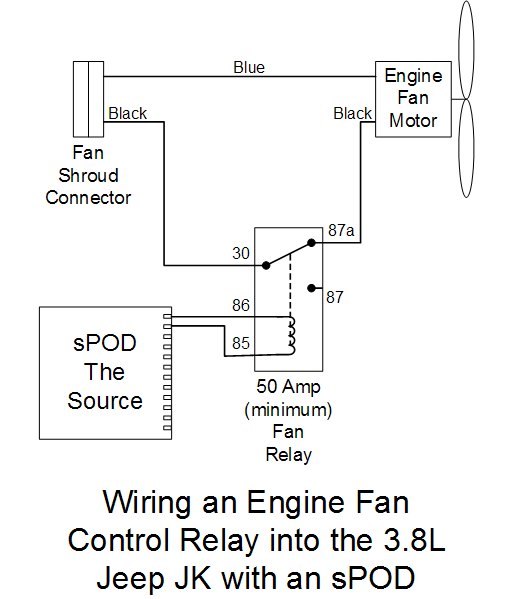
The relay I selected for this task was this one. I looked at lower powered ones, but wasn't happy that they were very well built (all of this stuff is cheap Chinese imports, so beware) ...
Amazon.com: High Power 80 Amp Relay Single Pole, Double Throw: Automotive
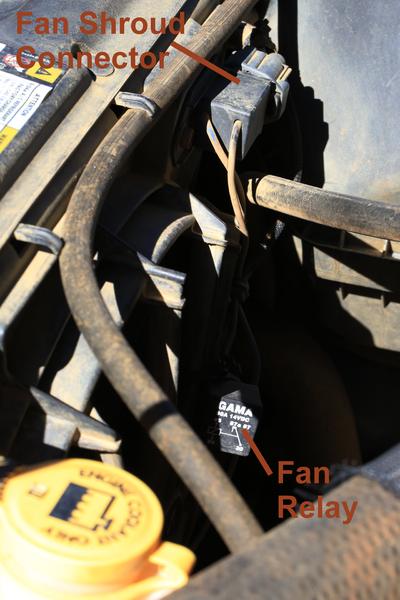
That relay does not fit into a conventional relay socket. The primary power pins are oversized, and it comes with crimp-on terminal lugs that are also oversized. There wasn't really a good place to mount a relay socket, anyway, unless I extended and rerouted the existing fan motor wiring, which I didn't want to do. So, I cut the fan wiring by the shroud, inserted the relay there, wrapped it up with some F-4 tape (F4 Tape - Self-Fusing Silicone Tape - Home), and then zip-tied it to the shroud.
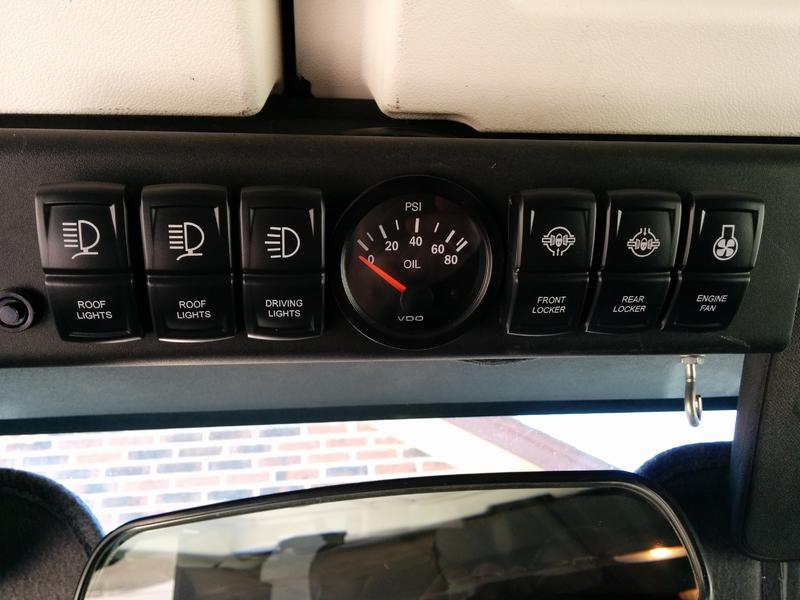
Final touch was the switch toggle from OTRATTW ...
For those folks who own Pentastars, there is an extra wire to the fan (fan speed?). A friend of mine has installed this same mod to his Pentastar and says it works fine. So, just ignore that extra wire. And if you don't own an sPOD controller, the coil current of the 80-amp relay is low enough that you could directly wire pins 85 and 86 on the new relay to a switch in the cab.
And, for the record, it works great!

When the switch on the sPOD controller is on, I needed the fan to turn off. When the switch is off, I wanted the fan under Jeep control (as originally designed). Unfortunately, an sPOD is not designed for this type of service. That is, internally, on "The Source" (their fuse and relay panel), they use four pin relays instead of five pin relays. The difference is that there is no contact for conducting a signal when the relay is de-energized. What that means is that had I used The Source to directly control the fan power (if it could handle the power even--the one I have can't!), that the switch on the controller would have been an on switch. That is, for the fan to run, the switch would have had to be positioned to on. And, if I left it on all of the time, since normally I need the fan ready to run when driving, it would have kept power to that relay at all times, even when the Jeep was parked. And if I turned it off, then forgot to turn it on, I could overheat the engine. So, I had to engineer several things:
1. Improve the current handling capacity beyond the 30 amp/circuit rating of The Source (fan is on a 50-amp fuse, IIRC).
2. Reverse the function of the controller switch such that power could flow when it was not activated.
3. Retain the OEM fan functionality when not fording water.
4. Create a design that would fail to the fan running (Should the relay fail to energize, that is. If the relay gets stuck on, a much rarer problem, then the fan will not run).
Here is how I did that (Pin 87a is the fifth pin missing on the sPOD relays) ...
The relay I selected for this task was this one. I looked at lower powered ones, but wasn't happy that they were very well built (all of this stuff is cheap Chinese imports, so beware) ...
Amazon.com: High Power 80 Amp Relay Single Pole, Double Throw: Automotive
That relay does not fit into a conventional relay socket. The primary power pins are oversized, and it comes with crimp-on terminal lugs that are also oversized. There wasn't really a good place to mount a relay socket, anyway, unless I extended and rerouted the existing fan motor wiring, which I didn't want to do. So, I cut the fan wiring by the shroud, inserted the relay there, wrapped it up with some F-4 tape (F4 Tape - Self-Fusing Silicone Tape - Home), and then zip-tied it to the shroud.
Final touch was the switch toggle from OTRATTW ...
For those folks who own Pentastars, there is an extra wire to the fan (fan speed?). A friend of mine has installed this same mod to his Pentastar and says it works fine. So, just ignore that extra wire. And if you don't own an sPOD controller, the coil current of the 80-amp relay is low enough that you could directly wire pins 85 and 86 on the new relay to a switch in the cab.
And, for the record, it works great!
Last edited by Mark Doiron; Apr 15, 2015 at 01:09 AM.

JK Junkie
Joined: Nov 2013
Posts: 3,703
Likes: 8
From: The Dirty South
Nice work, Mark! That's awesome. And you switched the negative (assuming black is negative). 
I may do this to mine, but I think I will add a blinking red LED to pin 87 to remind me to shut it off again. I can be scatterbrained sometimes.
I may do this to mine, but I think I will add a blinking red LED to pin 87 to remind me to shut it off again. I can be scatterbrained sometimes.
Thread Starter
JK Jedi Master
Joined: Mar 2007
Posts: 14,800
Likes: 374
From: Midwest City, OK
The Jeep is pretty quick to remind you when the engine coolant temperature gets too high. LOL.