


Performance On 17's Vs 18's Or 20's B.b. Issues


Thread Starter
JK Enthusiast
Joined: Mar 2008
Posts: 304
Likes: 0
From: New Jersey
 Performance On 17's Vs 18's Or 20's B.b. Issues
So I Am Deciding On Getting Either 17s Or If I Want The Bigger Look Will It Really Change The Performance Off Roading With Bigger Rims Is 20inch Too Crazy Will It Not Be Good In Some Deep Mud Also Got The Problem Between The Rough Country And Terra Seems Like The Rough Country With The 2.2 Shox Might Be Better Because Of The Alignment Issues On The Terra But Please Do Give Me Your Suggestions Definietly Enjoy Them Thanks Ahead

JK Enthusiast
Joined: Mar 2008
Posts: 270
Likes: 0
From: Smithton IL
So I Am Deciding On Getting Either 17s Or If I Want The Bigger Look Will It Really Change The Performance Off Roading With Bigger Rims Is 20inch Too Crazy Will It Not Be Good In Some Deep Mud Also Got The Problem Between The Rough Country And Terra Seems Like The Rough Country With The 2.2 Shox Might Be Better Because Of The Alignment Issues On The Terra But Please Do Give Me Your Suggestions Definietly Enjoy Them Thanks Ahead

JK Freak
Joined: Jul 2007
Posts: 753
Likes: 0
From: Orange County, CA
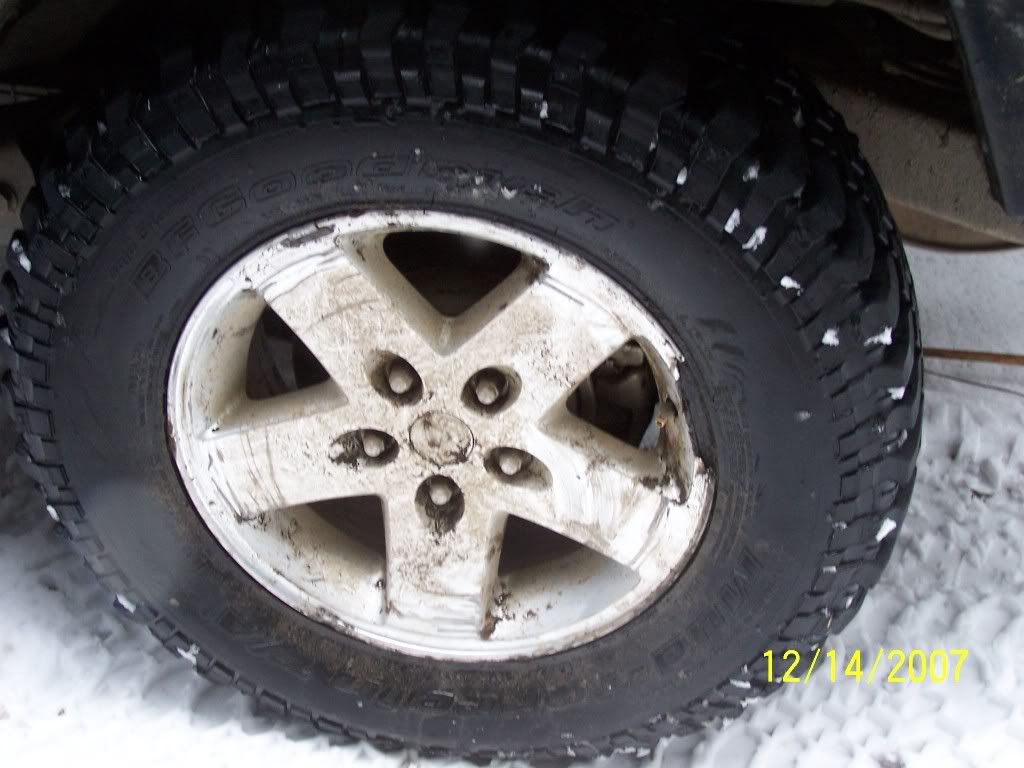
Bigger rims look cool, but reduce the amount of sidewall on the same size tire, which can cause problems off road. i run 17 inch rims and 33 inch tires and can only air down to about 15psi or I get dirt in the beads and air leaks.
for off road, stay with smaller rims and larger sidewalls.
for off road, stay with smaller rims and larger sidewalls.

JK Super Freak
Joined: Sep 2007
Posts: 1,623
Likes: 5
From: Lawrenceville, NJ

Right now, for the size tires that will fit in the wells, 17" rims are a good size limit...and there are lots of 17" off road tires to choose from.
The thing to keep in mind though, generally, the larger the rim, the more expensive the tire....so 15" tires tend to cost less than the others, and 16's are cheaper than 17's, and so forth.
As you need to replace tires on a regular basis...picking a giant rim size that makes you cry every time you need new tires might be a bad idea financially.
Some 15" rims have trouble clearing the brake calipers w/o grinding of the arts that rub....other fit, etc....all 16's on up are OK.
Remember that the Backspacing makes a HUGE difference on the new rims as to whether the tire will rub or not....the OEM rims have 6.25" BS.
Most people find that 4.75" of BS works well for 12.5 -13" section width tires, with less BS for wider than that, etc. [The OEM tires are about 10" section width at 255 mm - for the metric tires, the tread width equivalents of the 12.5" section width tires (Notice tread width is NOT the same as section width, but, the metrics tend to have more tread per section width...) - 305 - 315 mm is going to give you something equivalent to a 12.5" section width, etc]
Offroad, the taller sidewalls are better...on road, the shorter sidealls are better. A decent compromise will leave you about 7-9" of sidewall to work off road, and not be crazy squirrelly on road, etc.
Good luck!
The thing to keep in mind though, generally, the larger the rim, the more expensive the tire....so 15" tires tend to cost less than the others, and 16's are cheaper than 17's, and so forth.
As you need to replace tires on a regular basis...picking a giant rim size that makes you cry every time you need new tires might be a bad idea financially.
Some 15" rims have trouble clearing the brake calipers w/o grinding of the arts that rub....other fit, etc....all 16's on up are OK.
Remember that the Backspacing makes a HUGE difference on the new rims as to whether the tire will rub or not....the OEM rims have 6.25" BS.
Most people find that 4.75" of BS works well for 12.5 -13" section width tires, with less BS for wider than that, etc. [The OEM tires are about 10" section width at 255 mm - for the metric tires, the tread width equivalents of the 12.5" section width tires (Notice tread width is NOT the same as section width, but, the metrics tend to have more tread per section width...) - 305 - 315 mm is going to give you something equivalent to a 12.5" section width, etc]
Offroad, the taller sidewalls are better...on road, the shorter sidealls are better. A decent compromise will leave you about 7-9" of sidewall to work off road, and not be crazy squirrelly on road, etc.
Good luck!
JK Enthusiast
Joined: Mar 2008
Posts: 270
Likes: 0
From: Smithton IL
Right now, for the size tires that will fit in the wells, 17" rims are a good size limit...and there are lots of 17" off road tires to choose from.
The thing to keep in mind though, generally, the larger the rim, the more expensive the tire....so 15" tires tend to cost less than the others, and 16's are cheaper than 17's, and so forth.
As you need to replace tires on a regular basis...picking a giant rim size that makes you cry every time you need new tires might be a bad idea financially.
Some 15" rims have trouble clearing the brake calipers w/o grinding of the arts that rub....other fit, etc....all 16's on up are OK.
Remember that the Backspacing makes a HUGE difference on the new rims as to whether the tire will rub or not....the OEM rims have 6.25" BS.
Most people find that 4.75" of BS works well for 12.5 -13" section width tires, with less BS for wider than that, etc. [The OEM tires are about 10" section width at 255 mm - for the metric tires, the tread width equivalents of the 12.5" section width tires (Notice tread width is NOT the same as section width, but, the metrics tend to have more tread per section width...) - 305 - 315 mm is going to give you something equivalent to a 12.5" section width, etc]
Offroad, the taller sidewalls are better...on road, the shorter sidealls are better. A decent compromise will leave you about 7-9" of sidewall to work off road, and not be crazy squirrelly on road, etc.
Good luck!
The thing to keep in mind though, generally, the larger the rim, the more expensive the tire....so 15" tires tend to cost less than the others, and 16's are cheaper than 17's, and so forth.
As you need to replace tires on a regular basis...picking a giant rim size that makes you cry every time you need new tires might be a bad idea financially.
Some 15" rims have trouble clearing the brake calipers w/o grinding of the arts that rub....other fit, etc....all 16's on up are OK.
Remember that the Backspacing makes a HUGE difference on the new rims as to whether the tire will rub or not....the OEM rims have 6.25" BS.
Most people find that 4.75" of BS works well for 12.5 -13" section width tires, with less BS for wider than that, etc. [The OEM tires are about 10" section width at 255 mm - for the metric tires, the tread width equivalents of the 12.5" section width tires (Notice tread width is NOT the same as section width, but, the metrics tend to have more tread per section width...) - 305 - 315 mm is going to give you something equivalent to a 12.5" section width, etc]
Offroad, the taller sidewalls are better...on road, the shorter sidealls are better. A decent compromise will leave you about 7-9" of sidewall to work off road, and not be crazy squirrelly on road, etc.
Good luck!
Thats the best "to the point explanation" Ive heard and sums up about 30 other threads on tire & wheel size issues!

chuck

JK Junkie
Joined: Oct 2007
Posts: 2,361
Likes: 0
From: Montana
Look at the weight of the tires and wheels too. You would think the tires for bigger rims would get lighter, but they dont. THe wheels and tires get heavier and will harm your preformance. Stick with 16s or 17s and you should be fine. If you use the search button this has been discussed a lot and lots of weights of wheels and tires have been posted.
Trending Topics

JK Enthusiast
Joined: Dec 2007
Posts: 251
Likes: 0
From: Deer Park, TX
Right now, for the size tires that will fit in the wells, 17" rims are a good size limit...and there are lots of 17" off road tires to choose from.
The thing to keep in mind though, generally, the larger the rim, the more expensive the tire....so 15" tires tend to cost less than the others, and 16's are cheaper than 17's, and so forth.
As you need to replace tires on a regular basis...picking a giant rim size that makes you cry every time you need new tires might be a bad idea financially.
Some 15" rims have trouble clearing the brake calipers w/o grinding of the arts that rub....other fit, etc....all 16's on up are OK.
Remember that the Backspacing makes a HUGE difference on the new rims as to whether the tire will rub or not....the OEM rims have 6.25" BS.
Most people find that 4.75" of BS works well for 12.5 -13" section width tires, with less BS for wider than that, etc. [The OEM tires are about 10" section width at 255 mm - for the metric tires, the tread width equivalents of the 12.5" section width tires (Notice tread width is NOT the same as section width, but, the metrics tend to have more tread per section width...) - 305 - 315 mm is going to give you something equivalent to a 12.5" section width, etc]
Offroad, the taller sidewalls are better...on road, the shorter sidealls are better. A decent compromise will leave you about 7-9" of sidewall to work off road, and not be crazy squirrelly on road, etc.
Good luck!
The thing to keep in mind though, generally, the larger the rim, the more expensive the tire....so 15" tires tend to cost less than the others, and 16's are cheaper than 17's, and so forth.
As you need to replace tires on a regular basis...picking a giant rim size that makes you cry every time you need new tires might be a bad idea financially.
Some 15" rims have trouble clearing the brake calipers w/o grinding of the arts that rub....other fit, etc....all 16's on up are OK.
Remember that the Backspacing makes a HUGE difference on the new rims as to whether the tire will rub or not....the OEM rims have 6.25" BS.
Most people find that 4.75" of BS works well for 12.5 -13" section width tires, with less BS for wider than that, etc. [The OEM tires are about 10" section width at 255 mm - for the metric tires, the tread width equivalents of the 12.5" section width tires (Notice tread width is NOT the same as section width, but, the metrics tend to have more tread per section width...) - 305 - 315 mm is going to give you something equivalent to a 12.5" section width, etc]
Offroad, the taller sidewalls are better...on road, the shorter sidealls are better. A decent compromise will leave you about 7-9" of sidewall to work off road, and not be crazy squirrelly on road, etc.
Good luck!
Agreed X2......