


QUICK DIFF cover/fluid level question

Thread Starter
JK Junkie

Joined: Nov 2010
Posts: 3,802
Likes: 3
From: Kitchener
 QUICK DIFF cover/fluid level question
Hi guys and gals.... Just checking my front diff fluid level and curious how much I should have in. It's a Solid cover and as you can see above the "D" I unscrewed the plug to check the fluid level.
Looking at the pics is there a certain height the fluid level should be up too? It seemed like I had to go down pretty far before I got fluid on my dip stick. So looking at the pics for a reference point where should the Diff fluid be coming up to?
Thanks
Looking at the pics is there a certain height the fluid level should be up too? It seemed like I had to go down pretty far before I got fluid on my dip stick. So looking at the pics for a reference point where should the Diff fluid be coming up to?
Thanks


Thread Starter
JK Junkie
Joined: Nov 2010
Posts: 3,802
Likes: 3
From: Kitchener
Originally Posted by HLKSTER
Fill it just below the lvl of the plug
Trending Topics

JK Jedi Master

Joined: Feb 2008
Posts: 12,907
Likes: 185
From: Maine
Your fill plug is a lot higher than the stock plug; too high to use as an indicator of proper fluid level.
You can't go by a quantity number, either. Therer is just too much variation.
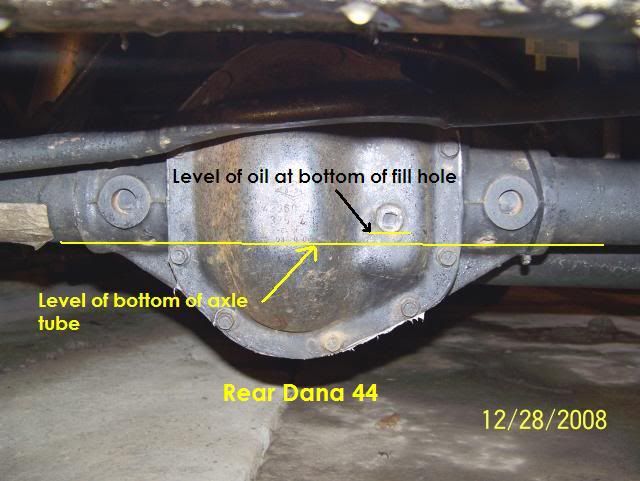
Make a little dip stick to check the leve. It should be a little above the bottom of the inside of the axle tube. This will allow oil to get to the outer axle bearings on the rear axle, and get to the carrier bearings on the front axle.
Here is the oil level as it relates to a stock cover and axle tube. Your oil level should be the same compared to the axle tube.
You can't go by a quantity number, either. Therer is just too much variation.
Make a little dip stick to check the leve. It should be a little above the bottom of the inside of the axle tube. This will allow oil to get to the outer axle bearings on the rear axle, and get to the carrier bearings on the front axle.
Here is the oil level as it relates to a stock cover and axle tube. Your oil level should be the same compared to the axle tube.

JK Enthusiast
Joined: Feb 2012
Posts: 483
Likes: 0
From: West Haverstraw, New York
The danger is in the fluid not being enough to do it's job, (mainly cooling.)
As the gears mesh they create heat. The Fluids primary job is to keep the
gears cool and it secondary job is to coat and lubricate them. If Your fluid
levels are TOO low, then you don't have enough to efficiently Cool the gears.
Though You may not know for how long this has been low, have you noticed
and meshing, or gear noisy from your axles? It would have been more noticeable
while in reverse, (as the gears were meshing on the less worn side.)
The noise is typically described as a buzz or "zzzzzzzzzzz" noise.
If not then you are fine. Just fill to the bottom of the fill hole with the
recommended fluid weight and replace the plug.
Even if You do notice a slight noise, the damage may be minimal, and all You need
do is fill to the bottom of the fill hole and replace the plug.
If You have notice the noise for some time, and wondered what the hell is that
and did nothing to find out for several weeks or months, the damage could be
more severe. If Your a DIY Guy there are several things You need to do to
correct the problem.
The following is a written testimony by Randy Lyman
Diagnosing Drivetrain Noise
Many things can go wrong inside a differential. Although the hints are often subtle,
most impending failures give fair warning in the form of noise.
Several situations can create ring-and-pinion noise. If the gears have been quiet and
begin to howl, they are probably worn or wearing. If the gears howl during deceleration
only, it’s possible that the pinion-bearing preload has loosened. Howling under acceleration
at all speeds indicates that something in the differential -- gears, pinion or carrier bearings -
- has worn or no longer keeps the gear alignment correct. If the gears howl while accelerating
over a certain speed range, but not all speeds, it’s likely that the gears are worn due to
lubrication failure or overloading. When a newly installed gear set howls, suspect the
design or setup.
A common problem is worn carrier bearings, as indicated by a low-pitch rumble above 20 mph.
On vehicles with C-clip axles the noise may vary while negotiating turns. Worn pinion bearings
can cause whirring noises at all speeds, under deceleration and/or acceleration. Pinion bearings
tend to whir, rather than rumble because the pinion is turning several times faster (depending
on gear ratio) that the carrier. Badly worn bearings can also cause howl if they do not support
the gears correctly.
Worn wheel bearings can be difficult to determine. A very bad wheel bearing typically makes
itself heard with great clarity; it’s the bearing that is going bad, but not destroyed that is
hard to find. Turning back and forth from hard right to hard left can identify the culprit;
however, I’ve been fooled by right-front wheel bearings that make noise when turning right
(which heavily loads the inside-left-front wheel bearing, but also loads the outside-right-front
bearing).
One common situation that may not make any noise: The pinion spins, but the tires
don’t rotate. Broken spider gears can render the differential immobile, and usually make
a loud, crunching sound as they make their final departure. A broken ring gear will allow
the differential to propel the vehicle for about eight feet at a time, then bang or grind as
the section with broken teeth tries to engage the pinion. Depending on ratio, a broken
pinion tooth (or teeth) will clunk about every two or three feet.
A broken axle is easily determined. After it breaks, a C-clip design axle can be pulled out of
the housing without unbolting anything -- or may even find it’s own way out. On many
bolt-in-design axles, the wheel will give the broken axle shaft away by cambering in at
an angle.
A high spot on a gear tooth may sound similar to a broken gear, but will only make noise
while accelerating or decelerating, since the spot appears on just one side of the offending
tooth. A high spot on the ring gear will make a heavy clicking sound about every eight feet;
a high spot on the pinion makes noise every two or three feet and is much more pronounced
due to its higher frequency.
Whether large or small, differential noise is telling you something. Listen carefully! If in doubt,
pull off the cover or remove the third member for a closer look. Catching a bad part before is
ruins others is definitely worth the effort.
Ring & Pinion Service can custom rebuild your posi to be smooth or aggressive
If you’ve been left hanging with a "mystery" differential noise that still refuses to
make itself clearly understood, then hopefully this info will lend some more insight.
Anyone who has been involved with four-wheel-drive vehicles has probably heard of or
experienced positraction (posi) "chatter". Posi chatter is noise that is very recognizable
and happens when there is too much friction in the clutches. Some hardcore offroaders
set up their posi this way intentionally. The noise sounds like someone is pounding on the
rearend with a huge sledgehammer. It is most prevalent when backing up in a parking lot
(when everyone around can stare), and gets worse as the differential heats up. It also
tends to show up on freeway off-ramps and when turning while taking off from a stop sign.
Broken spider gears can sound similar to posi chatter, only more consistent, regardless
of oil temperature. Broken spider gears will make a grinding or banging sound any time
the vehicle is making a turn, and, if they are bad enough, even when going straight.
Driveline vibrations can be caused by several problems. Worn universal joints or a driveline
that is out of balance are often the problem, but driveline angle can cause a balanced
driveline with good U-joints to vibrate. If the U-joints are bad, they can cause several
different noises from squeaking, to clunking, to grinding, to vibrations. If the driveline is
out of balance, it will vibrate with a steady pitch that increases as the vehicle speed
increases. If the pinion shaft is out of alignment and not parallel to the transmission yoke,
the difference in the angles between the front and back U-joints can cause the driveline
to vibrate. If the vibration is due to improper angles, it will create a cyclic sound that
increases and decreases in intensity and is not steady. An out-of-alignment problem can
also be identified by the change in the noise when accelerating or decelerating. As the
pinion yoke torques up from acceleration or down from deceleration, the rear U-joint
angle changes and causes the vibration to change.
A worn side-gear bore in the carrier case will usually cause a clicking sound as the vehicle
is coasting down from speeds of about 20 miles per hour to a stop. If the bore that supports
the side gear becomes too worn to hold the side gear in place the side gear will "roll over" the
spider pinion gears and will make a clicking noise.
If your differential problem is still not clear and you don’t want to take the time to look inside
for more data, you can always drive it until it breaks and the problem will be much clearer,
although much more expensive.
Gear Talk is written by Randy Lyman, founder and President of Randy's Ring & Pinion.
Hope this helps.