


Rain in snorkel...

JK Enthusiast
Joined: Mar 2009
Posts: 337
Likes: 0
From: Lower Westchester, NY

I've recently installed the AEV snorkel... and there are 3 "obstacles" that water would have to bypass before finally getting into the engine.
1) there is a ~5" "hump" between the body of the snorkel (which is visible along the outside of the jeep), and the entrance into the engine. I imagine you'd have to fill up the body of the snorkel with at least a couple gallons of water to get to half way up the hump
2) there is a large airbox (air is pulled from the top) that acts as a reservoir if water were to enter - and i imagine that another gallon or so would be needed to fill this airbox
3) the air filter itself would need to get full saturated before allowing water into the engine intake
i can't see that much water accumulating (not taking into account the water evaporating (ie. in small enough quantities to not be harmful to the engine) with the air being sucked into the engine) even hrs in a torrential downpour, through a ram air scoop. I'd imagine way less using the prefilter (which is capped and pulls air up - vs. air pushed horizontally)
1) there is a ~5" "hump" between the body of the snorkel (which is visible along the outside of the jeep), and the entrance into the engine. I imagine you'd have to fill up the body of the snorkel with at least a couple gallons of water to get to half way up the hump
2) there is a large airbox (air is pulled from the top) that acts as a reservoir if water were to enter - and i imagine that another gallon or so would be needed to fill this airbox
3) the air filter itself would need to get full saturated before allowing water into the engine intake
i can't see that much water accumulating (not taking into account the water evaporating (ie. in small enough quantities to not be harmful to the engine) with the air being sucked into the engine) even hrs in a torrential downpour, through a ram air scoop. I'd imagine way less using the prefilter (which is capped and pulls air up - vs. air pushed horizontally)

JK Freak
Joined: Oct 2008
Posts: 896
Likes: 0
From: Colorado Springs, CO
I've recently installed the AEV snorkel... and there are 3 "obstacles" that water would have to bypass before finally getting into the engine.
1) there is a ~5" "hump" between the body of the snorkel (which is visible along the outside of the jeep), and the entrance into the engine. I imagine you'd have to fill up the body of the snorkel with at least a couple gallons of water to get to half way up the hump
2) there is a large airbox (air is pulled from the top) that acts as a reservoir if water were to enter - and i imagine that another gallon or so would be needed to fill this airbox
3) the air filter itself would need to get full saturated before allowing water into the engine intake
i can't see that much water accumulating (not taking into account the water evaporating (ie. in small enough quantities to not be harmful to the engine) with the air being sucked into the engine) even hrs in a torrential downpour, through a ram air scoop. I'd imagine way less using the prefilter (which is capped and pulls air up - vs. air pushed horizontally)
1) there is a ~5" "hump" between the body of the snorkel (which is visible along the outside of the jeep), and the entrance into the engine. I imagine you'd have to fill up the body of the snorkel with at least a couple gallons of water to get to half way up the hump
2) there is a large airbox (air is pulled from the top) that acts as a reservoir if water were to enter - and i imagine that another gallon or so would be needed to fill this airbox
3) the air filter itself would need to get full saturated before allowing water into the engine intake
i can't see that much water accumulating (not taking into account the water evaporating (ie. in small enough quantities to not be harmful to the engine) with the air being sucked into the engine) even hrs in a torrential downpour, through a ram air scoop. I'd imagine way less using the prefilter (which is capped and pulls air up - vs. air pushed horizontally)
Although my situation was more a "going too fast" rather than going too deep.
Last edited by stlfan06; Nov 10, 2009 at 01:24 PM.
JK Enthusiast
Joined: Mar 2009
Posts: 337
Likes: 0
From: Lower Westchester, NY
It would not take near a gallon. Trust me, with the water sloshing around in there and the fact that air is being sucked out of the airbox by the engine...it doesn't take much. Right after mine hydrolocked, I opened the airbox to find nothing but the bottom of the airbox being wet...no standing water....
Although my situation was more a "going to fast" rather than going to deep.
Although my situation was more a "going to fast" rather than going to deep.
 so back to the OP's question, do you think enough rain water could find it's way through the snorkel opening, through the snorkel body, past the airbox reservoir, and past the airfilter to damage the engine?
JK Freak
Joined: Oct 2008
Posts: 896
Likes: 0
From: Colorado Springs, CO

fair enough. since i've never hydrolocked, i'll defer to you as the expert so back to the OP's question, do you think enough rain water could find it's way through the snorkel opening, through the snorkel body, past the airbox reservoir, and past the airfilter to damage the engine?
so back to the OP's question, do you think enough rain water could find it's way through the snorkel opening, through the snorkel body, past the airbox reservoir, and past the airfilter to damage the engine?
JK Junkie
Joined: Dec 2008
Posts: 2,540
Likes: 0
From: New France
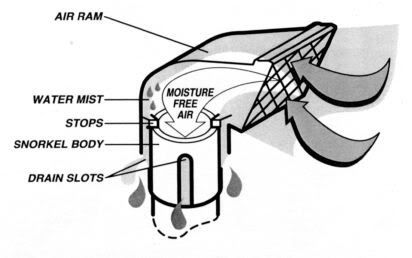
I would really like to see a diagram or something, showing how the water does not get to the airbox...I mean if you're running an air ram head on the highway for a couple hours (in the rain) how could it not?...I know there's a way because people obviously do it all the time, I just don't know how?


JK Super Freak
Joined: Jul 2008
Posts: 1,637
Likes: 0
From: ASS-KRACK-ISTAN