


SCBA air tank?


JK Enthusiast
Joined: Oct 2007
Posts: 392
Likes: 2
From: Jacksonville, North Carolina, United States


JK Super Freak
Joined: Jun 2008
Posts: 1,116
Likes: 4
From: Calgary, Alberta, Canada

I know w/ co2 tanks (powertank) they reccomend a more upright mounting position if you plan on using it in situ. Otherwise you should remove it and set it upright for optimal performance.
Roll bar works well for mounting but makes getting soft-top up or down pretty much impossible.
I like the idea of interior tailgate mount, never thought of that myself .
.
Roll bar works well for mounting but makes getting soft-top up or down pretty much impossible.
I like the idea of interior tailgate mount, never thought of that myself
.SCBA bottles will not have that problem as the contents are a homogenous gas...essentially the same as the air you're breathing now. Go ahead and mount it horizontally if that's what floats your boat.

Now I get to "give back" to the community that's answered so many Jeep questions for me. Breathing apparatus is my bread and butter, so I'm even better informed than most firefighters on the topic. I work for a specialty toxic gas safety company.
As far as capacity of SCBA bottles go, here's the scoop:
A 30 minute bottle will contain 45 cubic feet of air. (full size 2216psi or small 4500 psi)
A 60 minute bottle will contain 90 cubic feet of air. (full size 4500 psi)
Based on stats from the Viair site, if you want to air up a 33" tire, it's +/- 5 cubic feet (15 to 30 psi). So you're probably looking at two "air-up" session with a 2216 psi bottle, or four with 4500 psi bottle.
There are lots of other sizes of bottle out there (7 cu. ft .for SABA/SKA packs, 10 cu. ft. for SKAT packs...Scott makes a pile of flavours), but I don't think that any of those would be worth hauling around for filling tires or running air tools. Just not enough capacity to make it worthwhile.
Firerescue707:
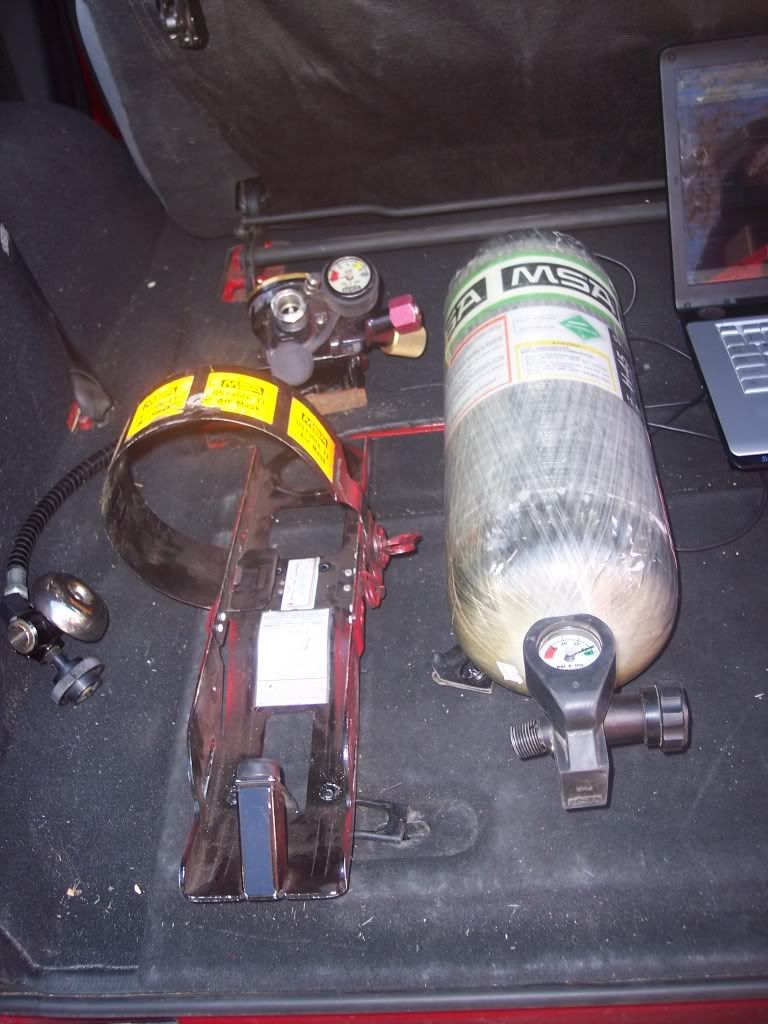
That single stage MSA regulator that you have may be ok, but I'm not sure. We don't have them in our domestic inventory anymore (only overseas use at htis point in time). My familiarity with them is based on customer's packs. You've got a couple of advantages with that type of regulator.
#1. They're just about bulletproof. The older SCOTT and MSA gear is almost impossible to break. I've seen stuff that's been ignored and abused for thirty years (except for hydro-testing once every five years), and it just keeps ticking.

#2. Both the standard feed and purge/override knobs are manual. Unlike the systems that rely on a mask-mounted regulator, the user sets how much air flows.
The two things that I can't tell you are these:
-Will that regulator deliver enough pressure to get a flow rate through a standard valve stem to fill the tire in a reasonable amount of time?
-How much of a pain in the @ss will it be to get the large diameter outlet of that regulator necked down to a standard air hose.
Let us know how your make out!

One last thing. (I'm adding this because we're talking about using "old" bottles)
PLEASE do not use a bottle that's out of hydrotest. There are a myriad of things that can go wrong with an SCBA bottle, and most of them are related to repeated fill cycles - especially if there's been a history of shock or "hot" fills...which a lot of departments seem to end up doing when they're under pressure to get bottles filled at a fire scene. Any failure that happens to an SCBA bottle will be a catastrophic failure, and it's very easy for someone to lose a limb or their life in that type of incident.
Also be aware that anything other than a vanilla aluminum or steel bottle may have a fixed lifespan. This is because of the potential effects of UV light and aging on the composites and epoxies used in making a light, strong bottle. Some of the first generation of 4500 psi bottles had a mandated lifespan of less than fifteen years from date of manufacture. If in doubt, call the manufacturer.



JK Freak
Joined: Mar 2007
Posts: 710
Likes: 0
From: Atlanta, GA
You can get them online from fire/rescue suppliers, but they are around $200.
If you can find a local welding supply company they should be able to get you something similar for less. I think a company called Victor makes them also.
I don't own one for personal use, but we carry 2 on our rescue truck for portable SCBA air when needed. If you cannot find anything let me know and I can look up the manufacturer/model numbers on ours.
If you can find a local welding supply company they should be able to get you something similar for less. I think a company called Victor makes them also.
I don't own one for personal use, but we carry 2 on our rescue truck for portable SCBA air when needed. If you cannot find anything let me know and I can look up the manufacturer/model numbers on ours.