


Steering Mods Help


Thread Starter
JK Newbie

Joined: Jun 2020
Posts: 21
Likes: 2
From: Nashville, TN
 Steering Mods Help
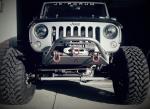
So I got a 2007 JK 2-door X for my daughter. It already has about a 3" lift in the front and 4" lift in the back (measured 15" between the spring mounts in the front and 12" between the spring mounts in the back). It also has a drop pitman arm and a double steering stabilizer. It still has the stock track bar and stock control arms. The current tires/wheels are 35" on 20" rims.
The steering wanders a bit and there was a good bit of play in the steering wheel. The play was a loose pitman arm. I have tightened it up but is seems to want to keep working itself loose.
Tomorrow I am replacing the drag link as the ends are worn out. I think I will also replace the drop pitman arm with a stock one. and the double steering stabilizer with a single one. The main question I have is regarding lower control arms. Most of what I have read, 3+" lift will alter your caster enough to cause wander. My plan was to install adjustable or longer fixed length lower front control arms to get the caster back to stock. I was discussing this with a guy at 4WP and and he said he did not think I should do lower control arms, but rather an expensive single steering stabilizer, and heavy duty track bar (in addition to the stock pitman arm and new drag link)
What is the collective wisdom of the list? Lower control arms and a stock steering stabilizer, a heavy duty trackbar and expensive single steering stabilizer, both, neither? The jeep will not see any real wheeling of any kind until she leaves for college and it becomes mine. ;-)
Thanks for the help.
The steering wanders a bit and there was a good bit of play in the steering wheel. The play was a loose pitman arm. I have tightened it up but is seems to want to keep working itself loose.
Tomorrow I am replacing the drag link as the ends are worn out. I think I will also replace the drop pitman arm with a stock one. and the double steering stabilizer with a single one. The main question I have is regarding lower control arms. Most of what I have read, 3+" lift will alter your caster enough to cause wander. My plan was to install adjustable or longer fixed length lower front control arms to get the caster back to stock. I was discussing this with a guy at 4WP and and he said he did not think I should do lower control arms, but rather an expensive single steering stabilizer, and heavy duty track bar (in addition to the stock pitman arm and new drag link)
What is the collective wisdom of the list? Lower control arms and a stock steering stabilizer, a heavy duty trackbar and expensive single steering stabilizer, both, neither? The jeep will not see any real wheeling of any kind until she leaves for college and it becomes mine. ;-)
Thanks for the help.
JK Jedi


Joined: Jun 2013
Posts: 11,362
Likes: 2,089
From: Willow Park, TX
Please note that the guys at 4WP are complete morons.
The drop pitman is there as part of a high steer kit due to the lift height. You should have a corresponding raised TB bracket on the axle side. If you remove the drop pitman and resintall a factory pitman, then you need to flip the DL at the knuckle. This is a better configuration and will require a new DL. At that lift height you should have a decent adjustable front TB IMO. The factory steering stabilizer is fine, you don't need an expensive unit. If the jeep is giving you some feedback (bumpsteer or wobble), then you have a problem to address. Too many people simply cover us underlying issues with a SS. Those issues just get worse and worse until a failure. For your daughter, I'd go with control arm brackets to adjust caster rather than adjustable or fixed length arms. They will provide a better ride as they flatten the angle of the control arm. You lose a little ground clearance at the frame, but that doesn't seem like it would be an issue for her. Most of us aren't fans of 20" wheels and opt for 17", but that is what it is as they came with the jeep.
The drop pitman is there as part of a high steer kit due to the lift height. You should have a corresponding raised TB bracket on the axle side. If you remove the drop pitman and resintall a factory pitman, then you need to flip the DL at the knuckle. This is a better configuration and will require a new DL. At that lift height you should have a decent adjustable front TB IMO. The factory steering stabilizer is fine, you don't need an expensive unit. If the jeep is giving you some feedback (bumpsteer or wobble), then you have a problem to address. Too many people simply cover us underlying issues with a SS. Those issues just get worse and worse until a failure. For your daughter, I'd go with control arm brackets to adjust caster rather than adjustable or fixed length arms. They will provide a better ride as they flatten the angle of the control arm. You lose a little ground clearance at the frame, but that doesn't seem like it would be an issue for her. Most of us aren't fans of 20" wheels and opt for 17", but that is what it is as they came with the jeep.

JK Jedi Master
Joined: Jan 2008
Posts: 11,463
Likes: 165
From: Austin <--> Colorado Springs
Is this a Rough Country lift? (should be able to see the name on the shocks or the stabilizers.) If so, their taller kits generally come with some form of Caster correction. Depending on how long ago it was purchased, it could be either Cam Bolts or 'Fixed' lower control arms. Before you spend money on new parts, take another look. Or find a shop that does 'free' alignment checks (they will print the current specs but won't change anything). Or grab a cheap angle finder to get a ball-park Caster number.
As mentioned, the drop pitman works in conjunction with a trackbar bracket to flatten the angles on both bars. If you swap back to the stock pitman, you will want to remove the bracket at the same time. If you choose to go to a flip instead, you will move the draglink up to the top of the knuckle, while re-raising the axle end of the trackbar with a bracket. Moving one bar without moving the other at the same time messes with the angles and causes some handling you want to avoid.
(your current trackbar bracket raises from the axle, or it lowers from the frame???)
The stock stabilizers are fine, if you check Craigslist you just might find a freebie someone is looking to get out of the parts pile in the garage.
Decide on the Flip/No-Flip situation before you buy a front trackbar. The trackbar relo bracket will help center the axle, so if you go back to stock pitman with no flip, you will want the adj trackbar. If you do decide to Flip, wait until the bracket is on to see how centered the axle is. (assuming you re-use the same bracket, you already have the visual...)
And x2 on the 4WP comment, not the best advice coming from them in my experience either.
As mentioned, the drop pitman works in conjunction with a trackbar bracket to flatten the angles on both bars. If you swap back to the stock pitman, you will want to remove the bracket at the same time. If you choose to go to a flip instead, you will move the draglink up to the top of the knuckle, while re-raising the axle end of the trackbar with a bracket. Moving one bar without moving the other at the same time messes with the angles and causes some handling you want to avoid.
(your current trackbar bracket raises from the axle, or it lowers from the frame???)
The stock stabilizers are fine, if you check Craigslist you just might find a freebie someone is looking to get out of the parts pile in the garage.
Decide on the Flip/No-Flip situation before you buy a front trackbar. The trackbar relo bracket will help center the axle, so if you go back to stock pitman with no flip, you will want the adj trackbar. If you do decide to Flip, wait until the bracket is on to see how centered the axle is. (assuming you re-use the same bracket, you already have the visual...)
And x2 on the 4WP comment, not the best advice coming from them in my experience either.
Last edited by nthinuf; Jun 19, 2020 at 04:06 PM.
Thread Starter
JK Newbie
Joined: Jun 2020
Posts: 21
Likes: 2
From: Nashville, TN
I did not get warm fuzzies from 4WP either.
First things first, a confession. I have driven an FJ40 for the last 33 years. Leaf springs, shackle reversals, Saginaw steering conversions, etc are what I know. The whole coil suspension and related components are new to me.
It does appear to be a Rough Country 4" kit and was installed in 2014. It raises the track bar at the axle instead of dropping it at the frame (the current kit on the website looks like it drops the track bar at the frame). It also appears to have cam bolts. However, I measured the distance between the center lines of the control arm bolts and got 22 3/4" even with the cam bolts. From what I have read on multiple forums, that distance should be closer to 23 1/8" to 23 1/4" or more (depending upon your actual caster). I will do a check of the caster tomorrow, but it seems to me I need slightly longer arms.
I understand the need for a flatter angle on the drag link to control bump steer. However, do the angle of the track bar and the drag link need to be the same? I really do not like a drop pitman arm and the extra stress it puts on the steering box. I think I will go back to a stock pitman arm and get a sleeve to let me drill out and flip the drag link. (https://teraflex.com/shop_items/jk-d...-insert-sleeve). The Rough Country Bracket both raises the axle end of the track bar, and moves it slightly inboard. I suppose moving the axle mounting location inboard off sets the increased distance between mounting points caused by the lift, allowing the continued use of the factory bar. If my axle is centered correctly, what is the benefit of the aftermarket track bar?
I also don't really like 35s in 20" rims, but that was what was on the jeep and she likes them OK. When the tires wear out, the 20" rims will go away. I still run 35s on steel 15" rims omn my 40, but I am kind of old school (or just old). I ran 37 Boggers on 15" rims when I used to rock crawl before my daughter was born. I run an aftermarket steering set up on my 40 that puts the tie rod behind the axle and the drag link up high. I don't even run a steering stabilizer.
Thanks again for the help and information. If I am incorrect in my understanding of this, let me know.
First things first, a confession. I have driven an FJ40 for the last 33 years. Leaf springs, shackle reversals, Saginaw steering conversions, etc are what I know. The whole coil suspension and related components are new to me.
It does appear to be a Rough Country 4" kit and was installed in 2014. It raises the track bar at the axle instead of dropping it at the frame (the current kit on the website looks like it drops the track bar at the frame). It also appears to have cam bolts. However, I measured the distance between the center lines of the control arm bolts and got 22 3/4" even with the cam bolts. From what I have read on multiple forums, that distance should be closer to 23 1/8" to 23 1/4" or more (depending upon your actual caster). I will do a check of the caster tomorrow, but it seems to me I need slightly longer arms.
I understand the need for a flatter angle on the drag link to control bump steer. However, do the angle of the track bar and the drag link need to be the same? I really do not like a drop pitman arm and the extra stress it puts on the steering box. I think I will go back to a stock pitman arm and get a sleeve to let me drill out and flip the drag link. (https://teraflex.com/shop_items/jk-d...-insert-sleeve). The Rough Country Bracket both raises the axle end of the track bar, and moves it slightly inboard. I suppose moving the axle mounting location inboard off sets the increased distance between mounting points caused by the lift, allowing the continued use of the factory bar. If my axle is centered correctly, what is the benefit of the aftermarket track bar?
I also don't really like 35s in 20" rims, but that was what was on the jeep and she likes them OK. When the tires wear out, the 20" rims will go away. I still run 35s on steel 15" rims omn my 40, but I am kind of old school (or just old). I ran 37 Boggers on 15" rims when I used to rock crawl before my daughter was born. I run an aftermarket steering set up on my 40 that puts the tie rod behind the axle and the drag link up high. I don't even run a steering stabilizer.
Thanks again for the help and information. If I am incorrect in my understanding of this, let me know.
JK Jedi Master
Joined: Jan 2008
Posts: 11,463
Likes: 165
From: Austin <--> Colorado Springs
Any CA length numbers you find online should be considered as 'starting points', not hard facts that work for every build. If you think about it, a 4" coil from one mfg might net an actual 4" of lift height, and from another mfg you might get 5", or even 3". Caster changes with any variation in height, as well as any variation to the control arm length. It can be hard to know ahead of time where you'll end up in terms of height and caster, since all builds are different and you shouldn't expect most coils to actually give the stated height. 
If you do decide to pull the cams instead of keeping them, read up on CA Brackets instead of swapping arms. Might be a better choice. Also, if you swap to new arms or brackets, have an idea of what you will do with the Cams, since the bolt holes in those brackets had to be enlarged when they were installed. Some folks will leave the cams in place, some will spot-weld the cams or weld up the notches, and many just add a cheap set of 'Cam Bolt Eliminators', which are just thick washers. But think it all through once you find out your current Caster.
Yes, you want the draglink and trackbar to remain parallel. That's why that lift came with both a drop pitman -and- a front trackbar bracket, and why flips/high-steers also use brackets. It not only centers the axle, but it moves one end of both bars to flatten the angles while keeping them parallel to each other.
Assuming you do run a trackbar bracket that centers the axle (any flip / high-steer / drop pitman setup), the benefit of an adjustable trackbar is that they are generally more robust than the stock bars, some are lighter, there are a variety of joint types to choose from, there are different bends in various mfg's bars that may give better clearance, and it gives you the ability to fine tune the axle centering. But again, if you run a bracket, no harm in seeing what you think of the axle centering before you commit to swapping out the trackbar...
You already have the 20's. Just an opinion, but keep em. When it is time for a new set of tires, you can re-visit the 20" vs 17" argument and see if you care enough to make the switch.
If you do decide to pull the cams instead of keeping them, read up on CA Brackets instead of swapping arms. Might be a better choice. Also, if you swap to new arms or brackets, have an idea of what you will do with the Cams, since the bolt holes in those brackets had to be enlarged when they were installed. Some folks will leave the cams in place, some will spot-weld the cams or weld up the notches, and many just add a cheap set of 'Cam Bolt Eliminators', which are just thick washers. But think it all through once you find out your current Caster.
Yes, you want the draglink and trackbar to remain parallel. That's why that lift came with both a drop pitman -and- a front trackbar bracket, and why flips/high-steers also use brackets. It not only centers the axle, but it moves one end of both bars to flatten the angles while keeping them parallel to each other.
Assuming you do run a trackbar bracket that centers the axle (any flip / high-steer / drop pitman setup), the benefit of an adjustable trackbar is that they are generally more robust than the stock bars, some are lighter, there are a variety of joint types to choose from, there are different bends in various mfg's bars that may give better clearance, and it gives you the ability to fine tune the axle centering. But again, if you run a bracket, no harm in seeing what you think of the axle centering before you commit to swapping out the trackbar...
You already have the 20's. Just an opinion, but keep em. When it is time for a new set of tires, you can re-visit the 20" vs 17" argument and see if you care enough to make the switch.
Last edited by nthinuf; Jun 19, 2020 at 10:32 PM.
JK Jedi
Joined: Jun 2013
Posts: 11,362
Likes: 2,089
From: Willow Park, TX
nthinuf nailed the late night response. Rough Country is popular among pickups and I totally see how the drop pitman works in those setups without the same issues. They carry that over to the jeep lifts and it's got to be one of the biggest headaches we see pop up here as people complain about steering issues. Be happy you have a bracket raising the axles side TB mount vs. dropping the frame side like you say the current lift they sell does. Always better to raise the axle side. That bracket will likely be fine to use with a flipped DL. A couple DL options to look at are Metalcloak and Synergy as they can be installed in either factory or flipped orientation. You could also look at the Yeti 26 no-drill DL end which is a little cheaper and just screws into the factory DL turnbuckle.
I hate cam bolts. Don't trust them. If it were me I'd remove those and use control arm brackets.
If you ever do change wheels in the future, a big reason 17s are the most common for us is they allow for brake and tie rod upgrades whereas the old school 15 does not.
I'll add this idea as a safety precaution. Frame side TB joints, bolt, and bracket are one of the largest causes of DW on these things. Undertorqued bolts, bad joints, and wallowed out bracket holes. There are several TB bracket reinforcements on the market these days that really beef up that frame side bracket. Cheap insurance you may want to at least look at. Ball joints are a very common thing with larger tires on the JKs. If that does not have upgraded BJs yet keep a close eye on them. At that lift height, does it have aftermarket driveshafts? I'd think if it's been lifted 6 years now these things have probably been addressed.
I hate cam bolts. Don't trust them. If it were me I'd remove those and use control arm brackets.
If you ever do change wheels in the future, a big reason 17s are the most common for us is they allow for brake and tie rod upgrades whereas the old school 15 does not.
I'll add this idea as a safety precaution. Frame side TB joints, bolt, and bracket are one of the largest causes of DW on these things. Undertorqued bolts, bad joints, and wallowed out bracket holes. There are several TB bracket reinforcements on the market these days that really beef up that frame side bracket. Cheap insurance you may want to at least look at. Ball joints are a very common thing with larger tires on the JKs. If that does not have upgraded BJs yet keep a close eye on them. At that lift height, does it have aftermarket driveshafts? I'd think if it's been lifted 6 years now these things have probably been addressed.
Thread Starter
JK Newbie
Joined: Jun 2020
Posts: 21
Likes: 2
From: Nashville, TN
I have seen bolt on control arm brackets for the frame side and weld on for the axle end. Am I correct to assume you are meaning the bolt on brackets? I see how they lower the frame end and put the arm in a more "stock" geometry. That won't do anything for eliminating any alterations made by the cam bolts at the axle. I did double check the TB bolts when I was tightening the pitman arm on the box (I had to drop the frame end). The bushing still looks good and i torqued it to spec. I will double check that everything is tight at the axle end with the RC bracket. Once I check the caster I will report. I have read to check it at the pinion, but no one seems to give a good photo/description of exactly how to measure to there. I was thinking at the bottom of the knuckle. Not on the case area, but in front of that where they have machined for the ball joint. That machined surface looks perpendicular to the knuckle joint.
Trending Topics
JK Jedi
Joined: Jun 2013
Posts: 11,362
Likes: 2,089
From: Willow Park, TX
As far as control arm brackets, they just bolt on to the frame side. Most of them are 2-piece brackets, but there are some nice 1-piece options, like Rancho, as well. Most of the brackets these days will offer 2-3 different mounting options for caster. On the axle side you just continue using the factory mounts, except in your case you need to address or eliminate the cam bolts, or at least I think you should to play it safe.
If you have a factory pinion flange still, this is what I had done in the past to measure pinion angle (post #11) -
https://www.jk-forum.com/forums/modi...1/#post4300548
I will say that even with a digital angle finder, and on flat garage floor that read no angle with that same angle finder, the pinion angle reading was still off by ~1* or so vs. what an actual alignment machine read. What I do think it is good for is measuring a baseline for adjustments. Ie, add your caster adjustment and take a good reading in what you determine is an accurate spot, note the angle. Go get a real alignment reading. Then, if you need to make any adjustments after that, you know what your baseline with the angle finder was and you can just adjust until you've increased (or decreased) the appropriate amount from your baseline. (that sounds a little confusing to read). That might be overkill for using control arm brackets and a bit more relevant when trying to dial in adjustable arms.
If you have a yoke instead of pinion flange, guess the C might be a better spot.
If you have a factory pinion flange still, this is what I had done in the past to measure pinion angle (post #11) -
https://www.jk-forum.com/forums/modi...1/#post4300548
I will say that even with a digital angle finder, and on flat garage floor that read no angle with that same angle finder, the pinion angle reading was still off by ~1* or so vs. what an actual alignment machine read. What I do think it is good for is measuring a baseline for adjustments. Ie, add your caster adjustment and take a good reading in what you determine is an accurate spot, note the angle. Go get a real alignment reading. Then, if you need to make any adjustments after that, you know what your baseline with the angle finder was and you can just adjust until you've increased (or decreased) the appropriate amount from your baseline. (that sounds a little confusing to read). That might be overkill for using control arm brackets and a bit more relevant when trying to dial in adjustable arms.
If you have a yoke instead of pinion flange, guess the C might be a better spot.
Last edited by resharp001; Jun 20, 2020 at 06:11 AM.
JK Jedi Master
Joined: Jan 2008
Posts: 11,463
Likes: 165
From: Austin <--> Colorado Springs
Once I check the caster I will report.
Thread Starter
JK Newbie
Joined: Jun 2020
Posts: 21
Likes: 2
From: Nashville, TN
After looking at the cam bolts, based on photos of the correct installation I looked at on-line, the passenger’s side seems to be set such that the caster would be corrected (thicker portion of the cam to the front, pushing bolt backward and the axle forward, but the driver’s site looks like it has shifted opposite.
I will first get the cam bolts correctly aligned before I check the pinion angle at the flange.
Am I correct that the pinion angle is 2 deg opposite of the caster? So a 2 deg negative pinion is 4 deg positive caster. So if I read say 4 deg of pinion angle I have a 2 deg caster.
thanks.
I will first get the cam bolts correctly aligned before I check the pinion angle at the flange.
Am I correct that the pinion angle is 2 deg opposite of the caster? So a 2 deg negative pinion is 4 deg positive caster. So if I read say 4 deg of pinion angle I have a 2 deg caster.
thanks.