


Transfer case exploded!


JK Freak
Joined: Jul 2008
Posts: 599
Likes: 0
From: Cumming, GA

It's not a t-case design flaw.
The common denominator in the t-case explosions is lifted, bad pinion angle, aftermarket drive shafts, re-geared, highway speeds. I'll even bet the OP's front drive shaft had a single, regular u-joint at the pinion, and a double cardan at the t-case.
This all adds up to hitting a critical front drive shaft vibration frequency, then KA-BOOM.
And the farther the t-case yoke puts the double cardan from the t-case, the easier it will be to hit that frequency.
This is assuming the t-case hasn't seen a trail impact or bent drive shaft.
The common denominator in the t-case explosions is lifted, bad pinion angle, aftermarket drive shafts, re-geared, highway speeds. I'll even bet the OP's front drive shaft had a single, regular u-joint at the pinion, and a double cardan at the t-case.
This all adds up to hitting a critical front drive shaft vibration frequency, then KA-BOOM.
And the farther the t-case yoke puts the double cardan from the t-case, the easier it will be to hit that frequency.
This is assuming the t-case hasn't seen a trail impact or bent drive shaft.
Welcome to the club. Get the 2 spd Atlas.
https://www.jk-forum.com/forums/show...Caught-on-Fire
JK Super Freak
Joined: Mar 2008
Posts: 1,439
Likes: 1
From: Flyover Country
sm_rubi, you shouldn't have to remove your front drive train for travel, nor is an Altas t-case mandatory.

Humor me - when you get your new 37s, adjust your front CAs to give 4.0-4.5 degrees caster. If you're doing this with a dial indicator, have it verified with an actual alignment.
Then drive the Jeep for a week. And come back and tell me if you're unhappy with its handling.
This notion a JK morphs into an evil handling machine threatening to buck a guy into the culvert with the slightest twitch of the steering is nonsense.
Remember, wide tires w/big contact patches slow steering down, countering the effect of lower caster numbers; the positive byproduct of less caster is reduced vibration which preserves your expensive drive train and power train components.
I wish you were local. I'd let you drive my Jeep with 35s and 3 degrees of caster. You probably couldn't tell the difference over factory spec (4.5 degrees), but the Jeep sure can.
Good luck.
Humor me - when you get your new 37s, adjust your front CAs to give 4.0-4.5 degrees caster. If you're doing this with a dial indicator, have it verified with an actual alignment.
Then drive the Jeep for a week. And come back and tell me if you're unhappy with its handling.
This notion a JK morphs into an evil handling machine threatening to buck a guy into the culvert with the slightest twitch of the steering is nonsense.
Remember, wide tires w/big contact patches slow steering down, countering the effect of lower caster numbers; the positive byproduct of less caster is reduced vibration which preserves your expensive drive train and power train components.
I wish you were local. I'd let you drive my Jeep with 35s and 3 degrees of caster. You probably couldn't tell the difference over factory spec (4.5 degrees), but the Jeep sure can.
Good luck.

JK Jedi
Joined: Mar 2009
Posts: 8,931
Likes: 6
From: San Marcos, CA
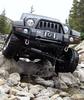
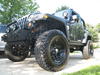
 But I did notice your jeep has some sharp wheel and tires.

JK Jedi
Joined: Mar 2009
Posts: 8,931
Likes: 6
From: San Marcos, CA
sm_rubi, you shouldn't have to remove your front drive train for travel, nor is an Altas t-case mandatory.
Humor me - when you get your new 37s, adjust your front CAs to give 4.0-4.5 degrees caster. If you're doing this with a dial indicator, have it verified with an actual alignment.
Then drive the Jeep for a week. And come back and tell me if you're unhappy with its handling.
This notion a JK morphs into an evil handling machine threatening to buck a guy into the culvert with the slightest twitch of the steering is nonsense.
Remember, wide tires w/big contact patches slow steering down, countering the effect of lower caster numbers; the positive byproduct of less caster is reduced vibration which preserves your expensive drive train and power train components.
I wish you were local. I'd let you drive my Jeep with 35s and 3 degrees of caster. You probably couldn't tell the difference over factory spec (4.5 degrees), but the Jeep sure can.
Good luck.
Humor me - when you get your new 37s, adjust your front CAs to give 4.0-4.5 degrees caster. If you're doing this with a dial indicator, have it verified with an actual alignment.
Then drive the Jeep for a week. And come back and tell me if you're unhappy with its handling.
This notion a JK morphs into an evil handling machine threatening to buck a guy into the culvert with the slightest twitch of the steering is nonsense.
Remember, wide tires w/big contact patches slow steering down, countering the effect of lower caster numbers; the positive byproduct of less caster is reduced vibration which preserves your expensive drive train and power train components.
I wish you were local. I'd let you drive my Jeep with 35s and 3 degrees of caster. You probably couldn't tell the difference over factory spec (4.5 degrees), but the Jeep sure can.
Good luck.

Yeah I'll report back after the tires go on. Would love to do the PR44 Unlimited to help with the angles but it isn't in the budget for now. We are removing to front DS for fear that the slight vibration is contributing to the explosions we are seeing. Question does a PSC help or hurt the "slow steering" effect?
JK Freak
Joined: Jun 2008
Posts: 595
Likes: 0
From: maryland
When going through the replacement of my driveshafts 2 years ago, I experienced significant vib with the shafts that work with the stock yokes. I sent them back and had them reconfigured for replacement yokes. IMO, the joint at the transfer case place too far out and increases the vib issue. I now have the replacement yokes with the joint much closer. I am at 4 degrees castor. Minimal vibe at 45mpg with my 5.13 gears.
The down side, is that i don't feel confident when taking the jeep on long trips...
The down side, is that i don't feel confident when taking the jeep on long trips...


JK Freak
Joined: Mar 2007
Posts: 709
Likes: 3
From: Frazier Park, CA
It's not a t-case design flaw.
The common denominator in the t-case explosions is lifted, bad pinion angle, aftermarket drive shafts, re-geared, highway speeds. I'll even bet the OP's front drive shaft had a single, regular u-joint at the pinion, and a double cardan at the t-case.
This all adds up to hitting a critical front drive shaft vibration frequency, then KA-BOOM.
And the farther the t-case yoke puts the double cardan from the t-case, the easier it will be to hit that frequency.
This is assuming the t-case hasn't seen a trail impact or bent drive shaft.
The common denominator in the t-case explosions is lifted, bad pinion angle, aftermarket drive shafts, re-geared, highway speeds. I'll even bet the OP's front drive shaft had a single, regular u-joint at the pinion, and a double cardan at the t-case.
This all adds up to hitting a critical front drive shaft vibration frequency, then KA-BOOM.
And the farther the t-case yoke puts the double cardan from the t-case, the easier it will be to hit that frequency.
This is assuming the t-case hasn't seen a trail impact or bent drive shaft.
While the common denominator that you speak of is true, it is just as true that the case half’s are very poor castings. I had a Tcase TIG welded in Moab this year and the welder commented that he had to do more grinding to find stable metal to weld to. He kept finding air pockets in the metal.
Also, when I took apart my broken case I found 4 major cracks in the front half and multiple areas of spider web cracking on the inside of the front case half.
Also of note is that when you buy the replacement case half to do this repair, you'll find that the part comes with a label that says "Made in China".
For all of these reasons, I agree with sm_rubi's statement that the case half’s are the problem and that the common denominators that have been discussed facilitate the fracturing of the case half.
JK Freak
Joined: Mar 2007
Posts: 709
Likes: 3
From: Frazier Park, CA
sm_rubi, you shouldn't have to remove your front drive train for travel, nor is an Altas t-case mandatory.
Humor me - when you get your new 37s, adjust your front CAs to give 4.0-4.5 degrees caster. If you're doing this with a dial indicator, have it verified with an actual alignment.
Then drive the Jeep for a week. And come back and tell me if you're unhappy with its handling.
This notion a JK morphs into an evil handling machine threatening to buck a guy into the culvert with the slightest twitch of the steering is nonsense.
Remember, wide tires w/big contact patches slow steering down, countering the effect of lower caster numbers; the positive byproduct of less caster is reduced vibration which preserves your expensive drive train and power train components.
I wish you were local. I'd let you drive my Jeep with 35s and 3 degrees of caster. You probably couldn't tell the difference over factory spec (4.5 degrees), but the Jeep sure can.
Good luck.
Humor me - when you get your new 37s, adjust your front CAs to give 4.0-4.5 degrees caster. If you're doing this with a dial indicator, have it verified with an actual alignment.
Then drive the Jeep for a week. And come back and tell me if you're unhappy with its handling.
This notion a JK morphs into an evil handling machine threatening to buck a guy into the culvert with the slightest twitch of the steering is nonsense.
Remember, wide tires w/big contact patches slow steering down, countering the effect of lower caster numbers; the positive byproduct of less caster is reduced vibration which preserves your expensive drive train and power train components.
I wish you were local. I'd let you drive my Jeep with 35s and 3 degrees of caster. You probably couldn't tell the difference over factory spec (4.5 degrees), but the Jeep sure can.
Good luck.
Prior to my Tcase failure I was running with 7 castor and no vibration that I noticed. Currently I'm running 4.3 castor and I have no vibration that I notice. My pinion angle is better, but no where near perfect. My steering however has suffered greatly. Your example of an evil machine is greatly exagerated, I do have flighty steering that is controlable and I have a bump steer problem that I didn't have before. It is controlable and by no means would I classify it as an "evil handling machine". There is no question that my jeep handled substantialy better at 7 castor than it does now with 4.3

JK Jedi Master

Joined: Feb 2008
Posts: 12,907
Likes: 185
From: Maine
Yes, it is a design flaw.
While the common denominator that you speak of is true, it is just as true that the case half’s are very poor castings. I had a Tcase TIG welded in Moab this year and the welder commented that he had to do more grinding to find stable metal to weld to. He kept finding air pockets in the metal.
Also, when I took apart my broken case I found 4 major cracks in the front half and multiple areas of spider web cracking on the inside of the front case half.
Also of note is that when you buy the replacement case half to do this repair, you'll find that the part comes with a label that says "Made in China".
For all of these reasons, I agree with sm_rubi's statement that the case half’s are the problem and that the common denominators that have been discussed facilitate the fracturing of the case half.
While the common denominator that you speak of is true, it is just as true that the case half’s are very poor castings. I had a Tcase TIG welded in Moab this year and the welder commented that he had to do more grinding to find stable metal to weld to. He kept finding air pockets in the metal.
Also, when I took apart my broken case I found 4 major cracks in the front half and multiple areas of spider web cracking on the inside of the front case half.
Also of note is that when you buy the replacement case half to do this repair, you'll find that the part comes with a label that says "Made in China".
For all of these reasons, I agree with sm_rubi's statement that the case half’s are the problem and that the common denominators that have been discussed facilitate the fracturing of the case half.
Vibration is something that can't be avoided. So an item is designed to survive whatever vibration it encounters from within itself, and from its associated equipment.
So, a consumer comes along and changes some of the associated equipment. Now the item is exposed to vibration it would never have seen otherwise.
When the vibration hits a certain critical harmonic frequency, the energy it must absorb is greatly amplified. KABOOM!
Since the TC explosions have been occurring on JK's whose front drivelines have been redesigned by the consumer, I believe that is where the design flaw lies.
If there are examples of TC's exploding with stock set-ups, I'll bet, with a little investigation, you will find something about that "stock set-up" has been changed.
edit to add:
Poor castings may be be part of the issue. Mine may be full of air pockets, but it has not exploded.
Poor casting are not designed in, though. That's a quality issue.
Last edited by ronjenx; Aug 1, 2010 at 04:26 AM.