


Over heating on highway

Thread Starter
JK Enthusiast
Joined: Nov 2007
Posts: 291
Likes: 0
From: Brooklyn, NY
 Over heating on highway
I have searched the forum but seem to have the opposite problem that everyone else has with overheating. My truck stays cool at idle and cruising around town and stays around 195. However with these hot days 85+ when driving on the highway for extended time with the ac on the temp goes above 230 and the needle rises until I pull over and let the fan cool off the car.
Any suggestions as to the culprit?
Any suggestions as to the culprit?

JK Super Freak
Joined: Jun 2009
Posts: 1,176
Likes: 0
From: Corona, California
I have searched the forum but seem to have the opposite problem that everyone else has with overheating. My truck stays cool at idle and cruising around town and stays around 195. However with these hot days 85+ when driving on the highway for extended time with the ac on the temp goes above 230 and the needle rises until I pull over and let the fan cool off the car.
Any suggestions as to the culprit?
Any suggestions as to the culprit?

JK Freak
Joined: Feb 2008
Posts: 770
Likes: 0
From: Orange County, CA
I have searched the forum but seem to have the opposite problem that everyone else has with overheating. My truck stays cool at idle and cruising around town and stays around 195. However with these hot days 85+ when driving on the highway for extended time with the ac on the temp goes above 230 and the needle rises until I pull over and let the fan cool off the car.
Any suggestions as to the culprit?
Any suggestions as to the culprit?
Looking at your sig line your JK is probably quite heavy even for a JK. When you combine that with the aerodynamics of a brick it takes alot of power to keep you moving at high speeds. On top of that you have a supercharger which lets the 3.8 make even more power than it was ever designed to make.
So my guess is that weight + bad aerodynamics + supercharger makes A LOT of heat at highway speeds. on the other hand the motor is not working very hard to put around town at 30-40 MPH.
I would look into a larger radiator, like the ones they use for Hemi conversions.

JK Jedi Master

Joined: Feb 2008
Posts: 12,907
Likes: 185
From: Maine
This is just a guess:
Looking at your sig line your JK is probably quite heavy even for a JK. When you combine that with the aerodynamics of a brick it takes alot of power to keep you moving at high speeds. On top of that you have a supercharger which lets the 3.8 make even more power than it was ever designed to make.
So my guess is that weight + bad aerodynamics + supercharger makes A LOT of heat at highway speeds. on the other hand the motor is not working very hard to put around town at 30-40 MPH.
I would look into a larger radiator, like the ones they use for Hemi conversions.
Looking at your sig line your JK is probably quite heavy even for a JK. When you combine that with the aerodynamics of a brick it takes alot of power to keep you moving at high speeds. On top of that you have a supercharger which lets the 3.8 make even more power than it was ever designed to make.
So my guess is that weight + bad aerodynamics + supercharger makes A LOT of heat at highway speeds. on the other hand the motor is not working very hard to put around town at 30-40 MPH.
I would look into a larger radiator, like the ones they use for Hemi conversions.
What else do you have piled on the bumper, in front of the grill?
It all takes away from cooling system's ability to take heat from the water at higher power settings.
Last edited by ronjenx; Jun 8, 2011 at 03:29 PM.
JK Freak
Joined: Feb 2008
Posts: 770
Likes: 0
From: Orange County, CA
 I did not even think of those.
 My naturally aspirated JK has trouble maintaining speeds above 70 mph at sea level on flat land. It really feels like I am pushing it to maintain a faster speed and I do not have dana 60's or full skid plates weighing me down. If I added a supercharger the extra HP would make it feel better at higher speeds but the engine its-self is still feeling much much more strain at 75 than 70 and even more if you are trying 80. And Strain = Heat.

JK Enthusiast
Joined: Jan 2011
Posts: 172
Likes: 0
From: Nashville, TN
This is just a guess:
Looking at your sig line your JK is probably quite heavy even for a JK. When you combine that with the aerodynamics of a brick it takes alot of power to keep you moving at high speeds. On top of that you have a supercharger which lets the 3.8 make even more power than it was ever designed to make.
So my guess is that weight + bad aerodynamics + supercharger makes A LOT of heat at highway speeds. on the other hand the motor is not working very hard to put around town at 30-40 MPH.
I would look into a larger radiator, like the ones they use for Hemi conversions.
Looking at your sig line your JK is probably quite heavy even for a JK. When you combine that with the aerodynamics of a brick it takes alot of power to keep you moving at high speeds. On top of that you have a supercharger which lets the 3.8 make even more power than it was ever designed to make.
So my guess is that weight + bad aerodynamics + supercharger makes A LOT of heat at highway speeds. on the other hand the motor is not working very hard to put around town at 30-40 MPH.
I would look into a larger radiator, like the ones they use for Hemi conversions.
Thread Starter
JK Enthusiast
Joined: Nov 2007
Posts: 291
Likes: 0
From: Brooklyn, NY
Thank you for the help
Thank you all
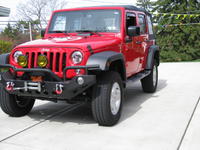
I do have a intercooler in front as well as a warn power plant but the winch does sit very low in the bumper and does not block the grill. I am surprised that I am having the overheating as I added the griffin radiator last year and ran this same set up without any problems but this year something has changed.
The other odd thing is that when I really push the motor with hard accelerations and high rpms it does not over heat. It is more at the 2200 rpm constant load on the highway which leaves me around 70 MPH
I do have a intercooler in front as well as a warn power plant but the winch does sit very low in the bumper and does not block the grill. I am surprised that I am having the overheating as I added the griffin radiator last year and ran this same set up without any problems but this year something has changed.
The other odd thing is that when I really push the motor with hard accelerations and high rpms it does not over heat. It is more at the 2200 rpm constant load on the highway which leaves me around 70 MPH
Trending Topics
JK Enthusiast
Joined: Jan 2011
Posts: 126
Likes: 1
From: pittsburgh PA.
Try adding some additive called water wetter to the rad I used it in my street rod and it dropped the temp by 20 deg. The air dam is there for a reason it helps direct air into the rad at highway speeds that's why every car has one it also smooths out the airflow under the vehicle witch gives you better gas mileage.
JK Jedi Master
Joined: Feb 2008
Posts: 12,907
Likes: 185
From: Maine
Thank you all
I do have a intercooler in front as well as a warn power plant but the winch does sit very low in the bumper and does not block the grill. I am surprised that I am having the overheating as I added the griffin radiator last year and ran this same set up without any problems but this year something has changed.
The other odd thing is that when I really push the motor with hard accelerations and high rpms it does not over heat. It is more at the 2200 rpm constant load on the highway which leaves me around 70 MPH
I do have a intercooler in front as well as a warn power plant but the winch does sit very low in the bumper and does not block the grill. I am surprised that I am having the overheating as I added the griffin radiator last year and ran this same set up without any problems but this year something has changed.
The other odd thing is that when I really push the motor with hard accelerations and high rpms it does not over heat. It is more at the 2200 rpm constant load on the highway which leaves me around 70 MPH
The problem has to be turbulent air flow, or insufficient air flow, through the radiator, at speed.
All the things you have going on in front of the radiator contribute to that.
Removing the air dam raises the pressure in the engine bay; also a contributing factor.
Is there any chance you have some mud/debris in the radiator fins?
Thread Starter
JK Enthusiast
Joined: Nov 2007
Posts: 291
Likes: 0
From: Brooklyn, NY
You are ok at idle, which means the fan comes on, pulling air through the radiator. This also indicates the temp sensor and thermostat are ok.
The problem has to be turbulent air flow, or insufficient air flow, through the radiator, at speed.
All the things you have going on in front of the radiator contribute to that.
Removing the air dam raises the pressure in the engine bay; also a contributing factor.
Is there any chance you have some mud/debris in the radiator fins?
The problem has to be turbulent air flow, or insufficient air flow, through the radiator, at speed.
All the things you have going on in front of the radiator contribute to that.
Removing the air dam raises the pressure in the engine bay; also a contributing factor.
Is there any chance you have some mud/debris in the radiator fins?
Thank you again for your help. I have no mud in the fins. so it must be air flow. I have two questions through. First, does having the aev hood etc help with the pressure problem you suggested or should I go back to the stock hood. Second, if I take the intercooler out and there is nothing infront and the problem still exists what solutions are there?