


How can I slow down my Lange electrical hardtop hoist?


JK Freak
Joined: Feb 2012
Posts: 684
Likes: 0
From: Chicago, IL

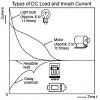
You are correct, UL does list the intended device function in the scope of test. However it does not charecterize the load condition, so lets look at which is actually a worse load at initial start up (bulb versus motor). As you can see be the attached graphic the initial inrush current of the light bulb is actuall slightly greater than that of the motor (when normalized to % of rating for each). Yes this graphic is a general representation and not actual data based on the specific devices in this thread, but it does show that we are not talking about crazy differences in expected load conditions at start up.
So how about we call for a treaty on the subject, you are correct that the dimmer is not originally intended to control a motor. I am just simply taking the position that in the correct operating conditions it is safe to control a small hoist motor using a dimmer, and that many DIY guys have been doing it for years.
Note to OP, always investigate the motor rating versus the dimmer rating to ensure you have a level of confidence that you do not feel you are putting your home at risk. I had no intentions to imply that saftey should be ignored.
So how about we call for a treaty on the subject, you are correct that the dimmer is not originally intended to control a motor. I am just simply taking the position that in the correct operating conditions it is safe to control a small hoist motor using a dimmer, and that many DIY guys have been doing it for years.
Note to OP, always investigate the motor rating versus the dimmer rating to ensure you have a level of confidence that you do not feel you are putting your home at risk. I had no intentions to imply that saftey should be ignored.
Last edited by JKbender; Jul 27, 2012 at 06:23 AM.

JK Enthusiast
Joined: Nov 2010
Posts: 185
Likes: 0
From: saskatchewan
While the dimmer might work its just not the proper application. You need a VFD (variable frequency drive). Used on electrical motors mostly in high amp draw scenarios as an energy saver they have the ability to slow a motor down by changing the frequency of electricity it is receiving. The ones I deal with are way out of your price range and 208/230v and up. But I know you can get them in 110v. A quick google tells me people use em on drill presses in there garage.... Pretty similar application no? That step less speed controller you linked in your first post may be what you need. Seems like that dial on the front would be to adjust your outgoing frequency to the motor hence being step less.
Using the dimmer will lessen the life of your motor. While the motor is internally protected thermally, which would directly relate to your amp draw you will be introducing the motor windings to condition closer to its LRA due to the improper application o the dimmer.
Using the dimmer will lessen the life of your motor. While the motor is internally protected thermally, which would directly relate to your amp draw you will be introducing the motor windings to condition closer to its LRA due to the improper application o the dimmer.
JK Jedi
Joined: Apr 2010
Posts: 4,468
Likes: 221
From: SE Michigan
You are correct, UL does list the intended device function in the scope of test. However it does not charecterize the load condition, so lets look at which is actually a worse load at initial start up (bulb versus motor). As you can see be the attached graphic the initial inrush current of the light bulb is actuall slightly greater than that of the motor (when normalized to % of rating for each). Yes this graphic is a general representation and not actual data based on the specific devices in this thread, but it does show that we are not talking about crazy differences in expected load conditions at start up.
So how about we call for a treaty on the subject, you are correct that the dimmer is not originally intended to control a motor. I am just simply taking the position that in the correct operating conditions it is safe to control a small hoist motor using a dimmer, and that many DIY guys have been doing it for years.
Note to OP, always investigate the motor rating versus the dimmer rating to ensure you have a level of confidence that you do not feel you are putting your home at risk. I had no intentions to imply that saftey should be ignored.
Attachment 346191
So how about we call for a treaty on the subject, you are correct that the dimmer is not originally intended to control a motor. I am just simply taking the position that in the correct operating conditions it is safe to control a small hoist motor using a dimmer, and that many DIY guys have been doing it for years.
Note to OP, always investigate the motor rating versus the dimmer rating to ensure you have a level of confidence that you do not feel you are putting your home at risk. I had no intentions to imply that saftey should be ignored.
Attachment 346191

You really weren't trying to convince me that the in rush current of a motor with a 200 lb weight load is less than a light bulb filament, were you?
 There's a reason the wire wrapped around the armature of a motor is much thicker than a light bulb filament and everyone tends to know why thicker wire is needed when it comes to current draw.
 I'm down with the treaty, it just seemed you were criticizing crazymike for giving some practical advise and then in the end you came around full circle and are now saying the same thing he outlined.

Last edited by Rednroll; Jul 27, 2012 at 09:28 AM.

JK Enthusiast
Joined: May 2011
Posts: 135
Likes: 0
From: Toronto, Ontario
Im sure you could use a light dimmer and it might not catch fire. But for the sake of a few dollars, I don't see why.
Not only that. But the proper device comes in a self contained, sealed enclosure.
There's lots of ways to jury rig this and that, but when you can do it proper, why bother?
Not only that. But the proper device comes in a self contained, sealed enclosure.
There's lots of ways to jury rig this and that, but when you can do it proper, why bother?