


AEV Lift - Shock Relocation


JK-Forum Founder
Joined: Jul 2006
Posts: 36,534
Likes: 16
From: Laguna Niguel, CA

Never doubted you WOL, but you must take into account that you have a strong influence over the forum members including myself and eventhough you have good intentions lending us your experience and knowledge others may not view it that way, so my point is that businesses may thrive or die depending on your critque of a product, thus to even the playing field in this case AEVs racional was needed and we got it thanks to Mike_Engle. Now, anyone who wishes to purchase an AEV lift kit is well informed. That is what makes this forum great. Thanks WOL!
Although I must say that Teraflex is better, but hey that my poragative. LOL!
Although I must say that Teraflex is better, but hey that my poragative. LOL!
 you are joking right? honestly, i'm just an average everyday normal guy who's passionate about jeeps and you're kidding yourself if you really think that anything i say can cause a business to "thrive or die". in spite of what you seem to have convinced yourself of, I WAS NOT offering a "critque" of anything but rather, answering a question and answering it based on my experience. likewise, IF what i say has any influence over anyone, i would hope that it's because people know that the information i provide comes from experience and nothing else. as far as the need for this company to offer up it's racional, i fail to see how it was needed or how it made any difference especially when they essentially confirmed what i was stating all along and i should add, that they are in fact developing a solution similar to what i posted way back on post #9. IF they had stated something that contradicted what i have stated or defended what they are using now and to the point of scoffing at the idea of developing anything else - well then, i might see where you are coming from but as you know, that has not been the case.
So I was noticing that AEV and Currie both move the shocks out to clear the frame, and both of them mount the shocks with the body near the axle. Everyone else doesn't relocate the shocks, but mounts the shock with the body against the frame. Is there any advantage to mounting them one way over the other?

JK Junkie
Joined: May 2007
Posts: 2,262
Likes: 1
From: Des Moines, Iowa
Currie actually is using the bracket in the front, from your write up (and in the rear):
These are the only two systems I knew of that did this, and they both had the shocks mounted can side down, so I thought it must have something to do with the way the shock was mounted, or if it was the amount of travel in the system. I am by no means an expert so this is why I was asking since it seemed these are the only two kits designed this way, and the shocks are mounted in the same manner. I haven't seen anyone with the AEV kit yet to compare the amount of travel relative to the Currie, so it may be the amount of travel / articulation in the kit since that is where AEV said it was hitting the frame, and it appears that maybe Currie had a similar issue with their suspension.
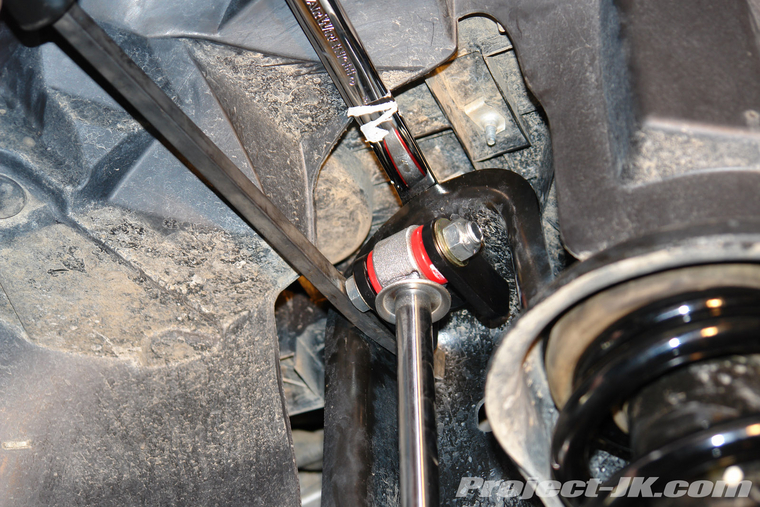
53. Install the Currie Rock Jock front shock relocation bracket so that the stud end goes up through your Jeep JK Wrangler’s shock tower and so that the "L" shaped sides with the mounting holes extend outward. Secure the bracket in place using the 5/8" nyloc nut and washer. You will need a 1" GearWrench to fasten this nut as well as a pry bar to keep the bracket from spinning.
JK-Forum Founder
Joined: Jul 2006
Posts: 36,534
Likes: 16
From: Laguna Niguel, CA
Currie actually is using the bracket in the front, from your write up (and in the rear):
These are the only two systems I knew of that did this, and they both had the shocks mounted can side down, so I thought it must have something to do with the way the shock was mounted, or if it was the amount of travel in the system. I am by no means an expert so this is why I was asking since it seemed these are the only two kits designed this way, and the shocks are mounted in the same manner.
These are the only two systems I knew of that did this, and they both had the shocks mounted can side down, so I thought it must have something to do with the way the shock was mounted, or if it was the amount of travel in the system. I am by no means an expert so this is why I was asking since it seemed these are the only two kits designed this way, and the shocks are mounted in the same manner.
I haven't seen anyone with the AEV kit yet to compare the amount of travel relative to the Currie, so it may be the amount of travel / articulation in the kit since that is where AEV said it was hitting the frame, and it appears that maybe Currie had a similar issue with their suspension
Last edited by wayoflife; Dec 2, 2008 at 07:04 AM.

JK-Forum Founder
Joined: Jul 2006
Posts: 36,534
Likes: 16
From: Laguna Niguel, CA
There are actually three systems out there, to my knowledge, that use this type of set-up. One uses a double shear bracket, which they say is overkill, but none the less they use it. Another who says the same thing and is in the process of designing a double shear bracket which they say is not really needed and is overkill but none the less will include it in their kits as well. The last company(Currie) does not use a double shear bracket because they fell it is not needed and to my knowledge they have not designed one for the rear lower shock mounts, Yet, but if I was a betting man, I would bet the answer would be the same as what Jim from AEV/Nth said: "...the cantilevered version we're using currently does fine."
have you not read anything posted on this thread let alone the ORIGINAL QUESTION that the OP asked? because, so far as i know, whether or not this cantilevered setup "does fine" was never the question. specifically, the question asked was..."would this put more stress on the stock bracket and risk breaking?"
and, i stand by my original answer that yes, more stress would be placed on the factory mount and yes, there is a very real potential risk of breaking it. there really is no two ways about it. so it's clear to everyone, we are not talking about a static load being placed on this cantilevered mount but rather, a load that pushes and pulls on it and on a regular basis and with great force. because this bolt on mount is cantilevered, it WILL leverage the factoy mount more and in a way that the factory mount was not designed to handle. you ever bend a paper clip back and forth for a minute or so? do you know what ultimately happens to it? now, i'm not say that this WILL happen to your factory mount using this cantilevered setup but you are kidding yourself if you or any guy who calls himself an engineer would try to suggest that these forces would not be at play. IF a break were to occur, it would not be immediate but rather, over time and depending on use. sure, your guy said that they have tested this setup "on several JK testers that I've had running around this way (and 'wheeling hard) for nearly two years now with no issues" and for whatever it's worth, i don't doubt it. but once again, there being any issues in a supposed two years of testing and "wheeling hard" was never the question. however, the question YOU should be asking is, IF this setup really "does fine", why bother giving it a 2nd look? why try to develop anything more? the very fact that this company is now pursuing a reinforced double sheer mount only proves what i have been saying all along.

and here is the discription, which sounds oddly the same as AEV/Nth's reasoning to move the shock outboard from the OE mount:
"Description: This is the rear shock relocator kit out of the RockJock® JK off road suspension system. Kit includes spacers that fit in original shock location, all necessary grade 8 hardware to relocate the shocks outboard of the original mounts, and complete instructions. Sold as a pair of relocators."
"Description: This is the rear shock relocator kit out of the RockJock® JK off road suspension system. Kit includes spacers that fit in original shock location, all necessary grade 8 hardware to relocate the shocks outboard of the original mounts, and complete instructions. Sold as a pair of relocators."

I don't see the difference with doing this with the front lower shock mounts (ala AEV/Nth) or the rear lower shock mounts (ala Currie). A cantilever is a cantilever is a cantilever is a cantilever, no matter what dia. the shock body is, right?
If I was a betting man, I would bet Currie had the same problem AEV/Nth had but on the oppisite end and chose to stay with the cantilevered design because it was/is working fine for them as well and feel overkill is not needed.
Last edited by wayoflife; Dec 2, 2008 at 10:41 AM.

JK Jedi
Joined: Sep 2006
Posts: 5,567
Likes: 1
From: So. Cal.


JK Freak
Joined: Oct 2008
Posts: 974
Likes: 0
From: Canisteo, NY
It's simple high school physics. A lever is a tool that makes a job easier. You add a lever and there is more force applied than when you didn't have a lever. So the cantilever system DOES place more force on the oem shock mounts. Believe whatever you want, but it's simple high school physics.
The OP asked if it put more stress on the stock brackets. YES. Plain and simple that's all there is to it. Can the stock brackets handle it???? Who knows. They have done their testing and they say that it can. It's up to you to decide if you want to trust what they say.
Idea: If you want the kit and don't like the way they set up the shock relocation, just put the lift on and install the new shocks in the stock location. (ie. without the cantilever setup)
The OP asked if it put more stress on the stock brackets. YES. Plain and simple that's all there is to it. Can the stock brackets handle it???? Who knows. They have done their testing and they say that it can. It's up to you to decide if you want to trust what they say.
Idea: If you want the kit and don't like the way they set up the shock relocation, just put the lift on and install the new shocks in the stock location. (ie. without the cantilever setup)


JK Junkie
Joined: May 2007
Posts: 2,262
Likes: 1
From: Des Moines, Iowa
I was going through the old photos, and at EJS in 2007 they were running this same set up on the All J Products Jeep. They would probably be able to tell you how this is holding up if someone wants to call or stop by while in Big Bear, CA. In all it looks like the only thing missing between the production kit and the kit shown in 07 is the rear stinger, and the exended brake lines.
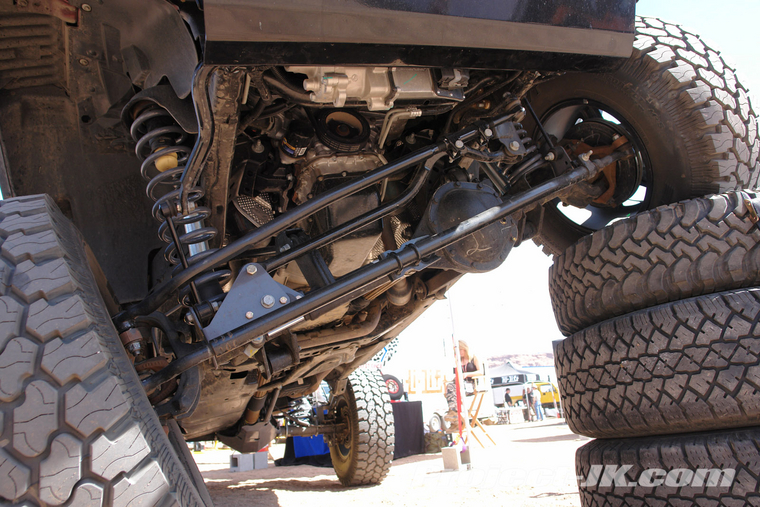
Good picture of the front steering kit, virtually unchanged between then and now(look at the paralellness between the track bar, and the drag link).
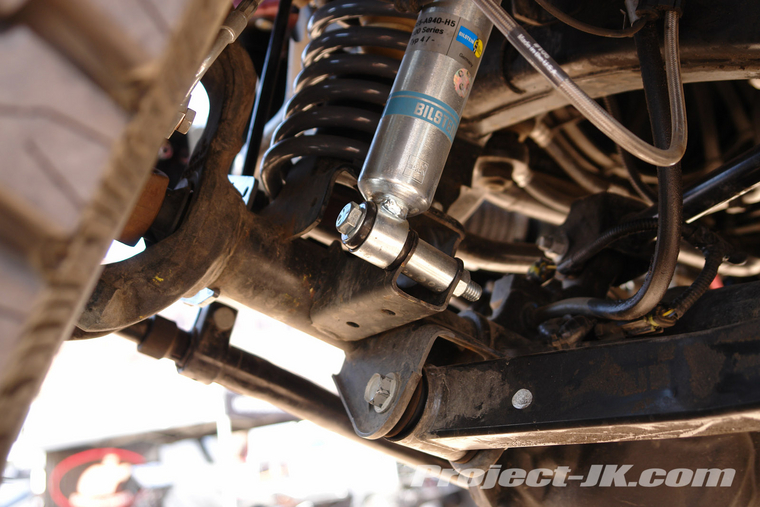
A better picture of the mount in question being flexed out.
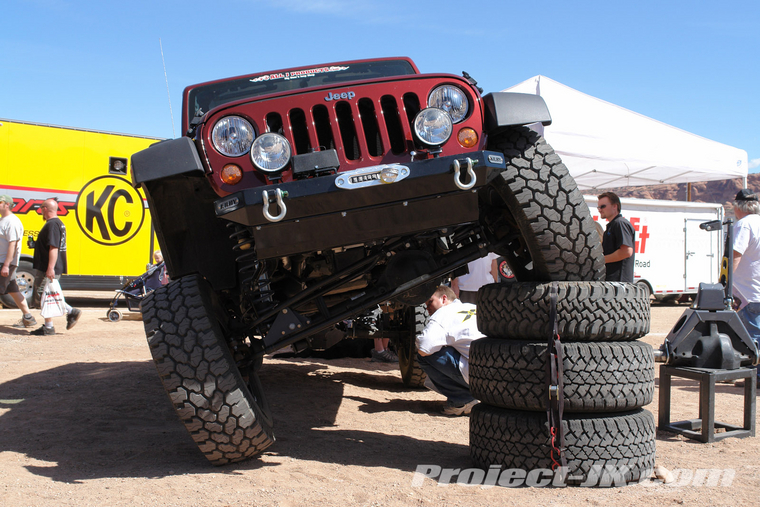
And finally a picture showing the amount of flex available with stock controll arms.
Here is a link to the full gallery.
Good picture of the front steering kit, virtually unchanged between then and now(look at the paralellness between the track bar, and the drag link).
A better picture of the mount in question being flexed out.
And finally a picture showing the amount of flex available with stock controll arms.
Here is a link to the full gallery.