


Air Pressure 33's


JK Enthusiast
Joined: Sep 2010
Posts: 163
Likes: 3
From: Winter Haven, FL

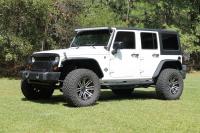
I'm running 33x12.50r18 Toyo Open Country MTs on my 2015 JKU. Smittybilt front and rear bumpers with a winch. I chalk tested them at 29 psi hot, which works out to be about 25 psi cold. They handle and wear really well with 90% on road use.

JK Junkie


Joined: Nov 2011
Posts: 2,199
Likes: 218
From: Over the hill

I run ~30 PSI cold with 285/70-17. Note that the pressure changes with the heat generated from driving, ambient temperature, and altitude.
Another crude empirical method besides chalking is measuring the air pressure rise from driving. For ~30 PSI I'm expecting about a 3 PSI rise (and for 80 PSI I would expect ~7 PSI rise). For best accuracy, testing needs to be done at night, or on a cloudy day, after sitting for several hours outdoors at a stable temperature. First step is setting all tires to the same pressure, including the spare tire. Drive at highway speeds (~65 MPH) for at least 30 minutes, stop, and immediately check tire pressures -- Then compare the running tires with the spare tire. Using the spare as a reference should cancel out changes in altitude, barometric pressure, and most of the ambient temperature change. If the pressure rise is too much, it means the tire is under inflated -- And too little rise means over inflated.
It's based on the absolute pressure in the tire and a certain amount of absolute temperature rise due to the proper flexing of a tire. Wish I could find the original write-up, vaguely remember it was from a tire engineer on a forum. Used it for years, seems to work as long as the pressure gauge reads accurately in at least 1 psi divisions.

Another crude empirical method besides chalking is measuring the air pressure rise from driving. For ~30 PSI I'm expecting about a 3 PSI rise (and for 80 PSI I would expect ~7 PSI rise). For best accuracy, testing needs to be done at night, or on a cloudy day, after sitting for several hours outdoors at a stable temperature. First step is setting all tires to the same pressure, including the spare tire. Drive at highway speeds (~65 MPH) for at least 30 minutes, stop, and immediately check tire pressures -- Then compare the running tires with the spare tire. Using the spare as a reference should cancel out changes in altitude, barometric pressure, and most of the ambient temperature change. If the pressure rise is too much, it means the tire is under inflated -- And too little rise means over inflated.
It's based on the absolute pressure in the tire and a certain amount of absolute temperature rise due to the proper flexing of a tire. Wish I could find the original write-up, vaguely remember it was from a tire engineer on a forum. Used it for years, seems to work as long as the pressure gauge reads accurately in at least 1 psi divisions.
Last edited by Mr.T; Nov 4, 2018 at 04:53 PM.

JK Newbie
Joined: Mar 2018
Posts: 12
Likes: 1
From: Jacksonville Beach, FL
I run the 285/70/17 NRG's and we were visiting near where the OP lives a few weeks ago and was running with 30 psi for the drive up from FL. The temps fell into the 20's overnight and that set 2 of the TPMS off when they got below 28 psi the next morning. Not a big deal but a hassle to stop, air up and reset. Might want to consider a winter/summer variance in your area.
