


Caster correction on 2.5" lift

Thread Starter
JK Enthusiast
Joined: Jan 2016
Posts: 111
Likes: 0
From: Redlands, Ca
 Caster correction on 2.5" lift
so i thought i had it all planned out. install 2.5" BB or coil lift and done. Nope after noseying around i seem to find that things tend to snowball when one "messes" with OEM.
#1 i see i MAY need exhaust spacers. really depends on my particular findings to specific to MY jeep and also depends on how far my shocks will allow to droop.
#2 i MAY end up with my axles tilting inward towards center of jeep. front axle moved to toward rear, rear axle moved toward front. Ie Caster changes
Anyhow, in terms of inches, with a 2.5" lift whether BB or coil, how noticeable is this "move/axle shift" ? in regards to 4door JKU. what alarmed me to this was a post on this forum and that rear axle on a 2 door was shifted forward ALOT.
I had always noticed that many 2 door jeeps looked like the rear axle was way toooo forward and never thought much about it till now, and also used to think why would Jeep manufacturing do this. Apparently its mostly due to the lift and not so much that jeep built them that way.
so, how bad will my 4 door JKU look in terms of inches of the axles being shifted? again ill mention all 2 doors ive seen have the rear axle slammed toward the front of the fender well. 4 door JKU's i havent noticed having this visual nastiness. IMO.
also what is the easiest budget freindly way of resolving caster issues? drop brackets? upper/lower control arms? other?
#1 i see i MAY need exhaust spacers. really depends on my particular findings to specific to MY jeep and also depends on how far my shocks will allow to droop.
#2 i MAY end up with my axles tilting inward towards center of jeep. front axle moved to toward rear, rear axle moved toward front. Ie Caster changes
Anyhow, in terms of inches, with a 2.5" lift whether BB or coil, how noticeable is this "move/axle shift" ? in regards to 4door JKU. what alarmed me to this was a post on this forum and that rear axle on a 2 door was shifted forward ALOT.
I had always noticed that many 2 door jeeps looked like the rear axle was way toooo forward and never thought much about it till now, and also used to think why would Jeep manufacturing do this. Apparently its mostly due to the lift and not so much that jeep built them that way.
so, how bad will my 4 door JKU look in terms of inches of the axles being shifted? again ill mention all 2 doors ive seen have the rear axle slammed toward the front of the fender well. 4 door JKU's i havent noticed having this visual nastiness. IMO.
also what is the easiest budget freindly way of resolving caster issues? drop brackets? upper/lower control arms? other?
JK Jedi
Joined: Apr 2010
Posts: 4,468
Likes: 221
From: SE Michigan
Caster Correction options
I'm no expert, but have done some research to figure out my options as well. I learned just like you, it's not as easy as just slapping on a lift and being done. If you want it done right (which we all do), then there are other things that need to be considered since the leg bone connects to the foot bone, and the foot bone connects to the toe bone and when you alter one then all the rest get impacted in some manner.
Caster Correction Options (plus/minuses):
1. Cam Bolts <$5 (Very Inexpensive, allow caster adjustment, does not reduce ground clearance/Causes damage that needs additional parts to fix if you later choose to upgrade to a higher height or use another solution, Not very robust damage on rocks, tend to loose adjustment).
2. Relocation Brackets $100+ (Better solution that eliminates minuses of Cam bolts, mid-price economical solution, adjustable for lift upgrade/Reduces ground clearance by about 1in, can be damaged on rocks).
3. Fixed Lower Control Arm replacements $200+(Improved solution over Relo Brackets, does not lose ground clearance, does not lose caster adjustment/ expensive cost at least 2X as relo brackets, no caster adjustment will need to replace if upgrade/raise lift in future).
4. Adjustable Lower Control Arm replacements $300+ (Same pluses as fixed LCA, allows caster adjustment, can be further adjusted if upgrade lift/ Most costly solution).
5. Adjustable Upper Control Arm replacements $150+ (Slightly lower cost than LCA replacement/Limited adjustment capabilities, likely can't be used if upgrade lift in the future.)
Right now I'm debating between using AEV or Rubicon Express correction brackets ($100) or going with a cheaper adjustable Lower Control arm such as the Rough Country adjustable LCA ($200-$250).
Caster Correction Options (plus/minuses):
1. Cam Bolts <$5 (Very Inexpensive, allow caster adjustment, does not reduce ground clearance/Causes damage that needs additional parts to fix if you later choose to upgrade to a higher height or use another solution, Not very robust damage on rocks, tend to loose adjustment).
2. Relocation Brackets $100+ (Better solution that eliminates minuses of Cam bolts, mid-price economical solution, adjustable for lift upgrade/Reduces ground clearance by about 1in, can be damaged on rocks).
3. Fixed Lower Control Arm replacements $200+(Improved solution over Relo Brackets, does not lose ground clearance, does not lose caster adjustment/ expensive cost at least 2X as relo brackets, no caster adjustment will need to replace if upgrade/raise lift in future).
4. Adjustable Lower Control Arm replacements $300+ (Same pluses as fixed LCA, allows caster adjustment, can be further adjusted if upgrade lift/ Most costly solution).
5. Adjustable Upper Control Arm replacements $150+ (Slightly lower cost than LCA replacement/Limited adjustment capabilities, likely can't be used if upgrade lift in the future.)
Right now I'm debating between using AEV or Rubicon Express correction brackets ($100) or going with a cheaper adjustable Lower Control arm such as the Rough Country adjustable LCA ($200-$250).
Last edited by Rednroll; May 26, 2016 at 01:57 PM.

JK Junkie
Joined: Nov 2013
Posts: 3,703
Likes: 8
From: The Dirty South
so i thought i had it all planned out. install 2.5" BB or coil lift and done. Nope after noseying around i seem to find that things tend to snowball when one "messes" with OEM.
#1 i see i MAY need exhaust spacers. really depends on my particular findings to specific to MY jeep and also depends on how far my shocks will allow to droop.
#2 i MAY end up with my axles tilting inward towards center of jeep. front axle moved to toward rear, rear axle moved toward front. Ie Caster changes
Anyhow, in terms of inches, with a 2.5" lift whether BB or coil, how noticeable is this "move/axle shift" ? in regards to 4door JKU. what alarmed me to this was a post on this forum and that rear axle on a 2 door was shifted forward ALOT.
I had always noticed that many 2 door jeeps looked like the rear axle was way toooo forward and never thought much about it till now, and also used to think why would Jeep manufacturing do this. Apparently its mostly due to the lift and not so much that jeep built them that way.
so, how bad will my 4 door JKU look in terms of inches of the axles being shifted? again ill mention all 2 doors ive seen have the rear axle slammed toward the front of the fender well. 4 door JKU's i havent noticed having this visual nastiness. IMO.
also what is the easiest budget freindly way of resolving caster issues? drop brackets? upper/lower control arms? other?
#1 i see i MAY need exhaust spacers. really depends on my particular findings to specific to MY jeep and also depends on how far my shocks will allow to droop.
#2 i MAY end up with my axles tilting inward towards center of jeep. front axle moved to toward rear, rear axle moved toward front. Ie Caster changes
Anyhow, in terms of inches, with a 2.5" lift whether BB or coil, how noticeable is this "move/axle shift" ? in regards to 4door JKU. what alarmed me to this was a post on this forum and that rear axle on a 2 door was shifted forward ALOT.
I had always noticed that many 2 door jeeps looked like the rear axle was way toooo forward and never thought much about it till now, and also used to think why would Jeep manufacturing do this. Apparently its mostly due to the lift and not so much that jeep built them that way.
so, how bad will my 4 door JKU look in terms of inches of the axles being shifted? again ill mention all 2 doors ive seen have the rear axle slammed toward the front of the fender well. 4 door JKU's i havent noticed having this visual nastiness. IMO.
also what is the easiest budget freindly way of resolving caster issues? drop brackets? upper/lower control arms? other?
Exactly what happens? Well the control arms are attached to the frame and the axles. The control arm frame side attachment is closer to the passenger compartment, both front and rear. Therefore, as the Jeep rises the arms draw the axles closer to the passenger compartment as they swing down in an arc. Think of it as putting your rig on a lift and raising it up with no limitations to prevent the axles from full droop. The axles, guided by gravity, would drop to a 90 degree angle in an arc from the frame toward the tub. Obviously, that is a shorter wheel base than ride height. But it also affects roll center, caster/pinion in the front, and pinion in the rear. In the front the sum of the caster and pinion is 6 degrees. Factory is around 4.2 caster. So 6 minus 4.2 equals 1.8 degrees of pinion. So as the front axle droops it raises the pinion which as a result reduces the caster. This can lead to flightiness when driving. Typical caster adjustment after lifting can be as high as 5 degrees for a proper ride.To correct the caster you can use either drop brackets or adjustable control arms. The biggest drawback of the drop brackets is loss of clearance. If that is not a concern then that is the cheapest option. The control arm drop brackets lower the frame side attachment points approximately as much as you have lifted returning the control arms to near stock position, including its positioning in the wheel well. In the rear, however, you will have the wheels misaligned with the wheel wells as you said you commonly see unless you get the adjustable control arms. Not correcting the rear pinion may lead to vibrations and shortened drive shaft life, though especially on a 2 door.
I chose to go with adjustable control arms all around. They allow you to restore the wheel base at ride height with the lowers and set the pinion with the uppers. But a side effect of "stretching" the wheel base is as it compress (stuffs) the wheel into the wheel well, it can rub quicker as it is no longer centered when stuffed. This is why you need bump stops. The bigger the tires and the more your shocks/coils can compress the more you will need bump stops as well. My kit included bump stops in 1" increments which can be stacked from 1" to 4". Mine are perfect front and rear at 2".
Now the track bar is also attached to the frame and the axle. So again, as the Jeep rises the axle will shift side-to-side toward the frame attachment. This is the left (driver side on LHD) on the front and right on the rear. This will be apparent as the wheel to flare position will be different on each side of the axle. An adjustable track bar allows you to recenter the axle, side-to-side, at ride height.
The roll center is also affected. The roll center is the point at which the Jeep pivots on a front to rear axis when off camber. Lifting the Jeep without addressing the roll center makes it more susceptible to rollovers. Better kits address that by raising the rear track bar with an axle side bracket which in turn raises the roll center.
So lift kits give you lift. The cheaper options are cheaper because they leave out components. How much you need the components is based a lot on how you plan to use your rig and your concern for ride quality. My kit came with coils, shocks, 8 adjustable control arms, two adjustable track bars, rear axle side track bar bracket, bumps, extended brake lines, longer rear sway bar links, and longer front sway bar links which were also quick disconnects. Separately, I purchased a cam bolt eliminator kit and a full shoulder suspension bolt kit.
As far as exhaust spacers, if your kit increases droop (your shocks are the limiting factor on that unless you have limit straps) you need to make sure the driveshaft boot doesn't make contact with the exhaust system, specifically the crossover. The exhaust spacers will push the exhaust back a bit but also drop the exhaust at the same time. Again, a clearance issue. If that is not a concern then that should work fine for you. I was concerned so I had a muffler shop move my exhaust crossover straight back a couple of inches. As a result, I did not loose clearance.
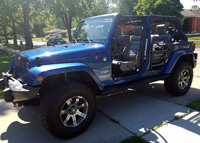
Again, I'm not an expert. All my Jeep ever sees is forest roads. This is just what worked for me. And as you can see, my rear wheels do not look too far forward thanks to the adjustable rear lower control arms. I'm sure the experts will chime in and when they do, I hope I am at least close.

Last edited by 14Sport; May 27, 2016 at 10:25 AM.
JK Junkie
Joined: Nov 2013
Posts: 3,703
Likes: 8
From: The Dirty South
I'm no expert, but have done some research to figure out my options as well. I learned just like you, it's not as easy as just slapping on a lift and being done. If you want it done right (which we all do), then there are other things that need to be considered since the leg gone connects to the foot bone, and the foot bone connects to the toe bone and when you alter one then all the rest get impacted in some manner.
Caster Correction Options (plus/minuses):
1. Cam Bolts <$5 (Very Inexpensive, allow caster adjustment, does not reduce ground clearance/Causes damage that needs additional parts to fix if you later choose to upgrade to a higher height or use another solution, Not very robust damage on rocks, tend to loose adjustment).
2. Relocation Brackets $100+ (Better solution that eliminates minuses of Cam bolts, mid-price economical solution, adjustable for lift upgrade/Reduces ground clearance by about 1in, can be damaged on rocks).
3. Fixed Lower Control Arm replacements $200+(Improved solution over Relo Brackets, does not lose ground clearance, does not lose caster adjustment/ expensive cost at least 2X as relo brackets, no caster adjustment will need to replace if upgrade/raise lift in future).
4. Adjustable Lower Control Arm replacements $300+ (Same pluses as fixed LCA, allows caster adjustment, can be further adjusted if upgrade lift/ Most costly solution).
5. Adjustable Upper Control Arm replacements $150+ (Slightly lower cost than LCA replacement/Limited adjustment capabilities, likely can't be used if upgrade lift in the future.)
Right now I'm debating between using AEV or Rubicon Express correction brackets ($100) or going with a cheaper adjustable Lower Control arm such as the Rough Country adjustable LCA ($200-$250).
Caster Correction Options (plus/minuses):
1. Cam Bolts <$5 (Very Inexpensive, allow caster adjustment, does not reduce ground clearance/Causes damage that needs additional parts to fix if you later choose to upgrade to a higher height or use another solution, Not very robust damage on rocks, tend to loose adjustment).
2. Relocation Brackets $100+ (Better solution that eliminates minuses of Cam bolts, mid-price economical solution, adjustable for lift upgrade/Reduces ground clearance by about 1in, can be damaged on rocks).
3. Fixed Lower Control Arm replacements $200+(Improved solution over Relo Brackets, does not lose ground clearance, does not lose caster adjustment/ expensive cost at least 2X as relo brackets, no caster adjustment will need to replace if upgrade/raise lift in future).
4. Adjustable Lower Control Arm replacements $300+ (Same pluses as fixed LCA, allows caster adjustment, can be further adjusted if upgrade lift/ Most costly solution).
5. Adjustable Upper Control Arm replacements $150+ (Slightly lower cost than LCA replacement/Limited adjustment capabilities, likely can't be used if upgrade lift in the future.)
Right now I'm debating between using AEV or Rubicon Express correction brackets ($100) or going with a cheaper adjustable Lower Control arm such as the Rough Country adjustable LCA ($200-$250).
JK Jedi
Joined: Apr 2010
Posts: 4,468
Likes: 221
From: SE Michigan
Another thing you will likely need to take into consideration when installing a lift are a potential need for wheel spacers/adapters. This will depend on the wheels you go with. Stock wheels which have 6.5in back spacing are likely to rub after installing most lifts. A <5in of backspacing wheel is typically recommended for most lifts.
Thread Starter
JK Enthusiast
Joined: Jan 2016
Posts: 111
Likes: 0
From: Redlands, Ca
...
1. Cam Bolts <$5 (Very Inexpensive, allow caster adjustment, does not reduce ground clearance/Causes damage that needs additional parts to fix if you later choose to upgrade to a higher height or use another solution, Not very robust damage on rocks, tend to loose adjustment).
...
1. Cam Bolts <$5 (Very Inexpensive, allow caster adjustment, does not reduce ground clearance/Causes damage that needs additional parts to fix if you later choose to upgrade to a higher height or use another solution, Not very robust damage on rocks, tend to loose adjustment).
...
Thread Starter
JK Enthusiast
Joined: Jan 2016
Posts: 111
Likes: 0
From: Redlands, Ca
Were your talking about the brackets or the adjustable control arm regarding the wheel getting stuffed and rubbing? it would be off center no matter what wouldnt it? or does the adj control arm do something
Trending Topics
Thread Starter
JK Enthusiast
Joined: Jan 2016
Posts: 111
Likes: 0
From: Redlands, Ca
Another thing you will likely need to take into consideration when installing a lift are a potential need for wheel spacers/adapters. This will depend on the wheels you go with. Stock wheels which have 6.5in back spacing are likely to rub after installing most lifts. A <5in of backspacing wheel is typically recommended for most lifts.
JK Junkie
Joined: Nov 2013
Posts: 3,703
Likes: 8
From: The Dirty South
The adjustable control arms. The brackets work with the stock control arms.
JK Jedi
Joined: Apr 2010
Posts: 4,468
Likes: 221
From: SE Michigan
https://www.youtube.com/watch?v=FwY0yjWfBok