


ome installed. First pics.


JK Freak
Joined: Jan 2007
Posts: 516
Likes: 0

OK, i want to see some flexin shots of this lift. I remember the older tj OME lifts were only 2" but could flex like crazy, they usually could out flex allot of other systems on the market. I want to see if this holds true with the new jk. Come on, i want to see this thing maxed out 
i wonder how it would compare to a 3" FT lift ???
i wonder how it would compare to a 3" FT lift ???

JK Enthusiast
Joined: Jun 2007
Posts: 347
Likes: 0
From: Orlando, FL
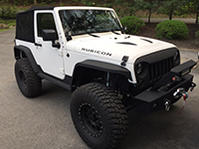
My darling wife just bought me this lift from Northridge and it is arriving Friday (early Christmas present)! Can't wait! I have 5 Procomp 8179 rims (17x9) sitting in my den. Now, all I need is the rear bumper (looking at LoD rear w/ tire carrier) and my tires (Toyo MT's 35x12.5).

JK Super Freak
Joined: Sep 2007
Posts: 1,623
Likes: 5
From: Lawrenceville, NJ

That's funny, the OME on the TJ's I wheeled with did not have as much droop due to the shocks being too short...
?
The easiest way to cross check would be to measure the stock shocks extended/compressed lengths, the 3" SL extended/compressed lengths, and compare them to the OME shock lengths.
Obviously, on a live axle suspension....the droop is all gravity after you ease off of the springs...so either the arms, or the shocks, and maybe drive train reach, are typically your limiting factors....assuming brake lines, diff breathers and what not you extend/make slack for normally, are attended to.

?
The easiest way to cross check would be to measure the stock shocks extended/compressed lengths, the 3" SL extended/compressed lengths, and compare them to the OME shock lengths.
Obviously, on a live axle suspension....the droop is all gravity after you ease off of the springs...so either the arms, or the shocks, and maybe drive train reach, are typically your limiting factors....assuming brake lines, diff breathers and what not you extend/make slack for normally, are attended to.


JK Enthusiast
Joined: Feb 2007
Posts: 199
Likes: 0
So an adjustable track bar or a track bar relocation bracket is used to add distance from the hard point bushing to the wheel. then you can push it back to proper alignment with the frame.
Another issue with lifting is that the castor angle changes. As it gets shallower it gets more "darty" or "flighty". If severe enough this can become dangerous and expensive. The added wear to suspension from always being "worked" can add up to some big bucks down the road. This gets worse with bigger tires too. The added weight etc. can make it a real bear to drive.
Some folks add an aftermarket stabilizer to beef up the dampening and this serves to hide some of that dartyness.
I don't recomend hiding such problems but rather resolving them properly.
Once everything is porperly dialed in THEN add the beefier shock as it WILL smooth out the steering's "comeback" when offroad and that will help fight fatigue on long days. The stock stabilizer is just fine for onroad and off and should not be required. But it's a cheap upgrade as its from to 40 to 60 dollars to add.
Hope this helps your understanding as I learned the hardway myself...
Last edited by LinkSync; Nov 25, 2007 at 08:14 AM.

 . Looks good on a lifted JK.

JK Enthusiast
Joined: Oct 2007
Posts: 165
Likes: 0
From: Saint Louis, MO
As the suspension is dropped down it has to rotate around the hard point of the track bar which is a fixed distance to the wheels. So what happenes is the entire suspension shifts over towards the drivers side. The bigger the lift the bigger the shift. It could all still be straight and true but wouldn't be centered under your Jeep anymore.
So an adjustable track bar or a track bar relocation bracket is used to add distance from the hard point bushing to the wheel. then you can push it back to proper alignment with the frame.
Another issue with lifting is that the castor angle changes. As it gets shallower it gets more "darty" or "flighty". If severe enough this can become dangerous and expensive. The added wear to suspension from always being "worked" can add up to some big bucks down the road. This gets worse with bigger tires too. The added weight etc. can make it a real bear to drive.
Some folks add an aftermarket stabilizer to beef up the dampening and this serves to hide some of that dartyness.
I don't recomend hiding such problems but rather resolving them properly.
Once everything is porperly dialed in THEN add the beefier shock as it WILL smooth out the steering's "comeback" when offroad and that will help fight fatigue on long days. The stock stabilizer is just fine for onroad and off and should not be required. But it's a cheap upgrade as its from to 40 to 60 dollars to add.
Hope this helps your understanding as I learned the hardway myself...
So an adjustable track bar or a track bar relocation bracket is used to add distance from the hard point bushing to the wheel. then you can push it back to proper alignment with the frame.
Another issue with lifting is that the castor angle changes. As it gets shallower it gets more "darty" or "flighty". If severe enough this can become dangerous and expensive. The added wear to suspension from always being "worked" can add up to some big bucks down the road. This gets worse with bigger tires too. The added weight etc. can make it a real bear to drive.
Some folks add an aftermarket stabilizer to beef up the dampening and this serves to hide some of that dartyness.
I don't recomend hiding such problems but rather resolving them properly.
Once everything is porperly dialed in THEN add the beefier shock as it WILL smooth out the steering's "comeback" when offroad and that will help fight fatigue on long days. The stock stabilizer is just fine for onroad and off and should not be required. But it's a cheap upgrade as its from to 40 to 60 dollars to add.
Hope this helps your understanding as I learned the hardway myself...