


Over compressing springs


JK Enthusiast
Joined: Mar 2008
Posts: 184
Likes: 1
From: VA

When you spec a coil, there are a zillion factors that are taken into account. One of them is whether or not the coil can withstand compression to full solid (all coils touching). Many manufacturers don't take that extra step and you'll find that their coils start to sag immediately following your first off road trip. The reason is that coils aren't guided, so that when the vehicle articulates the coil pukes one way or another as they compress, creating stressed areas.
There are NO hard and fast rules for determining coil compression. It depends entirely on the intention of the engineer. I worked for a company that made coils for Land Rovers that could withstand full solid compression and still return to set height. Others brands were less tolerant and would sag quickly. But when we spec'd the coil we did so with the intention of making them indestructible -- and of course they cost more.
Redneck Jeep's knuckle rule works, but doesn't guarantee maximum performance, as you might be wasting some up travel.
There are NO hard and fast rules for determining coil compression. It depends entirely on the intention of the engineer. I worked for a company that made coils for Land Rovers that could withstand full solid compression and still return to set height. Others brands were less tolerant and would sag quickly. But when we spec'd the coil we did so with the intention of making them indestructible -- and of course they cost more.
Redneck Jeep's knuckle rule works, but doesn't guarantee maximum performance, as you might be wasting some up travel.

JK Jedi Master

Joined: Jan 2008
Posts: 11,463
Likes: 165
From: Austin <--> Colorado Springs
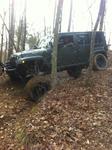
Here are OME HD's (3.25" + 3/4" spacer)
No ext Bumpstop

2" RE Lower Bumpstop

(I believe Redneck was one of the guys that said the coils are still too over-compressed and I need to add more bumpstop...)
No ext Bumpstop
2" RE Lower Bumpstop
(I believe Redneck was one of the guys that said the coils are still too over-compressed and I need to add more bumpstop...)
Last edited by nthinuf; Oct 21, 2009 at 05:01 PM.

JK-Forum Founder
Joined: Jul 2006
Posts: 36,534
Likes: 16
From: Laguna Niguel, CA
JK Jedi Master
Joined: Jan 2008
Posts: 11,463
Likes: 165
From: Austin <--> Colorado Springs
can i get setup with a set of 2 inch bottom bumpstop extensions for all the way around i just cant find anyone that has them
JK Enthusiast
Joined: Mar 2008
Posts: 184
Likes: 1
From: VA
That front coil is dead. It'll will start sagging and lose its rate.
The reason is that once you go past its engineered point of compression (or extension for that matter) the spring is fatigued. Its not an instant failure, but its past its point of return.
The reason is that once you go past its engineered point of compression (or extension for that matter) the spring is fatigued. Its not an instant failure, but its past its point of return.
JK Jedi Master
Joined: Jan 2008
Posts: 11,463
Likes: 165
From: Austin <--> Colorado Springs
So what exactly is the 'engineered point of compression' ? Since OME lifts do not come with bumpstops, I can't see the engineers 'designing' them to fail...

JK Newbie
Joined: Sep 2009
Posts: 59
Likes: 0
From: Sequim, Wa
JK Enthusiast
Joined: Mar 2008
Posts: 184
Likes: 1
From: VA
There's a point where the spring cannot return to its preset. Maybe OME has changed their manufacturing processes for their coils but full solid used to be the death of them.
Stolen from Lee Spring:
The dimensions, along with the load and deflection requirements, determine the stresses in the spring. When a compression spring is loaded, the coiled wire is stressed in torsion. The stress is greatest at the surface of the wire; as the spring is deflected, the load varies, causing a range of operating stress. Stress and stress range govern the life of the spring. The higher the stress range, the lower the maximum stress must be to obtain comparable life. Relatively high stresses may be used when the stress range is low or if the spring is subjected to static loads only. The stress at solid height must be high enough to permit presetting, yet low enough to avoid permanent damage since springs are often compressed solid during installation.
More info...
From Ace Wire Spring:
Compression Spring Stress Levels:
1. A compression spring that can be compressed solid without permanent set, so that an extra operation for removing set is not needed. These springs are designed with torsional stress levels when compressed solid that do not exceed about 40 percent of the minimum tensile strength of the material.
2. A compression spring which can be compressed solid without further permanent set after set has initially be removed. These may be pre-set by the spring manufacturer as an added operation, or they may be pre-set later by the user prior to or during the assembly operation. These are springs designed with torsional stress levels when compressed solid that do not exceed 60 percent of the minimum tensile strength of the material.
3. Springs which cannot be compressed solid without some further permanent set taking place because set cannot be completely removed in advanced. These springs involve torsional stress levels which exceed 60 percent of the minimum tensile strength of the material. The spring manufacturer will usually advise the user of the maximum allowable spring deflection without set whenever springs are specified in this category.
Basically all that mumbo jumbo boils down to some bozo in a room has to make a decision as to how much stress the spring needs to be capable of taking before it fatigues. Those factors are mitigated by cost too. In the case of the springs we used to make for Rovers, the springs were 30% more expensive in order to all for them to go to full solid without taking a set.
(EDITTED FOR CONSOLIDATION)
Stolen from Lee Spring:
The dimensions, along with the load and deflection requirements, determine the stresses in the spring. When a compression spring is loaded, the coiled wire is stressed in torsion. The stress is greatest at the surface of the wire; as the spring is deflected, the load varies, causing a range of operating stress. Stress and stress range govern the life of the spring. The higher the stress range, the lower the maximum stress must be to obtain comparable life. Relatively high stresses may be used when the stress range is low or if the spring is subjected to static loads only. The stress at solid height must be high enough to permit presetting, yet low enough to avoid permanent damage since springs are often compressed solid during installation.
More info...
From Ace Wire Spring:
Compression Spring Stress Levels:
1. A compression spring that can be compressed solid without permanent set, so that an extra operation for removing set is not needed. These springs are designed with torsional stress levels when compressed solid that do not exceed about 40 percent of the minimum tensile strength of the material.
2. A compression spring which can be compressed solid without further permanent set after set has initially be removed. These may be pre-set by the spring manufacturer as an added operation, or they may be pre-set later by the user prior to or during the assembly operation. These are springs designed with torsional stress levels when compressed solid that do not exceed 60 percent of the minimum tensile strength of the material.
3. Springs which cannot be compressed solid without some further permanent set taking place because set cannot be completely removed in advanced. These springs involve torsional stress levels which exceed 60 percent of the minimum tensile strength of the material. The spring manufacturer will usually advise the user of the maximum allowable spring deflection without set whenever springs are specified in this category.
Basically all that mumbo jumbo boils down to some bozo in a room has to make a decision as to how much stress the spring needs to be capable of taking before it fatigues. Those factors are mitigated by cost too. In the case of the springs we used to make for Rovers, the springs were 30% more expensive in order to all for them to go to full solid without taking a set.
(EDITTED FOR CONSOLIDATION)
Last edited by Sethmark; Oct 21, 2009 at 05:30 PM.