


Spacers...how safe are they?

Thread Starter
JK Enthusiast
Joined: May 2007
Posts: 252
Likes: 0
From: Orlando, Fl.
 Spacers...how safe are they?
I have a feeling I will need to invest on some spacers when I get my 35" tires. I'm planning on running a 2.5 Teraflex BB with stock 17" rims. Would I need to get a whole set (4)? Are they a pain to deal with when it comes to finding tire shops or dealerships that won't mind working around them? Are they safe enough on the highway? i guess what I'm trying to ask is...How's life with spacers?
JK Junkie
Joined: May 2009
Posts: 3,074
Likes: 1
From: Denton, TX
I have a feeling I will need to invest on some spacers when I get my 35" tires. I'm planning on running a 2.5 Teraflex BB with stock 17" rims. Would I need to get a whole set (4)? Are they a pain to deal with when it comes to finding tire shops or dealerships that won't mind working around them? Are they safe enough on the highway? i guess what I'm trying to ask is...How's life with spacers?
I have no issues with them, driven at 90mph (not very long) on them, 11,000 miles and wheeled hard on them..

JK Freak
Joined: Sep 2008
Posts: 916
Likes: 3
From: Terryville, LI, NY
I recently installed a set of 1.5" Spidertrax spacers. However, prior to doing so, I took one of them, along with my spare wheel, into our engineering lab.
We modeled both in 3D using the latest NX CAD software. We did this by reverse engineering. That means taking all dimensions and determining the materials.
We identified the wheel material as alloy 356-T6. The spacers are made from 6061-T6 alloy. 356-T6 has tensile strength of 30,000 PSI. 6061-T6 has a tensile strength of 45,000 PSI. This means that in reference to the basic materials, the spacer is 50% stronger than the wheel for a given thickness, and the spacer is much thicker in section.
We ran an extremely complex finite element analysis of both to determine where peak stresses are and where each component is most likely to fail. The result is what I expected. In short, spacers are not the weak link. The wheel itself is 2x more likely to fail under severe loading than the well designed spacer.
Now, let me qualify our findings. Our corporate engineering team has designed significant portions of the Airbus A350 landing gear system. We engineered the latest landing gear system for the Boeing CH-47. Our hardware is on the F-35, F/A-18, F-16 and a number of other aircraft.
This same engineering team has analyzed the Spirdertrax spacers and concluded that they are extremely strong, stronger than they need to be. Over engineered. These spacers are utterly safe if installed properly. Like an offset wheel, they may accelerate bearing wear, but the offset is so little as to be of no great significance.
I installed the spacers very carefully. Not knowing specifically what brand and type of threadlocker compound was provided with the spacers, I tossed it and used Loctite 271 Red. Each spacer was torqued to recommended specs in a star pattern. The wheel was then installed and torqued to 95 lb/ft.
After about 150 miles, I pulled off the rear wheels and checked the spacer lug nut torque. No change... I'll re-check torque at each tire rotation.
Installed correctly, Spidertrax wheel spacers are not only safe, they're stronger than the wheels you bolt to them.
My regards,
Widewing
We modeled both in 3D using the latest NX CAD software. We did this by reverse engineering. That means taking all dimensions and determining the materials.
We identified the wheel material as alloy 356-T6. The spacers are made from 6061-T6 alloy. 356-T6 has tensile strength of 30,000 PSI. 6061-T6 has a tensile strength of 45,000 PSI. This means that in reference to the basic materials, the spacer is 50% stronger than the wheel for a given thickness, and the spacer is much thicker in section.
We ran an extremely complex finite element analysis of both to determine where peak stresses are and where each component is most likely to fail. The result is what I expected. In short, spacers are not the weak link. The wheel itself is 2x more likely to fail under severe loading than the well designed spacer.
Now, let me qualify our findings. Our corporate engineering team has designed significant portions of the Airbus A350 landing gear system. We engineered the latest landing gear system for the Boeing CH-47. Our hardware is on the F-35, F/A-18, F-16 and a number of other aircraft.
This same engineering team has analyzed the Spirdertrax spacers and concluded that they are extremely strong, stronger than they need to be. Over engineered. These spacers are utterly safe if installed properly. Like an offset wheel, they may accelerate bearing wear, but the offset is so little as to be of no great significance.
I installed the spacers very carefully. Not knowing specifically what brand and type of threadlocker compound was provided with the spacers, I tossed it and used Loctite 271 Red. Each spacer was torqued to recommended specs in a star pattern. The wheel was then installed and torqued to 95 lb/ft.
After about 150 miles, I pulled off the rear wheels and checked the spacer lug nut torque. No change... I'll re-check torque at each tire rotation.
Installed correctly, Spidertrax wheel spacers are not only safe, they're stronger than the wheels you bolt to them.
My regards,
Widewing

JK Jedi Master
Joined: Aug 2007
Posts: 15,665
Likes: 4
From: Hammond Louisiana
I recently installed a set of 1.5" Spidertrax spacers. However, prior to doing so, I took one of them, along with my spare wheel, into our engineering lab.
We modeled both in 3D using the latest NX CAD software. We did this by reverse engineering. That means taking all dimensions and determining the materials.
We identified the wheel material as alloy 356-T6. The spacers are made from 6061-T6 alloy. 356-T6 has tensile strength of 30,000 PSI. 6061-T6 has a tensile strength of 45,000 PSI. This means that in reference to the basic materials, the spacer is 50% stronger than the wheel for a given thickness, and the spacer is much thicker in section.
We ran an extremely complex finite element analysis of both to determine where peak stresses are and where each component is most likely to fail. The result is what I expected. In short, spacers are not the weak link. The wheel itself is 2x more likely to fail under severe loading than the well designed spacer.
Now, let me qualify our findings. Our corporate engineering team has designed significant portions of the Airbus A350 landing gear system. We engineered the latest landing gear system for the Boeing CH-47. Our hardware is on the F-35, F/A-18, F-16 and a number of other aircraft.
This same engineering team has analyzed the Spirdertrax spacers and concluded that they are extremely strong, stronger than they need to be. Over engineered. These spacers are utterly safe if installed properly. Like an offset wheel, they may accelerate bearing wear, but the offset is so little as to be of no great significance.
I installed the spacers very carefully. Not knowing specifically what brand and type of threadlocker compound was provided with the spacers, I tossed it and used Loctite 271 Red. Each spacer was torqued to recommended specs in a star pattern. The wheel was then installed and torqued to 95 lb/ft.
After about 150 miles, I pulled off the rear wheels and checked the spacer lug nut torque. No change... I'll re-check torque at each tire rotation.
Installed correctly, Spidertrax wheel spacers are not only safe, they're stronger than the wheels you bolt to them.
My regards,
Widewing
We modeled both in 3D using the latest NX CAD software. We did this by reverse engineering. That means taking all dimensions and determining the materials.
We identified the wheel material as alloy 356-T6. The spacers are made from 6061-T6 alloy. 356-T6 has tensile strength of 30,000 PSI. 6061-T6 has a tensile strength of 45,000 PSI. This means that in reference to the basic materials, the spacer is 50% stronger than the wheel for a given thickness, and the spacer is much thicker in section.
We ran an extremely complex finite element analysis of both to determine where peak stresses are and where each component is most likely to fail. The result is what I expected. In short, spacers are not the weak link. The wheel itself is 2x more likely to fail under severe loading than the well designed spacer.
Now, let me qualify our findings. Our corporate engineering team has designed significant portions of the Airbus A350 landing gear system. We engineered the latest landing gear system for the Boeing CH-47. Our hardware is on the F-35, F/A-18, F-16 and a number of other aircraft.
This same engineering team has analyzed the Spirdertrax spacers and concluded that they are extremely strong, stronger than they need to be. Over engineered. These spacers are utterly safe if installed properly. Like an offset wheel, they may accelerate bearing wear, but the offset is so little as to be of no great significance.
I installed the spacers very carefully. Not knowing specifically what brand and type of threadlocker compound was provided with the spacers, I tossed it and used Loctite 271 Red. Each spacer was torqued to recommended specs in a star pattern. The wheel was then installed and torqued to 95 lb/ft.
After about 150 miles, I pulled off the rear wheels and checked the spacer lug nut torque. No change... I'll re-check torque at each tire rotation.
Installed correctly, Spidertrax wheel spacers are not only safe, they're stronger than the wheels you bolt to them.
My regards,
Widewing



Trending Topics

JK Enthusiast
Joined: Jan 2009
Posts: 491
Likes: 0
From: Windsor, Ontario
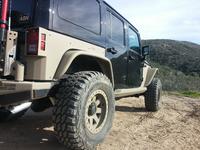
Does anyone have any pictures of their spacers installed? I'd like to see what the stance looks like.
I have a 2.5" bb, and stock Rubi 32's, and am thinking of installing spacers to get the wider stance and more aggressive look. I'm just not sure if it will look dumb without a 4" lift and bigger wheels, ya know?
(sorry to hijack, but at least it's on topic)
I have a 2.5" bb, and stock Rubi 32's, and am thinking of installing spacers to get the wider stance and more aggressive look. I'm just not sure if it will look dumb without a 4" lift and bigger wheels, ya know?
(sorry to hijack, but at least it's on topic)
JK Freak
Joined: Sep 2008
Posts: 916
Likes: 3
From: Terryville, LI, NY
Does anyone have any pictures of their spacers installed? I'd like to see what the stance looks like.
I have a 2.5" bb, and stock Rubi 32's, and am thinking of installing spacers to get the wider stance and more aggressive look. I'm just not sure if it will look dumb without a 4" lift and bigger wheels, ya know?
(sorry to hijack, but at least it's on topic)
I have a 2.5" bb, and stock Rubi 32's, and am thinking of installing spacers to get the wider stance and more aggressive look. I'm just not sure if it will look dumb without a 4" lift and bigger wheels, ya know?
(sorry to hijack, but at least it's on topic)
spidertrax-wheel-spacers-installation-write-up
Here's how 1.5" spacers increase track... I'm running 285/70-17s (33/11.50-17)on factory Moabs.

My regards,
Widewing

JK Junkie
Joined: Jul 2009
Posts: 2,343
Likes: 1
From: The San Andreas Fault
I recently installed a set of 1.5" Spidertrax spacers. However, prior to doing so, I took one of them, along with my spare wheel, into our engineering lab.
We modeled both in 3D using the latest NX CAD software. We did this by reverse engineering. That means taking all dimensions and determining the materials.
We identified the wheel material as alloy 356-T6. The spacers are made from 6061-T6 alloy. 356-T6 has tensile strength of 30,000 PSI. 6061-T6 has a tensile strength of 45,000 PSI. This means that in reference to the basic materials, the spacer is 50% stronger than the wheel for a given thickness, and the spacer is much thicker in section.
We ran an extremely complex finite element analysis of both to determine where peak stresses are and where each component is most likely to fail. The result is what I expected. In short, spacers are not the weak link. The wheel itself is 2x more likely to fail under severe loading than the well designed spacer.
Now, let me qualify our findings. Our corporate engineering team has designed significant portions of the Airbus A350 landing gear system. We engineered the latest landing gear system for the Boeing CH-47. Our hardware is on the F-35, F/A-18, F-16 and a number of other aircraft.
This same engineering team has analyzed the Spirdertrax spacers and concluded that they are extremely strong, stronger than they need to be. Over engineered. These spacers are utterly safe if installed properly. Like an offset wheel, they may accelerate bearing wear, but the offset is so little as to be of no great significance.
I installed the spacers very carefully. Not knowing specifically what brand and type of threadlocker compound was provided with the spacers, I tossed it and used Loctite 271 Red. Each spacer was torqued to recommended specs in a star pattern. The wheel was then installed and torqued to 95 lb/ft.
After about 150 miles, I pulled off the rear wheels and checked the spacer lug nut torque. No change... I'll re-check torque at each tire rotation.
Installed correctly, Spidertrax wheel spacers are not only safe, they're stronger than the wheels you bolt to them.
My regards,
Widewing
We modeled both in 3D using the latest NX CAD software. We did this by reverse engineering. That means taking all dimensions and determining the materials.
We identified the wheel material as alloy 356-T6. The spacers are made from 6061-T6 alloy. 356-T6 has tensile strength of 30,000 PSI. 6061-T6 has a tensile strength of 45,000 PSI. This means that in reference to the basic materials, the spacer is 50% stronger than the wheel for a given thickness, and the spacer is much thicker in section.
We ran an extremely complex finite element analysis of both to determine where peak stresses are and where each component is most likely to fail. The result is what I expected. In short, spacers are not the weak link. The wheel itself is 2x more likely to fail under severe loading than the well designed spacer.
Now, let me qualify our findings. Our corporate engineering team has designed significant portions of the Airbus A350 landing gear system. We engineered the latest landing gear system for the Boeing CH-47. Our hardware is on the F-35, F/A-18, F-16 and a number of other aircraft.
This same engineering team has analyzed the Spirdertrax spacers and concluded that they are extremely strong, stronger than they need to be. Over engineered. These spacers are utterly safe if installed properly. Like an offset wheel, they may accelerate bearing wear, but the offset is so little as to be of no great significance.
I installed the spacers very carefully. Not knowing specifically what brand and type of threadlocker compound was provided with the spacers, I tossed it and used Loctite 271 Red. Each spacer was torqued to recommended specs in a star pattern. The wheel was then installed and torqued to 95 lb/ft.
After about 150 miles, I pulled off the rear wheels and checked the spacer lug nut torque. No change... I'll re-check torque at each tire rotation.
Installed correctly, Spidertrax wheel spacers are not only safe, they're stronger than the wheels you bolt to them.
My regards,
Widewing
Just for the record, if you simulated the Spidertrax spacers subjected to the same dynamic loads as an F/A-18 20g carrier landing, then they are good enough for me.
