


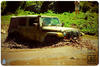
RIver Crossing


 so true...

JK Super Freak
Joined: Jan 2010
Posts: 1,467
Likes: 0
From: Torrington CT

typically you take on water through the breathers in the tranny, diffs and/or t-case. The tranny is the only one that will really tell you this happened very soon since it'll start acting very badly very quicly! Diff gears are gears. If you don't change the fluid, you won't know anything's wrong until you wear out a bearing on your 100 mile ride home. The t-case may stop shifting smoothly with water in it, but you won't know until you shift it, which may not be until you leave the trails.
The engine doesn't typically take on water in the oil if you don't hydro lock it. it could, I guess, via seals if you're sitting submerged for a long time.
Here's the short answer, now that you read the long one: after all deep crossings, check your tranny (auto) and engine dipsticks. Easy to do. Accurate indicator of water presence.
if you don't see any water, it's still not a bad idea to change your fluids as soon as is practical after water crossings. seals are not 100% submergeable waterproof.
The engine doesn't typically take on water in the oil if you don't hydro lock it. it could, I guess, via seals if you're sitting submerged for a long time.
Here's the short answer, now that you read the long one: after all deep crossings, check your tranny (auto) and engine dipsticks. Easy to do. Accurate indicator of water presence.
if you don't see any water, it's still not a bad idea to change your fluids as soon as is practical after water crossings. seals are not 100% submergeable waterproof.

JK Junkie
Joined: Nov 2008
Posts: 2,498
Likes: 5
From: Long Island, NY
if u found water in anything, I'd change it all!
I don't know if you'd feel a differenvce in manual tranny shifting with a little water, but I wouldn't personally chance it if any water got in anywhere.
I don't know if you'd feel a differenvce in manual tranny shifting with a little water, but I wouldn't personally chance it if any water got in anywhere.
JK Super Freak
Joined: Jan 2010
Posts: 1,467
Likes: 0
From: Torrington CT
I was told anything over the front bumper and you run the risk, especially if you haven't relocated your breathers. Got me nervous so I just went and did it.

JK Jedi
Joined: Oct 2007
Posts: 4,730
Likes: 3
From: BC

JK Super Freak
Joined: Feb 2009
Posts: 1,488
Likes: 1
From: Sydney, Australia
 Sealing the airbox
I've got a question regarding the effectiveness of snorkel keeping water out of the airbox. I stupidly went into a waterhole when I first got the JK without first checking the depth & got stuck. As soon as I realised I wasn't going anywhere I shut her down as the water was over the right headlight & I knew that was about the height of the air intake.
I swam around to the front, popped the hood and quickly pulled the top cover off the airbox & pulled the filter out as the JK was almost new and I was crapping myself that I'd sucked in some water. The airbox was half full of muddy water and before my very eyes continued to fill up to nearly the top to my confusion. When we pulled the Jeep out I checked the airbox again and the water level in it was now falling; when empty I discovered that there is a drain hole in the bottom of the airbox.
So I'm guessing that even with a snorkel, if you're in deep water for long enough water will flood in through this drain hole and risk hydrolocking? Or do you seal the drain hole as part of the snorkel install (but then wouldn't this result in the airbox holding rainwater ingested through the snorkel intake & slowly filling up the sealed airbox eventually leading to hydrolocking risk)? Just something I've been wondering about as I'm planning to fit a snorkel eventually.
PS: As a side note, I also had to change the fluids in both diffs, the gearbox and the transfer case as they were all full of muddy water so it was an expensive newby lesson learned.
I swam around to the front, popped the hood and quickly pulled the top cover off the airbox & pulled the filter out as the JK was almost new and I was crapping myself that I'd sucked in some water. The airbox was half full of muddy water and before my very eyes continued to fill up to nearly the top to my confusion. When we pulled the Jeep out I checked the airbox again and the water level in it was now falling; when empty I discovered that there is a drain hole in the bottom of the airbox.
So I'm guessing that even with a snorkel, if you're in deep water for long enough water will flood in through this drain hole and risk hydrolocking? Or do you seal the drain hole as part of the snorkel install (but then wouldn't this result in the airbox holding rainwater ingested through the snorkel intake & slowly filling up the sealed airbox eventually leading to hydrolocking risk)? Just something I've been wondering about as I'm planning to fit a snorkel eventually.
PS: As a side note, I also had to change the fluids in both diffs, the gearbox and the transfer case as they were all full of muddy water so it was an expensive newby lesson learned.