


Teraflex Leveling Kit Questions

JK Enthusiast
Joined: Jan 2009
Posts: 272
Likes: 0
From: Mesa, AZ

No level shots. I installed the leveling kit in a couple hours. Super easy. Toughest part is getting the second side spring back in. Key is to get the frame jacked up as high as possible to start with. I left the rear spacers off and installed Spidertrax on all 4 corners. Because I did this my rock rails sit perfectly level from front to rear.
For me this is just an intermitten "lift", I hate any rake in a rig!
A flexy poser shoot testing rub and clearance. No issues.
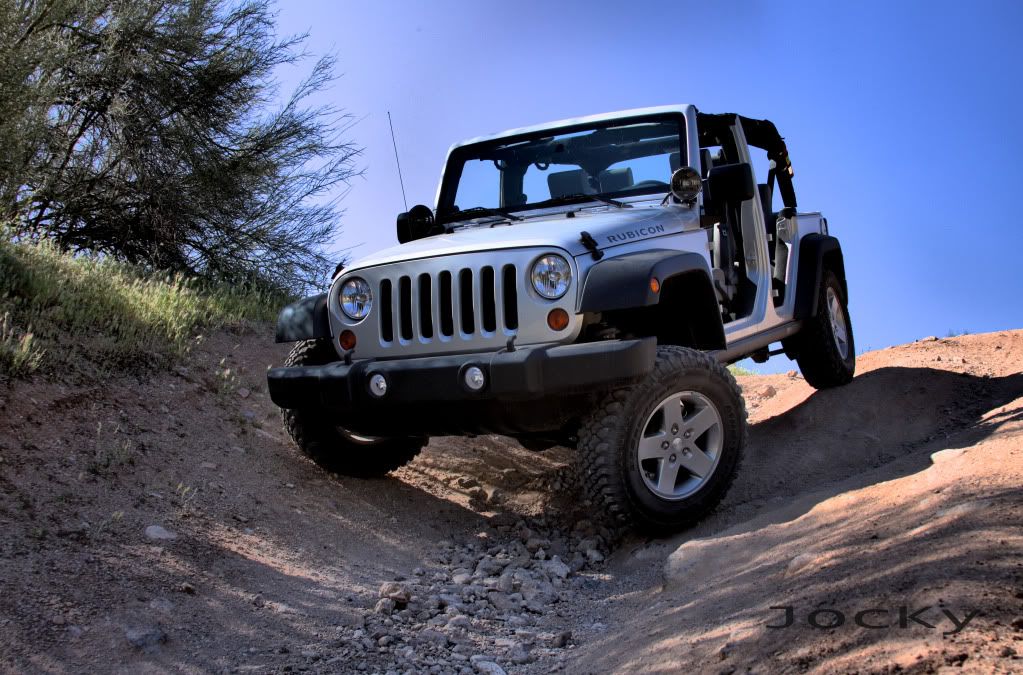
For me this is just an intermitten "lift", I hate any rake in a rig!
A flexy poser shoot testing rub and clearance. No issues.
Last edited by JocKy; Apr 27, 2010 at 07:52 PM.

JK Enthusiast
Joined: Apr 2010
Posts: 292
Likes: 0
From: Munchkin Land
also, for me i have the money right now to buy whatever lift i want. the reason why i would choose this option is because it eliminates warranty issues and death wobble. It seems that this is best solution if those are priorities for someone (???)
thanks
JK Enthusiast
Joined: Apr 2010
Posts: 292
Likes: 0
From: Munchkin Land

JK Freak
Joined: Feb 2009
Posts: 923
Likes: 0
From: SPACE
Im currently running BFG KM2 285/70/17 on stock 17x7.5 wheels(No Lift) and I was wondering if the Teraflex leveling Kit would cause trackbars/suspension rubbing against my tires? Because there is only 3/8'' free between tire and suspension arm.
I know that with the TF 2.5'' BB, I will need wheels spacers...Is it the same issue with TF leveling kit? Will I need wheels Spacers?
I would prefer to run no wheel spacers, I dont want my tires to stick out of my fender. Right now there is still 1/2'' free before they stick out, and wheelspacer will add 1.5'' So they would stick out 1''
So is it possible to run 33x11.5 with TF leveling kit with no wheel spacers and no rubbing issues?
I know that with the TF 2.5'' BB, I will need wheels spacers...Is it the same issue with TF leveling kit? Will I need wheels Spacers?
I would prefer to run no wheel spacers, I dont want my tires to stick out of my fender. Right now there is still 1/2'' free before they stick out, and wheelspacer will add 1.5'' So they would stick out 1''
So is it possible to run 33x11.5 with TF leveling kit with no wheel spacers and no rubbing issues?


JK Newbie
Joined: Jun 2007
Posts: 32
Likes: 0
From: Greenville, SC
Looking for a level 2 inch lift
1.5 is nice but does any body know if there is a good quality kit that gets you a true 2 inch lift and leaves her leveled out. I have a 1 inch differance from back to front. I have read on other post that you end up with issues if you get over 2. I was looking at the 2.5 coil lift but you end up with more lift than advertized. either way I am not wanting to take my tire size beyond 33/34. Is there any issue with stacking a half inch spacer in the leveling kit? Can I get the kit with the 2.5 spacers in the front and stack a 0.5 and the 1 inch spacer in the rear. I think that the sag from the LOD bumper and Waren winch up front would eat up the extra 0.5 inch in the front. for an overall 2 inch increase in the front and 1.5 in the rear, keeping it under the 2 inch issue mark? HELP
JK Freak
Joined: Feb 2009
Posts: 923
Likes: 0
From: SPACE
You may want to send a pm to Dave at northridge, there's two 2.5 lifts BB and Coil. I believe the Coil 2.5 gives a total of 3"lift and the BB is more a true 2.5. I don't know any reason why couldn't add a spacer to the front to level it out.

JK Enthusiast
Joined: Mar 2010
Posts: 364
Likes: 0
From: Maine
Most important lesson you'll EVER learn with any install (here, TF leveling kit)
I recently put 33's (285/75R16) on my "mostlystock" 2010 JK, and tonight attempted to install the TeraFlex 1.5" leveling kit (TeraFlex SKU no. 1155200, approx $130). This kit lifts the front 2" and the rear 1", leveling the rake and giving a slight boost. Took me three hours to install the fronts. I'll tackle the rears tomorrow... It's a simple install but why did it take so long? Jeep slipped off the jack stands three times. Even with plywood underneath, the ground was too soft under them.
I've tinkered with cars for many years and thought I was pretty mindful of safety. Tonight's installation was a wakeup call. Some reminders... and fortunately I did follow most of these.
1) even when the vehicle is on jack stands, lay down a wheel and slide it under the frame, JUST under the frame (i.e. almost at jack stand's support height), so if the jack stand fails, you have a backup that will catch and support the vehicle after it falls say only 1/2 inch. JACKSTANDS ARE NOT FAIL-SALE. As you torque down bolts and wiggle and jiggle and tighten them, you're rocking the vehicle. This is exactly when it slipped. My "backup" wheel did its job -- supported the frame (with no damage to the wheel -- the tire sidewall cushioned it). Could be a life saver if you happen to be under the vehicle and can't back out in time.
2) if at all possible, don't get under the vehicle. I was able to do most of the wrenching (shock bolts, front sway bar links) from under the wheel well, and I deliberately positioned myself so I could spring backward if things slipped. Which is exactly what I did when that's exactly what happened. If I happened to be laying down under the jeep, I'd likely be crushed right now. If I hadn't slid the wheel under there anyway. Can't stress it enough... have something under there for when your jack stands fail.
3) keep a spare bottle jack within reach, wherever you are, and pre-set it for "jacking up" (tighten the release screw) and affix the lever handle ready to go. If you're lucky, when you're pinned you can reach it and save yourself. Scissor jack is no good - you can't operate it one-handed with simple lever action.
4) have an escape route and be ready to go. The warning sign for me was the creaks and pops. Started slow, so I backed off QUICK and in almost slow motion the jeep slid to the side and off the stands. Get clear, FAST, because there's nothing you can do to stop it from falling once it starts.
5) block the wheels on the corners you're not working on. Block them on both front and back of the tires, even if you're on a level surface. Simple to do, easy to forget.
6) put it in gear if you have a manual transmission. Set parking brake too.
7) solid ground is key. Don't work on dirt or grass, even with plywood underneath. Find terra firma! Before I tackle the rear portion of the lift tomorrow, I'm moving the jeep to the (flat) driveway....
Can't stress the safety enough. Too easy to get crushed. A slip of the jack stands reminds you of how easy it is to get killed.
Well, that's it. Forget all the tips and lessons about installing the lift... these ones are far more important. Fortunately no damage done to jeep or me. Ground was soft, slips were slow with soft landings in the dirt and sand.
Hate to sound like an old fart but safety first, it's the truth.
The backup plans are critical. If one fails the other catches it. It's like gun safety... one of the reasons you follow ALL the basic rules (muzzle in safe direction; don't put finger on trigger; know what's behind target; etc..) is that if you happen to screw up ONE of them, the other will back it up and save you or someone else from harm. You have to follow all of them in order for this "backup plan" to work. Have backup plans. They could save your life when one safety mechanism fails.
I've tinkered with cars for many years and thought I was pretty mindful of safety. Tonight's installation was a wakeup call. Some reminders... and fortunately I did follow most of these.
1) even when the vehicle is on jack stands, lay down a wheel and slide it under the frame, JUST under the frame (i.e. almost at jack stand's support height), so if the jack stand fails, you have a backup that will catch and support the vehicle after it falls say only 1/2 inch. JACKSTANDS ARE NOT FAIL-SALE. As you torque down bolts and wiggle and jiggle and tighten them, you're rocking the vehicle. This is exactly when it slipped. My "backup" wheel did its job -- supported the frame (with no damage to the wheel -- the tire sidewall cushioned it). Could be a life saver if you happen to be under the vehicle and can't back out in time.
2) if at all possible, don't get under the vehicle. I was able to do most of the wrenching (shock bolts, front sway bar links) from under the wheel well, and I deliberately positioned myself so I could spring backward if things slipped. Which is exactly what I did when that's exactly what happened. If I happened to be laying down under the jeep, I'd likely be crushed right now. If I hadn't slid the wheel under there anyway. Can't stress it enough... have something under there for when your jack stands fail.
3) keep a spare bottle jack within reach, wherever you are, and pre-set it for "jacking up" (tighten the release screw) and affix the lever handle ready to go. If you're lucky, when you're pinned you can reach it and save yourself. Scissor jack is no good - you can't operate it one-handed with simple lever action.
4) have an escape route and be ready to go. The warning sign for me was the creaks and pops. Started slow, so I backed off QUICK and in almost slow motion the jeep slid to the side and off the stands. Get clear, FAST, because there's nothing you can do to stop it from falling once it starts.
5) block the wheels on the corners you're not working on. Block them on both front and back of the tires, even if you're on a level surface. Simple to do, easy to forget.
6) put it in gear if you have a manual transmission. Set parking brake too.
7) solid ground is key. Don't work on dirt or grass, even with plywood underneath. Find terra firma! Before I tackle the rear portion of the lift tomorrow, I'm moving the jeep to the (flat) driveway....
Can't stress the safety enough. Too easy to get crushed. A slip of the jack stands reminds you of how easy it is to get killed.
Well, that's it. Forget all the tips and lessons about installing the lift... these ones are far more important. Fortunately no damage done to jeep or me. Ground was soft, slips were slow with soft landings in the dirt and sand.
Hate to sound like an old fart but safety first, it's the truth.
The backup plans are critical. If one fails the other catches it. It's like gun safety... one of the reasons you follow ALL the basic rules (muzzle in safe direction; don't put finger on trigger; know what's behind target; etc..) is that if you happen to screw up ONE of them, the other will back it up and save you or someone else from harm. You have to follow all of them in order for this "backup plan" to work. Have backup plans. They could save your life when one safety mechanism fails.
Last edited by mostlystock; Sep 30, 2010 at 04:35 PM.

JK Enthusiast
Joined: May 2009
Posts: 188
Likes: 0
From: Florida

I recently put 33's (285/75R16) on my "mostlystock" 2010 JK, and tonight attempted to install the TeraFlex 1.5" leveling kit (TeraFlex SKU no. 1155200, approx $130). This kit lifts the front 2" and the rear 1", leveling the rake and giving a slight boost. Took me three hours to install the fronts. I'll tackle the rears tomorrow... It's a simple install but why did it take so long? Jeep slipped off the jack stands three times. Even with plywood underneath, the ground was too soft under them.
I've tinkered with cars for many years and thought I was pretty mindful of safety. Tonight's installation was a wakeup call. Some reminders... and fortunately I did follow most of these.
1) even when the vehicle is on jack stands, lay down a wheel and slide it under the frame, JUST under the frame (i.e. almost at jack stand's support height), so if the jack stand fails, you have a backup that will catch and support the vehicle after it falls say only 1/2 inch. JACKSTANDS ARE NOT FAIL-SALE. As you torque down bolts and wiggle and jiggle and tighten them, you're rocking the vehicle. This is exactly when it slipped. My "backup" wheel did its job -- supported the frame (with no damage to the wheel -- the tire sidewall cushioned it). Could be a life saver if you happen to be under the vehicle and can't back out in time.
2) if at all possible, don't get under the vehicle. I was able to do most of the wrenching (shock bolts, front sway bar links) from under the wheel well, and I deliberately positioned myself so I could spring backward if things slipped. Which is exactly what I did when that's exactly what happened. If I happened to be laying down under the jeep, I'd likely be crushed right now. If I hadn't slid the wheel under there anyway. Can't stress it enough... have something under there for when your jack stands fail.
3) keep a spare bottle jack within reach, wherever you are, and pre-set it for "jacking up" (tighten the release screw) and affix the lever handle ready to go. If you're lucky, when you're pinned you can reach it and save yourself. Scissor jack is no good - you can't operate it one-handed with simple lever action.
4) have an escape route and be ready to go. The warning sign for me was the creaks and pops. Started slow, so I backed off QUICK and in almost slow motion the jeep slid to the side and off the stands. Get clear, FAST, because there's nothing you can do to stop it from falling once it starts.
5) block the wheels on the corners you're not working on. Block them on both front and back of the tires, even if you're on a level surface. Simple to do, easy to forget.
6) put it in gear
7) solid ground is key. Don't work on dirt or grass, even with plywood underneath. Find terra firma! Before I tackle the rear portion of the lift tomorrow, I'm moving the jeep to the (flat) driveway....
Can't stress the safety enough. Too easy to get crushed. A slip of the jack stands reminds you of how easy it is to get killed.
Well, that's it. Forget all the tips and lessons about installing the lift... these ones are far more important. Fortunately no damage done to jeep or me. Ground was soft, slips were slow with soft landings in the dirt and sand.
Hate to sound like an old fart but safety first, it's the truth.
The backup plans are critical. If one fails the other catches it. It's like gun safety... one of the reasons you follow ALL the basic rules (muzzle in safe direction; don't put finger on trigger; know what's behind target; etc..) is that if you happen to screw up ONE of them, the other will back it up and save you or someone else from harm. You have to follow all of them in order for this "backup plan" to work. Have backup plans. They could save your life when one safety mechanism fails.
I've tinkered with cars for many years and thought I was pretty mindful of safety. Tonight's installation was a wakeup call. Some reminders... and fortunately I did follow most of these.
1) even when the vehicle is on jack stands, lay down a wheel and slide it under the frame, JUST under the frame (i.e. almost at jack stand's support height), so if the jack stand fails, you have a backup that will catch and support the vehicle after it falls say only 1/2 inch. JACKSTANDS ARE NOT FAIL-SALE. As you torque down bolts and wiggle and jiggle and tighten them, you're rocking the vehicle. This is exactly when it slipped. My "backup" wheel did its job -- supported the frame (with no damage to the wheel -- the tire sidewall cushioned it). Could be a life saver if you happen to be under the vehicle and can't back out in time.
2) if at all possible, don't get under the vehicle. I was able to do most of the wrenching (shock bolts, front sway bar links) from under the wheel well, and I deliberately positioned myself so I could spring backward if things slipped. Which is exactly what I did when that's exactly what happened. If I happened to be laying down under the jeep, I'd likely be crushed right now. If I hadn't slid the wheel under there anyway. Can't stress it enough... have something under there for when your jack stands fail.
3) keep a spare bottle jack within reach, wherever you are, and pre-set it for "jacking up" (tighten the release screw) and affix the lever handle ready to go. If you're lucky, when you're pinned you can reach it and save yourself. Scissor jack is no good - you can't operate it one-handed with simple lever action.
4) have an escape route and be ready to go. The warning sign for me was the creaks and pops. Started slow, so I backed off QUICK and in almost slow motion the jeep slid to the side and off the stands. Get clear, FAST, because there's nothing you can do to stop it from falling once it starts.
5) block the wheels on the corners you're not working on. Block them on both front and back of the tires, even if you're on a level surface. Simple to do, easy to forget.
6) put it in gear
7) solid ground is key. Don't work on dirt or grass, even with plywood underneath. Find terra firma! Before I tackle the rear portion of the lift tomorrow, I'm moving the jeep to the (flat) driveway....
Can't stress the safety enough. Too easy to get crushed. A slip of the jack stands reminds you of how easy it is to get killed.
Well, that's it. Forget all the tips and lessons about installing the lift... these ones are far more important. Fortunately no damage done to jeep or me. Ground was soft, slips were slow with soft landings in the dirt and sand.
Hate to sound like an old fart but safety first, it's the truth.
The backup plans are critical. If one fails the other catches it. It's like gun safety... one of the reasons you follow ALL the basic rules (muzzle in safe direction; don't put finger on trigger; know what's behind target; etc..) is that if you happen to screw up ONE of them, the other will back it up and save you or someone else from harm. You have to follow all of them in order for this "backup plan" to work. Have backup plans. They could save your life when one safety mechanism fails.

