


Trail Master Lift


JK Freak
Joined: May 2008
Posts: 759
Likes: 0
From: North AL

The drive shafts look to be of great quality. They're not on yet, but I do go out to the garage every night just to look at them. All the parts move freely, but nothing is loose or wobbly. The shafts are slightly heavy, but not too heavy. Heavy shafts tend to have more vibration problems. Everything has a good fit and finish. There aren't any rough edges on anything.
I will probably put them on this weekend. The instructions say to tighten the nuts and bolt to factory specs. But I was finding different answers to the torque specs. So after a few hours of internet searching, I came up with the transfer case yoke nut torque is 110-130 ft lbs and use red loctite. All the other nuts and bolts are 25-30 ft lbs and use red loctite.
Here are a few pics I took earlier.


By the way, that big factory drive shaft, here's what it looks like separated.

I will probably put them on this weekend. The instructions say to tighten the nuts and bolt to factory specs. But I was finding different answers to the torque specs. So after a few hours of internet searching, I came up with the transfer case yoke nut torque is 110-130 ft lbs and use red loctite. All the other nuts and bolts are 25-30 ft lbs and use red loctite.
Here are a few pics I took earlier.
By the way, that big factory drive shaft, here's what it looks like separated.
Last edited by Denny2565; Jun 3, 2010 at 03:17 PM. Reason: corrected torque numbers


Sponsoring Manufacturer
Joined: Dec 2007
Posts: 67
Likes: 0
From: Prescott, AZ
They are slightly longer that the stock ones, but they have enough slip in the yoke to fit a wrangler with a 2" - 6" lift kit on it. They are a great update for any JK Wrangler. We do sell the driveline kits as well.
Dennis, the torque on the bolts are about 25-30 ft. lbs. with red locktite
JK Freak
Joined: May 2008
Posts: 759
Likes: 0
From: North AL

JK Enthusiast
Joined: Feb 2010
Posts: 160
Likes: 0
From: San Diego
I think you'll be very happy with your purchase. I'll post up a few things that I learned while doing my installation that might make your install go a little easier.
As for the ride, it's both a little more firm and smoother. I can feel more bumps going through a parking lot, but it's smoother going down the highway. Before, I had a slight vibration in the steering wheel once I hit 50mph, and occasionally the vibration would turn into a shimmy. I thought I had a wheel out of balance. I've gone 70-75mph a few times over the past couple days and there is absolutely no vibration or shimmy. The jeep seems to track down the highway better too. I'm guessing the new control arms corrected whatever issues I was having on the highway.
As for the ride, it's both a little more firm and smoother. I can feel more bumps going through a parking lot, but it's smoother going down the highway. Before, I had a slight vibration in the steering wheel once I hit 50mph, and occasionally the vibration would turn into a shimmy. I thought I had a wheel out of balance. I've gone 70-75mph a few times over the past couple days and there is absolutely no vibration or shimmy. The jeep seems to track down the highway better too. I'm guessing the new control arms corrected whatever issues I was having on the highway.
Yea, I ordered the kit with drive shafts. Ive checked my factory shafts and they seem to be holding up with about 15k miles on a 2.5" lift. I plan on keeping them to use as spares to get me home in case the worst happens.
Thanks for all the pics and stuff so far. Did you do the entire install yourself? I've got access to a garage with lifts and everything where I'm stationed but I kind of plan on making it a driveway project so any more advice you've got would be awesome!
Also, BIG thanks to yhudson at Trail Master and David at Northridge 4x4. These guys have been a tremendous help so far, very timely.

JK Freak
Joined: May 2008
Posts: 759
Likes: 0
From: North AL
Yep, I did the entire install by myself with jack stands, a couple floor jacks and hand tools.
Instead of repeating the instructions, here are a few things that might make your install go a little easier.
First, the instructions are right even if you think you know better. A couple of things to do early on are to replace the brake lines and drop the transmission skid plate. I didn't know why because I never had to do this for my other installs. Short answer is the factory brake lines keep the axle from dropping down far enough and the drive shaft will hit the skid plate. Do everything in the order of the instructions and you should be ok. The only thing I didn't do yet are the drive shafts. Those are going on this weekend.
You will also need some of the nuts and bolts, the front sway bar links and the rear track bar from your factory suspension.
The measurements listed for the front control arms are perfect. I checked the caster after installation and it was right at 6 degrees.
The rear needed a small adjustment. I think the listed rear control arm length would be good for a 2-door, but it was a little off on my unlimited. I set the rear upper and lower control arms at the lengths stated in the instructions and the pinion was 2 degrees above the drive shaft angle. I left the upper arms alone and extend the lower arms 1/4" to 21-1/8". This put the pinion at 2 degrees below drive shaft angle. So I believe for unlimiteds, a good length to start at would be exactly 21". Also, when adjusting the control arm length, I measured one and for the second, I adjusted so that the bolts would drop into both ends.

A floor jack under the pinion makes arm installation MUCH easier. Bolt up one end of the control arms and as you jack up the pinion, the control arms will push into place. Make sure you have both control arms in place before you start lifting the pinion. A rubber mallet comes in handy to bump the arms up and down in order to line up the holes.

When I dropped the track bar in the bracket, there was a gap between the bar and bracket that I wasn't sure would go away when I torqued the bolt down so I got a couple washers to take up the space.

Speaking of bolts, there are two big bolts included in the hardware packs. The longer one goes through the bottom hole in the bracket and the shorter one goes through the track bar hole. The instructions say you may use the factory nut and bolt, but the bolt seemed a little short for my comfort so I went with the bolt included with the kit.
Also, since I was doing this by myself, I didn't have anyone to push the jeep back and forth to get the bolt through the bracket and track bar. However, as I was jacking up the axle, I noticed that the track bar hole lined up perfectly with the bracket at a certain point.
Finally, with this much lift, the rear axle breather hose will be too short when the axle droops so you can use the write-up on the Project-JK site to fix this.
This is all I can think of for now. As more comes to mind, I'll post it up.
Instead of repeating the instructions, here are a few things that might make your install go a little easier.
First, the instructions are right even if you think you know better. A couple of things to do early on are to replace the brake lines and drop the transmission skid plate. I didn't know why because I never had to do this for my other installs. Short answer is the factory brake lines keep the axle from dropping down far enough and the drive shaft will hit the skid plate. Do everything in the order of the instructions and you should be ok. The only thing I didn't do yet are the drive shafts. Those are going on this weekend.
You will also need some of the nuts and bolts, the front sway bar links and the rear track bar from your factory suspension.
The measurements listed for the front control arms are perfect. I checked the caster after installation and it was right at 6 degrees.
The rear needed a small adjustment. I think the listed rear control arm length would be good for a 2-door, but it was a little off on my unlimited. I set the rear upper and lower control arms at the lengths stated in the instructions and the pinion was 2 degrees above the drive shaft angle. I left the upper arms alone and extend the lower arms 1/4" to 21-1/8". This put the pinion at 2 degrees below drive shaft angle. So I believe for unlimiteds, a good length to start at would be exactly 21". Also, when adjusting the control arm length, I measured one and for the second, I adjusted so that the bolts would drop into both ends.
A floor jack under the pinion makes arm installation MUCH easier. Bolt up one end of the control arms and as you jack up the pinion, the control arms will push into place. Make sure you have both control arms in place before you start lifting the pinion. A rubber mallet comes in handy to bump the arms up and down in order to line up the holes.
When I dropped the track bar in the bracket, there was a gap between the bar and bracket that I wasn't sure would go away when I torqued the bolt down so I got a couple washers to take up the space.
Speaking of bolts, there are two big bolts included in the hardware packs. The longer one goes through the bottom hole in the bracket and the shorter one goes through the track bar hole. The instructions say you may use the factory nut and bolt, but the bolt seemed a little short for my comfort so I went with the bolt included with the kit.
Also, since I was doing this by myself, I didn't have anyone to push the jeep back and forth to get the bolt through the bracket and track bar. However, as I was jacking up the axle, I noticed that the track bar hole lined up perfectly with the bracket at a certain point.
Finally, with this much lift, the rear axle breather hose will be too short when the axle droops so you can use the write-up on the Project-JK site to fix this.
This is all I can think of for now. As more comes to mind, I'll post it up.
Last edited by Denny2565; Jun 3, 2010 at 09:39 PM.
JK Freak
Joined: May 2008
Posts: 759
Likes: 0
From: North AL
I started today with the front drive shaft, but had to stop. I took the drive shaft off but when I went to take off the yoke nut, I discovered I needed a 1-1/4" socket. And as luck would have it, the biggest socket I had was 1-3/16". So it looks like I'll be making a trip to Harbor Freight this week for a socket or I may go to O'Reilly to see if they have a loaner.
But until then, here's a few pointers on drive shaft removal.
First, remove the transfer case skid plate. It's not mandatory, but makes working around the transfer case easier. Put your floor jack against it first. That way, you're not trying to hold it up while your taking the bolts out.

Taking the shaft bolts out is a lot easier if you can turn the shaft in order to get to the ones on top. So put the axle up on stands and chock your tires to keep them from turning when you are breaking the bolts loose.

Four bolts and a little prying with a screwdriver breaks the front of the shaft free.

And here's the yoke nut that put me on hold.

But until then, here's a few pointers on drive shaft removal.
First, remove the transfer case skid plate. It's not mandatory, but makes working around the transfer case easier. Put your floor jack against it first. That way, you're not trying to hold it up while your taking the bolts out.
Taking the shaft bolts out is a lot easier if you can turn the shaft in order to get to the ones on top. So put the axle up on stands and chock your tires to keep them from turning when you are breaking the bolts loose.
Four bolts and a little prying with a screwdriver breaks the front of the shaft free.
And here's the yoke nut that put me on hold.
JK Freak
Joined: May 2008
Posts: 759
Likes: 0
From: North AL
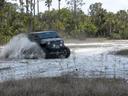
Going through some pics, thought this was an interesting one.
Instead of longer rear links, the kit comes with a couple brackets that allows you to re-locate the front links to the rear. I wasn't sure how this set-up would work, but even at full droop, the sway bar and links were not maxed out. While the shocks were fully extended, I also checked the coils and they were still snug in their perches.

Instead of longer rear links, the kit comes with a couple brackets that allows you to re-locate the front links to the rear. I wasn't sure how this set-up would work, but even at full droop, the sway bar and links were not maxed out. While the shocks were fully extended, I also checked the coils and they were still snug in their perches.