


37s and no lift.

JK Enthusiast
Joined: Oct 2014
Posts: 311
Likes: 2
From: Rockwall, Tx

My first thought seeing this... again.... "I can't believe that this is still going on!?"
Here is something to ponder... if you will.
The stock suspension is designed to use the provided 32" tire and have up travel that will not hurt the body, and down travel that will not hurt the stock driveshafts. Those two things were the limiting factors to FCA, as clearly seen by the elongated ABS/brake lines and the use of bump stops to limit the up travel to a safe distance with no sway bar links in place. You can use all of the designed in travel possible with no threat to the car. You can toss your sway bars on the scrap pile and the car will still remain mechanically intact.
So, that said, and that being non-negotiable, this fellow put on 37" tires. He still has a stock JK. So his option was to add bump stop to limit up travel (32" to 37" is 2.5" from axle center line) by an additional 2.5" plus whatever may be needed based on the larger diameter/width tire hitting things that were not part of the OEM designs 32" tire, such as the outer edge of the flares, the pinch seam locations that were radiused for the 32" diameter profile... the things that he readily says that he has addressed.
So he lost nothing in up travel by his own words. I don't doubt this.
He also lost nothing in down travel. I do not doubt this.
He gained nothing in up travel over a stock JK/U, he made sure of that with his aggressive clearance cutting to make sure that he didn't lose anything.
He gained nothing (so far) in axle drop, as he still has stock length shocks and stock drive shafts.
He created a fully useable, stock level of articulation (full stock level of articulation, non impeded) on a non lifted JK with a +5" tire diameter.
He could not flex better than stock (yet) because the shock will still be at full collapse and at full extent at the same place it was when not clearance cut, and with 32" tires.
Should he go and set a 28" shock beside his stock shock (I use that 28" because I am running 28" shocks) he would quickly observe that the 28" shock has much more exposed piston at full extent, therefor it has far more downward drop.
He would then consider that the shock is not at the outside edge of the axle, so an inch of added shock is actually more than inch of added travel at the axle ends. So that 28" shock with what 2.5" longer extended length adds over 4" of drop over a stock shock. Maybe a bit more or less, I don't care to measure it out and find the moment arm ratio.
The same thing happens to the drop, the shock limits the up travel and is what you use to decide the proper bump stop.... but as mentioned above, it's not 1:1.
The 28" shock is longer overall compared to the stock shock, and yes, it is longer fully collapsed... but not as much as the gains of the fully extended measurement.
So on just the most basic level of understanding, you have to agree that my 28" shock, if bump stopped to just shy of full collapse..... has a longer total effective stroke or range of motion. My 28" shock, not counting moment arm pivot ratio, in and of itself will net a properly rigged Jeep more wheel travel. Add in the additional gains in both drop and raise from the pivot ratio, and you see that it has no choice but to far exceed the total range of motion with the factory shocks.
I hope that at least some of you get what I am saying. I'm not taking away from his method or attempting to passive/aggressively insult anyone here, but physics and engineering are pretty well established concepts in our world today. This is something you should be able to easily visualize.
Try this, hold a pencil/pen like and axle, it is horizontal. Use you pointer and middle finger to grasp the pencil at the approximat shock mount location, with an inch of pencil/pen extending out past your fingers. Now, as you pretend to move the "axle" (pencil) up and down one one side or the other, you see some amount of multiplier effect on the 1" ends sticking out past your fingers. The further you move the "axle" up or down from horizontal, the more dramatic the effect. That is your axle. Moving it further down on the right causes it to raise on the left even though the left fingers never moved. And you note that it moved down further than your fingers on the right. It gave you a double gain.
That is how a solid axle works. Your springs and shocks are not out at the edges. Your shock is the ultimate limiting factor up and down. You can not claim to have added anything in up or down motion while keeping the shock in the same location and keeping it at the same extended/compressed total length.
There is no wizardry at play here.
If it means that much to you, I have also built race cars, built 4x4 competition sled pulling trucks, I am an engineer at a nuclear facility, and I stayed at the Holiday Inn more than once. It likely impresses no one and adds nothing to my internet credentials. But, I speak truth to the best of my knowledge.
Here is something to ponder... if you will.
The stock suspension is designed to use the provided 32" tire and have up travel that will not hurt the body, and down travel that will not hurt the stock driveshafts. Those two things were the limiting factors to FCA, as clearly seen by the elongated ABS/brake lines and the use of bump stops to limit the up travel to a safe distance with no sway bar links in place. You can use all of the designed in travel possible with no threat to the car. You can toss your sway bars on the scrap pile and the car will still remain mechanically intact.
So, that said, and that being non-negotiable, this fellow put on 37" tires. He still has a stock JK. So his option was to add bump stop to limit up travel (32" to 37" is 2.5" from axle center line) by an additional 2.5" plus whatever may be needed based on the larger diameter/width tire hitting things that were not part of the OEM designs 32" tire, such as the outer edge of the flares, the pinch seam locations that were radiused for the 32" diameter profile... the things that he readily says that he has addressed.
So he lost nothing in up travel by his own words. I don't doubt this.
He also lost nothing in down travel. I do not doubt this.
He gained nothing in up travel over a stock JK/U, he made sure of that with his aggressive clearance cutting to make sure that he didn't lose anything.
He gained nothing (so far) in axle drop, as he still has stock length shocks and stock drive shafts.
He created a fully useable, stock level of articulation (full stock level of articulation, non impeded) on a non lifted JK with a +5" tire diameter.
He could not flex better than stock (yet) because the shock will still be at full collapse and at full extent at the same place it was when not clearance cut, and with 32" tires.
Should he go and set a 28" shock beside his stock shock (I use that 28" because I am running 28" shocks) he would quickly observe that the 28" shock has much more exposed piston at full extent, therefor it has far more downward drop.
He would then consider that the shock is not at the outside edge of the axle, so an inch of added shock is actually more than inch of added travel at the axle ends. So that 28" shock with what 2.5" longer extended length adds over 4" of drop over a stock shock. Maybe a bit more or less, I don't care to measure it out and find the moment arm ratio.
The same thing happens to the drop, the shock limits the up travel and is what you use to decide the proper bump stop.... but as mentioned above, it's not 1:1.
The 28" shock is longer overall compared to the stock shock, and yes, it is longer fully collapsed... but not as much as the gains of the fully extended measurement.
So on just the most basic level of understanding, you have to agree that my 28" shock, if bump stopped to just shy of full collapse..... has a longer total effective stroke or range of motion. My 28" shock, not counting moment arm pivot ratio, in and of itself will net a properly rigged Jeep more wheel travel. Add in the additional gains in both drop and raise from the pivot ratio, and you see that it has no choice but to far exceed the total range of motion with the factory shocks.
I hope that at least some of you get what I am saying. I'm not taking away from his method or attempting to passive/aggressively insult anyone here, but physics and engineering are pretty well established concepts in our world today. This is something you should be able to easily visualize.
Try this, hold a pencil/pen like and axle, it is horizontal. Use you pointer and middle finger to grasp the pencil at the approximat shock mount location, with an inch of pencil/pen extending out past your fingers. Now, as you pretend to move the "axle" (pencil) up and down one one side or the other, you see some amount of multiplier effect on the 1" ends sticking out past your fingers. The further you move the "axle" up or down from horizontal, the more dramatic the effect. That is your axle. Moving it further down on the right causes it to raise on the left even though the left fingers never moved. And you note that it moved down further than your fingers on the right. It gave you a double gain.
That is how a solid axle works. Your springs and shocks are not out at the edges. Your shock is the ultimate limiting factor up and down. You can not claim to have added anything in up or down motion while keeping the shock in the same location and keeping it at the same extended/compressed total length.
There is no wizardry at play here.
If it means that much to you, I have also built race cars, built 4x4 competition sled pulling trucks, I am an engineer at a nuclear facility, and I stayed at the Holiday Inn more than once. It likely impresses no one and adds nothing to my internet credentials. But, I speak truth to the best of my knowledge.
JK Enthusiast


Joined: Nov 2015
Posts: 471
Likes: 19
From: Phoenix, AZ

Thread Starter
JK Enthusiast
Joined: Oct 2015
Posts: 384
Likes: 2
From: Central Texas
My first thought seeing this... again.... "I can't believe that this is still going on!?" Here is something to ponder... if you will. The stock suspension is designed to use the provided 32" tire and have up travel that will not hurt the body, and down travel that will not hurt the stock driveshafts. Those two things were the limiting factors to FCA, as clearly seen by the elongated ABS/brake lines and the use of bump stops to limit the up travel to a safe distance with no sway bar links in place. You can use all of the designed in travel possible with no threat to the car. You can toss your sway bars on the scrap pile and the car will still remain mechanically intact. So, that said, and that being non-negotiable, this fellow put on 37" tires. He still has a stock JK. So his option was to add bump stop to limit up travel (32" to 37" is 2.5" from axle center line) by an additional 2.5" plus whatever may be needed based on the larger diameter/width tire hitting things that were not part of the OEM designs 32" tire, such as the outer edge of the flares, the pinch seam locations that were radiused for the 32" diameter profile... the things that he readily says that he has addressed. So he lost nothing in up travel by his own words. I don't doubt this. He also lost nothing in down travel. I do not doubt this. He gained nothing in up travel over a stock JK/U, he made sure of that with his aggressive clearance cutting to make sure that he didn't lose anything. He gained nothing (so far) in axle drop, as he still has stock length shocks and stock drive shafts. He created a fully useable, stock level of articulation (full stock level of articulation, non impeded) on a non lifted JK with a +5" tire diameter. He could not flex better than stock (yet) because the shock will still be at full collapse and at full extent at the same place it was when not clearance cut, and with 32" tires. Should he go and set a 28" shock beside his stock shock (I use that 28" because I am running 28" shocks) he would quickly observe that the 28" shock has much more exposed piston at full extent, therefor it has far more downward drop. He would then consider that the shock is not at the outside edge of the axle, so an inch of added shock is actually more than inch of added travel at the axle ends. So that 28" shock with what 2.5" longer extended length adds over 4" of drop over a stock shock. Maybe a bit more or less, I don't care to measure it out and find the moment arm ratio. The same thing happens to the drop, the shock limits the up travel and is what you use to decide the proper bump stop.... but as mentioned above, it's not 1:1. The 28" shock is longer overall compared to the stock shock, and yes, it is longer fully collapsed... but not as much as the gains of the fully extended measurement. So on just the most basic level of understanding, you have to agree that my 28" shock, if bump stopped to just shy of full collapse..... has a longer total effective stroke or range of motion. My 28" shock, not counting moment arm pivot ratio, in and of itself will net a properly rigged Jeep more wheel travel. Add in the additional gains in both drop and raise from the pivot ratio, and you see that it has no choice but to far exceed the total range of motion with the factory shocks. I hope that at least some of you get what I am saying. I'm not taking away from his method or attempting to passive/aggressively insult anyone here, but physics and engineering are pretty well established concepts in our world today. This is something you should be able to easily visualize. Try this, hold a pencil/pen like and axle, it is horizontal. Use you pointer and middle finger to grasp the pencil at the approximat shock mount location, with an inch of pencil/pen extending out past your fingers. Now, as you pretend to move the "axle" (pencil) up and down one one side or the other, you see some amount of multiplier effect on the 1" ends sticking out past your fingers. The further you move the "axle" up or down from horizontal, the more dramatic the effect. That is your axle. Moving it further down on the right causes it to raise on the left even though the left fingers never moved. And you note that it moved down further than your fingers on the right. It gave you a double gain. That is how a solid axle works. Your springs and shocks are not out at the edges. Your shock is the ultimate limiting factor up and down. You can not claim to have added anything in up or down motion while keeping the shock in the same location and keeping it at the same extended/compressed total length. There is no wizardry at play here. If it means that much to you, I have also built race cars, built 4x4 competition sled pulling trucks, I am an engineer at a nuclear facility, and I stayed at the Holiday Inn more than once. It likely impresses no one and adds nothing to my internet credentials. But, I speak truth to the best of my knowledge.
Another thing I would like to point out others, those who seem to have reading/intelligence problems, that obviously a stock extended shock is shorter than an aftermarket extended shock. I never said anything that would lead a halfway intelligent person to believe anything else, unless you're simply blinded by your reactionary emotions, idk if it makes you mad that I can run this setup with full stock room or what. I won't attempt to dissect your skewed mentalities behind your words.
Let me give another example. Say you have a 3.5 lift with a 30" extended shock. That does not mean that you have 30" of travel, because there are other things besides a shock limiting that, such as body hitting your larger tire, your driveshafts, your control arm joints/bushings, your brake lines, etc. Some here in this thread are under that impression, that simply because they have a __" shock they automatically have that much travel. Sorry to burst your ignorant bubbles but that is not the case. Unless you have clearanced the shit out of your wheel wells, or have a much higher than 3.5" lift, you will not be able to fully use a 30" travel shock at that height.
You will hit your tire before me every single time, regardless of your shock length, those that haven't clearanced like me. You do not have the same amount of uptravel as me simply because your shock is longer, unless you compensate for your lack of clearance by adding more lift. And even then, only putting a 3.5 lift, the fact that I had 5" of wasted uptravel sitting at ride height with an unmodified wheel well, and regained it by clearancing, provides my stock height jku more uptravel than many lifted jku's at 3.5-3.5" , and equal uptravel to some others with better done setups.
When I mounted my tire at ride height it was touching my 2012 pinch seam in the front of the tire. And in the back of the tire it had about 1" or upward space before it would contact, however it couldn't even move up due to the front pinch seam. I did this to see exactly where I needed to work. I did the work. I now have more uptravel. Sitting at stock height with no spare, and a PSC rockbrawler2, I have 6-7" uptravel. Does that mean my shock has 6-7"? No, as explained by the extremely level headed and observant gentleman above. Unless you halfway know what you're talking about you wouldn't even argue over this.
People lift jeeps because they don't know anything and think a lift automatically gains travel and capability. Incorrect. 50% of lifts do not gain anything over stock with the way people set them up. They simply sit you higher up and let you run a bigger tire while still retaining stock articulation numbers. Despite what some fools may think, a stock jk disconnected is extremely capable. Multi thousand dollar lift kits usually only provide a few more inches of articulation over stock, and in real life the difference on an obstacle due to articulation limits is not the big deal. Tire size is king. Not lift height or how much you can flex. Go look at black ops 4x4 if you don't believe that.
I simply stated that my jeep as is, can equal and even beat some jeeps I have wheeled with that are on 37s and 3.5-2.5 of lift, due to the fact that they haven't trimmed a damn thing essentially, while I have. You may have longer shocks but that length is used in your ride height. You only can equal my rear uptravel by adding lift unless you want to go all out with clearancing like I did. This is extremely simple. This is how I can equal some jeeps at higher heights on same size tires. The whole point of me doing this was to gain that capability, running 37" tires with no lift, yet not being robbed of any articulation. If you try to deny that that is impressive and cool then you're just a mad hater. The whole goal of building a rig is to stay as low as possible while fitting the largest tire possible, and while retaining or gaining on stock articulation numbers.
Look at any high dollar rig you want, none of them have big tall lifts, because that isn't the point. After a certain ratio of increased tire size:increased lift size, you start getting more tipsy and are working backwards. This is why you rarely see any actual crawlers with high lifts. Only mall crawlers and soccer moms and middle age men with little dick syndrome want to put large lifts. They think it looks cool and stuff. After a point, more lift is just stupid and a waste of money and also dangerous.
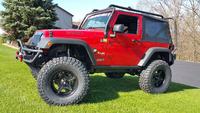
If anyone would like to continue to argue with the facts, I'll again refer you to the picture of the 3.5 rubicon express lift flexed out compared to mine flexed out. His bumpstops up front and lack of trimming in rear make it to where I equal or surpass his rti capability. I figured the pictures would be the end of any argument, as the evidence is obvious. But I guess not. Some people just want to argue and be right. It's a pity we have people like this because I never came in to this forum with that mindstate. I never wanted to start an argument. I simply wanted to show what I have done and compare it to others.
The point is that I'm at stock height with 37" tires, and even though the jeep was designed to safely use only a 31-32" tire, I have done things to allow me to safely use a 37" tire at the same height.
Imagine another jeep. Start with the tires. 37" in tire. They have literally 0" rear uptravel without trimming. Most guys don't want to trim because they don't know about their own jeeps body and think they'll cause irreversible damage. So they put a lift on to regain the lost travel. As I mentioned above, I had 6-7" of uptravel that I couldn't use before I trimmed. That's how big the gap was. I have pictures. I took out and moved what was preventing me from using that 6-7" of wasted uptravel. So, in comparison to those who do not trim and put on a 3.5 lift to regain 3.5" uptravel, guess what? I still have more rear uptravel at stock height than your lifted jeep.
There is no argument against that.
Taking this into account, those jeeps have more front wheel gap/uptravel than I do currently. So imagine we are both driving up a ramp. My front flex will run out before yours, but your rear flex will run out before mine. Therefore, I am able to achieve the same height on the rti ramp as the lifted jeeps, albeit my body will be at more of an angle due to the fact that my front axle is stopped so the force then is transferred to the rear axle, tilting the jeep on the rear axle, as opposed to the front axle tilting.
Is this really so hard to comprehend? There are some in this thread with level heads and who are actually having thoughtful discussion and ironing out the misunderstandings created via text. There are others here though, who seem to be either of very low intelligence and knowledge, or who are so immature and jealous that I can do the same thing at a lower height, that they want to cuss, and make attempts to condescend, and for some reason insist upon arguing against something that isn't even being asserted.
To those who aren't the douchebags, thank you for that. It's absolutely astonishing to me how these others are behaving. I did not start this thread by saying "my no lift on 37s can magically out articulate your lifted jeeps with longer shocks."
I simply posted pictures and wanted to show people what is actually possible, as I've seen numerous others ask about it over and over and some do it, yet not so effectively. People have the predeterminations that it isn't possible to NOT lose articulation at stock height with a 37" tire. That is not true. With proper clearancing, since Jeep failed so epically on the rear wells, it is possible to have the same capability as stock, st stock height, with a 5"+ larger tire.
The end.

JK Junkie

Joined: Jan 2013
Posts: 3,440
Likes: 0
From: CT
I completely agree with everything you just said, and I will again point out for others that I never claimed to have magically added anything to the stock components. That was never the point. That is however how some are insisting on taking it. Even when I have rephrased myself in order to be more clear as to my original point. Another thing I would like to point out others, those who seem to have reading/intelligence problems, that obviously a stock extended shock is shorter than an aftermarket extended shock. I never said anything that would lead a halfway intelligent person to believe anything else, unless you're simply blinded by your reactionary emotions, idk if it makes you mad that I can run this setup with full stock room or what. I won't attempt to dissect your skewed mentalities behind your words. Let me give another example. Say you have a 3.5 lift with a 30" extended shock. That does not mean that you have 30" of travel, because there are other things besides a shock limiting that, such as body hitting your larger tire, your driveshafts, your control arm joints/bushings, your brake lines, etc. Some here in this thread are under that impression, that simply because they have a __" shock they automatically have that much travel. Sorry to burst your ignorant bubbles but that is not the case. Unless you have clearanced the shit out of your wheel wells, or have a much higher than 3.5" lift, you will not be able to fully use a 30" travel shock at that height. You will hit your tire before me every single time, regardless of your shock length, those that haven't clearanced like me. You do not have the same amount of uptravel as me simply because your shock is longer, unless you compensate for your lack of clearance by adding more lift. And even then, only putting a 3.5 lift, the fact that I had 5" of wasted uptravel sitting at ride height with an unmodified wheel well, and regained it by clearancing, provides my stock height jku more uptravel than many lifted jku's at 3.5-3.5" , and equal uptravel to some others with better done setups. When I mounted my tire at ride height it was touching my 2012 pinch seam in the front of the tire. And in the back of the tire it had about 1" or upward space before it would contact, however it couldn't even move up due to the front pinch seam. I did this to see exactly where I needed to work. I did the work. I now have more uptravel. Sitting at stock height with no spare, and a PSC rockbrawler2, I have 6-7" uptravel. Does that mean my shock has 6-7"? No, as explained by the extremely level headed and observant gentleman above. Unless you halfway know what you're talking about you wouldn't even argue over this. People lift jeeps because they don't know anything and think a lift automatically gains travel and capability. Incorrect. 50% of lifts do not gain anything over stock with the way people set them up. They simply sit you higher up and let you run a bigger tire while still retaining stock articulation numbers. Despite what some fools may think, a stock jk disconnected is extremely capable. Multi thousand dollar lift kits usually only provide a few more inches of articulation over stock, and in real life the difference on an obstacle due to articulation limits is not the big deal. Tire size is king. Not lift height or how much you can flex. Go look at black ops 4x4 if you don't believe that. I simply stated that my jeep as is, can equal and even beat some jeeps I have wheeled with that are on 37s and 3.5-2.5 of lift, due to the fact that they haven't trimmed a damn thing essentially, while I have. You may have longer shocks but that length is used in your ride height. You only can equal my rear uptravel by adding lift unless you want to go all out with clearancing like I did. This is extremely simple. This is how I can equal some jeeps at higher heights on same size tires. The whole point of me doing this was to gain that capability, running 37" tires with no lift, yet not being robbed of any articulation. If you try to deny that that is impressive and cool then you're just a mad hater. The whole goal of building a rig is to stay as low as possible while fitting the largest tire possible, and while retaining or gaining on stock articulation numbers. Look at any high dollar rig you want, none of them have big tall lifts, because that isn't the point. After a certain ratio of increased tire size:increased lift size, you start getting more tipsy and are working backwards. This is why you rarely see any actual crawlers with high lifts. Only mall crawlers and soccer moms and middle age men with little dick syndrome want to put large lifts. They think it looks cool and stuff. After a point, more lift is just stupid and a waste of money and also dangerous. If anyone would like to continue to argue with the facts, I'll again refer you to the picture of the 3.5 rubicon express lift flexed out compared to mine flexed out. His bumpstops up front and lack of trimming in rear make it to where I equal or surpass his rti capability. I figured the pictures would be the end of any argument, as the evidence is obvious. But I guess not. Some people just want to argue and be right. It's a pity we have people like this because I never came in to this forum with that mindstate. I never wanted to start an argument. I simply wanted to show what I have done and compare it to others. The point is that I'm at stock height with 37" tires, and even though the jeep was designed to safely use only a 31-32" tire, I have done things to allow me to safely use a 37" tire at the same height. Imagine another jeep. Start with the tires. 37" in tire. They have literally 0" rear uptravel without trimming. Most guys don't want to trim because they don't know about their own jeeps body and think they'll cause irreversible damage. So they put a lift on to regain the lost travel. As I mentioned above, I had 6-7" of uptravel that I couldn't use before I trimmed. That's how big the gap was. I have pictures. I took out and moved what was preventing me from using that 6-7" of wasted uptravel. So, in comparison to those who do not trim and put on a 3.5 lift to regain 3.5" uptravel, guess what? I still have more rear uptravel at stock height than your lifted jeep. There is no argument against that. Taking this into account, those jeeps have more front wheel gap/uptravel than I do currently. So imagine we are both driving up a ramp. My front flex will run out before yours, but your rear flex will run out before mine. Therefore, I am able to achieve the same height on the rti ramp as the lifted jeeps, albeit my body will be at more of an angle due to the fact that my front axle is stopped so the force then is transferred to the rear axle, tilting the jeep on the rear axle, as opposed to the front axle tilting. Is this really so hard to comprehend? There are some in this thread with level heads and who are actually having thoughtful discussion and ironing out the misunderstandings created via text. There are others here though, who seem to be either of very low intelligence and knowledge, or who are so immature and jealous that I can do the same thing at a lower height, that they want to cuss, and make attempts to condescend, and for some reason insist upon arguing against something that isn't even being asserted. To those who aren't the douchebags, thank you for that. It's absolutely astonishing to me how these others are behaving. I did not start this thread by saying "my no lift on 37s can magically out articulate your lifted jeeps with longer shocks." I simply posted pictures and wanted to show people what is actually possible, as I've seen numerous others ask about it over and over and some do it, yet not so effectively. People have the predeterminations that it isn't possible to NOT lose articulation at stock height with a 37" tire. That is not true. With proper clearancing, since Jeep failed so epically on the rear wells, it is possible to have the same capability as stock, st stock height, with a 5"+ larger tire. The end.
You forgot to reuse this

JK Freak
Joined: Jun 2014
Posts: 782
Likes: 3
From: Pittsburgh, Pa
I would like to formally apologize for writing that. I was bored here at work waiting for a meeting, and I had time to kill. It was not fair to all of you good people. I promise not to do such a thing again in the future and waste all of your valuable time.
God bless you all. Be healthy, find kindness, and prosper in all of your endeavors.
Chuck-The-Ripper,
Thank you for your service, Sir.
God bless you all. Be healthy, find kindness, and prosper in all of your endeavors.
Chuck-The-Ripper,
Thank you for your service, Sir.
JK Enthusiast
Joined: Dec 2014
Posts: 230
Likes: 3
From: Phoenix AZ
Mr Gnarly,
I get what you are doing, and in all honesty opened this thread interested.
About 10 years ago I was a big proponent of LCOG in the Cherokee world.
I like that you trimmed, but to be fair anyone with any amount of commitment is doing just that.
Before you judge my age, intelligence, gender, upbringing... or any other unrelated peripheral please read just a little further before resorting to aggression, assumptions and generalizations.
I think what you have done is nifty. I think you may be on the right track to a very capable general purpose rig while being dollar conscious... That is commendable.
Having said that, the way you conduct yourself only provides opportunity and entertainment for others.
Good luck with your rig.
I get what you are doing, and in all honesty opened this thread interested.
About 10 years ago I was a big proponent of LCOG in the Cherokee world.
I like that you trimmed, but to be fair anyone with any amount of commitment is doing just that.
Before you judge my age, intelligence, gender, upbringing... or any other unrelated peripheral please read just a little further before resorting to aggression, assumptions and generalizations.
I think what you have done is nifty. I think you may be on the right track to a very capable general purpose rig while being dollar conscious... That is commendable.
Having said that, the way you conduct yourself only provides opportunity and entertainment for others.
Good luck with your rig.
JK Super Freak
Joined: Dec 2009
Posts: 1,695
Likes: 3
From: Texas
I am still in the middle of reading this back and forth shock length vs travel and have to say something.
Try this - unbolt and remove your shocks, set them on the ground or a table off to the side, all 4 of them. Next disconnect the sway bar.
Jack up on one side of an axle (front or rear) until the tire or axle meet something and no longer compress the spring.
Now lower that side of the same axle until a limiting strap (or brake line or anything else) stops movement or the spring just starts coming out of its perch.
Measure the distance the top (or bottom or middle) of your tire moved - this is the absolute maximum wheel travel you can have, that's it, for your current setup.
Now look at your shock's travel, is it more or less? If less your shock will limit travel every time. If your shock has more travel you need to re-install the shock to see where in its travel it sits, it may still be limiting on up travel or down travel, put a 20" travel shock on a stock jeep and if you can get it mounted it may be fully compressed meaning you only get the down travel and no up travel out of your suspension which means you have less travel than what was measured without the shocks.
You can get a lift out of a set of coils with a higher spring constant or longer springs, both will raise the Jeep but they will have different travel limits.
Try this - unbolt and remove your shocks, set them on the ground or a table off to the side, all 4 of them. Next disconnect the sway bar.
Jack up on one side of an axle (front or rear) until the tire or axle meet something and no longer compress the spring.
Now lower that side of the same axle until a limiting strap (or brake line or anything else) stops movement or the spring just starts coming out of its perch.
Measure the distance the top (or bottom or middle) of your tire moved - this is the absolute maximum wheel travel you can have, that's it, for your current setup.
Now look at your shock's travel, is it more or less? If less your shock will limit travel every time. If your shock has more travel you need to re-install the shock to see where in its travel it sits, it may still be limiting on up travel or down travel, put a 20" travel shock on a stock jeep and if you can get it mounted it may be fully compressed meaning you only get the down travel and no up travel out of your suspension which means you have less travel than what was measured without the shocks.
You can get a lift out of a set of coils with a higher spring constant or longer springs, both will raise the Jeep but they will have different travel limits.
Thread Starter
JK Enthusiast
Joined: Oct 2015
Posts: 384
Likes: 2
From: Central Texas
Mr Gnarly, I get what you are doing, and in all honesty opened this thread interested. About 10 years ago I was a big proponent of LCOG in the Cherokee world. I like that you trimmed, but to be fair anyone with any amount of commitment is doing just that. Before you judge my age, intelligence, gender, upbringing... or any other unrelated peripheral please read just a little further before resorting to aggression, assumptions and generalizations. I think what you have done is nifty. I think you may be on the right track to a very capable general purpose rig while being dollar conscious... That is commendable. Having said that, the way you conduct yourself only provides opportunity and entertainment for others. Good luck with your rig.
Having said that, I'm sorry, but I also would like to make the point that half or more people with jeeps must not possess "any level of commitment." I will tell you now with 99% certainty that based upon what I've seen, about 15% or less jeeps have as much clearanced as I do. I see many more jeeps than what are posted on forums. Hardly anyone with a jk has as much moved/removed as I do. So I completely disagree with your assertion that anyone with any amount of commitment has done the same. That is simply not true.
Yes, it is on its way, it is not staying this way, that's been established multiple times. Since the very beginning.